
Catalogue Search | MBRL


Are you sure you want to remove the book from the shelf?

{{itemTitle}}
412
result(s) for
"Reproduction - England"
Sort by:
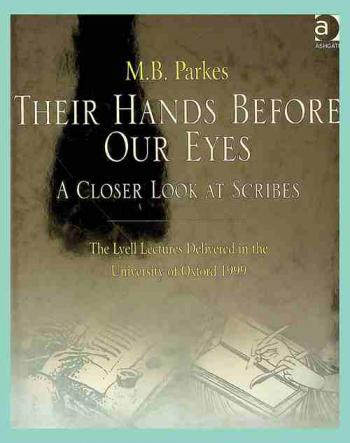
Their hands before our eyes : a closer look at scribes : the Lyell lectures delivered in the University of Oxford, 1999
\"This new book by Malcolm Parkes makes a fundamental contribution to the history of handwriting. Handwriting is a versatile medium that has always allowed individual scribes the opportunity for self-expression, despite the limitations of the pen and the finite number of possible movements. The purpose of this study is to focus on the handwriting of scribes from late antiquity to the beginning of the sixteenth century, and to identify those features which are a scribe's personal contribution to the techniques and art of handwriting.\"--Jacket.
Book

Generating Bodies and Gendered Selves
Generating Bodies and Gendered Selves examines the textured interrelations between medical writing about generation and childbirth - what we now call reproduction - and emerging notions of selfhood in early modern England. At a time when medical texts first appeared in English in large numbers and the first signs of modern medicine were emerging both in theory and in practice, medical discourse of the body was richly interwoven with cultural concerns.
Through close readings of a wide range of English-language medical texts from the mid-sixteenth to the early eighteenth centuries, from learned anatomies and works of observational embryology to popular books of physic and commercial midwifery manuals, Keller looks at the particular assumptions about bodies and selves that medical language inevitably enfolds. When wombs are described as \"free\" but nonetheless \"bridled\" to the bone; when sperm, first seen in the seventeenth century by the aid of the microscope, are imagined as minute \"adventurers\" seeking a safe spot to be \"nursed\": and when for the first time embryos are described as \"freeborn,\" fully \"independent\" from the females who bear them, the rhetorical formulations of generating bodies seem clearly to implicate ideas about the gendered self.
Keller shows how, in an age marked by social, intellectual, and political upheaval, early modern English medicine inscribes in the flesh and functioning of its generating bodies the manifold questions about gender, politics, and philosophy that together give rise to the modern Western liberal self - a historically constrained (and, Keller argues, a historically aberrant) notion of the self as individuated and autonomous, fully rational and thoroughly male.
An engagingly written and interdisciplinary work that forges a critical nexus among medical history, cultural studies, and literary analysis, Generating Bodies and Gendered Selves will interest scholars in early modern literary studies, feminist and cultural studies of the body and subjectivity, and the history of women's healthcare and reproductive rights.
eBook


Vernacular Bodies
Making babies was a mysterious process in early modern England. Mary Fissell employs a wealth of popular sources - ballads, jokes, witchcraft pamphlets, prayerbooks, popular medical manuals - to produce the first account of women's reproductive bodies in early-modern cheap print. Since little was certain about the mysteries of reproduction, the topic lent itself to a rich array of theories. The insides of women's reproductive bodies provided a kind of open interpretive space, a place where many different models of reproductive processes might be plausible. These models were profoundly shaped by cultural concerns; they afforded many ways to discuss and make sense of social, political, and economic changes such as the Protestant Reformation and the Civil War. They gave ordinary people ways of thinking about the changing relations between men and women that characterized these larger social shifts. Fissell offers a new way to think about the history of the body by focusing on women's bodies, showing how ideas about conception, pregnancy, and childbirth were also ways of talking about gender relations and thus all relations of power. Where other histories of the body have focused on learned texts and male bodies, Vernacular Bodies looks at the small books and pamphlets that ordinary people read and listened to - and provides new ways to understand how such people experienced political conflicts and social change.
eBook


Better Britons
In 1932, Aldous Huxley published Brave New World , his famous novel about a future in which humans are produced to spec in laboratories. Around the same time, Australian legislators announced an ambitious experiment to “breed the colour” out of Australia by procuring white husbands for women of white and indigenous descent. In this study, Nadine Attewell reflects on an assumption central to these and other policy initiatives and cultural texts from twentieth-century Britain, Australia, and New Zealand: that the fortunes of the nation depend on controlling the reproductive choices of citizen-subjects.
Better Britons charts an innovative approach to the politics of reproduction by reading an array of works and discourses – from canonical modernist novels and speculative fictions to government memoranda and public debates – that reflect on the significance of reproductive behaviours for civic, national, and racial identities. Bringing insights from feminist and queer theory into dialogue with work in indigenous studies, Attewell sheds new light on changing conceptions of British and settler identity during the era of decolonization.
eBook

Intra-Meadow Variation in Seagrass Flowering Phenology Across Depths
Variation in the timing of sexual reproduction, as well as differences in the relative investment in asexual vs sexual reproduction, commonly occurs among populations. Less is known about such variation within populations, yet small-scale differences in phenology and reproductive investment have the potential to limit gene flow and consequently the adaptive capacity of populations. We examined within-site variation in sexual reproduction in seagrasses, marine angiosperms that can reproduce asexually via clonal propagation or sexually via flowering, and that form the foundation of critical marine ecosystems globally. Many factors, including light availability, temperature, nutrient availability, and genetic identity, influence the rate and timing of seagrass flower development, yet little is known about how phenology varies across common environmental gradients within individual seagrass meadows. Here, we investigate how the density, morphology, and phenology of eelgrass (Zostera marina) differs across depths within multiple sites in New England. Despite variation in the proportion of reproductive vs vegetative shoots across sites, reproductive investment did not differ across depths within sites. However, a comparison of developmental stages of flowering shoots revealed delays in flower development for deep plants compared with shallow plants for all sites, demonstrating a consistent offset in reproductive phenology across depths. Our results suggest that differences in the timing of flowering may limit gene flow across seagrass meadows, with the potential for repeated genetic divergence in eelgrass populations spanning a depth gradient.
Journal Article

Assessing transmissibility of SARS-CoV-2 lineage B.1.1.7 in England
The SARS-CoV-2 lineage B.1.1.7, designated variant of concern (VOC) 202012/01 by Public Health England
1
, was first identified in the UK in late summer to early autumn 2020
2
. Whole-genome SARS-CoV-2 sequence data collected from community-based diagnostic testing for COVID-19 show an extremely rapid expansion of the B.1.1.7 lineage during autumn 2020, suggesting that it has a selective advantage. Here we show that changes in VOC frequency inferred from genetic data correspond closely to changes inferred by
S
gene target failures (SGTF) in community-based diagnostic PCR testing. Analysis of trends in SGTF and non-SGTF case numbers in local areas across England shows that B.1.1.7 has higher transmissibility than non-VOC lineages, even if it has a different latent period or generation time. The SGTF data indicate a transient shift in the age composition of reported cases, with cases of B.1.1.7 including a larger share of under 20-year-olds than non-VOC cases. We estimated time-varying reproduction numbers for B.1.1.7 and co-circulating lineages using SGTF and genomic data. The best-supported models did not indicate a substantial difference in VOC transmissibility among different age groups, but all analyses agreed that B.1.1.7 has a substantial transmission advantage over other lineages, with a 50% to 100% higher reproduction number.
Genetic and testing data from England show that the SARS-CoV-2 variant of concern B.1.1.7 has a transmission advantage over other lineages.
Journal Article
The epidemiological impact of the NHS COVID-19 app
The COVID-19 pandemic has seen the emergence of digital contact tracing to help to prevent the spread of the disease. A mobile phone app records proximity events between app users, and when a user tests positive for COVID-19, their recent contacts can be notified instantly. Theoretical evidence has supported this new public health intervention
1
–
6
, but its epidemiological impact has remained uncertain
7
. Here we investigate the impact of the National Health Service (NHS) COVID-19 app for England and Wales, from its launch on 24 September 2020 to the end of December 2020. It was used regularly by approximately 16.5 million users (28% of the total population), and sent approximately 1.7 million exposure notifications: 4.2 per index case consenting to contact tracing. We estimated that the fraction of individuals notified by the app who subsequently showed symptoms and tested positive (the secondary attack rate (SAR)) was 6%, similar to the SAR for manually traced close contacts. We estimated the number of cases averted by the app using two complementary approaches: modelling based on the notifications and SAR gave an estimate of 284,000 (central 95% range of sensitivity analyses 108,000–450,000), and statistical comparison of matched neighbouring local authorities gave an estimate of 594,000 (95% confidence interval 317,000–914,000). Approximately one case was averted for each case consenting to notification of their contacts. We estimated that for every percentage point increase in app uptake, the number of cases could be reduced by 0.8% (using modelling) or 2.3% (using statistical analysis). These findings support the continued development and deployment of such apps in populations that are awaiting full protection from vaccines.
Statistical analysis of COVID-19 transmission among users of a smartphone-based digital contact-tracing app suggests that such apps can be an effective measure for reducing disease spread.
Journal Article