
Catalogue Search | MBRL


Are you sure you want to remove the book from the shelf?

{{itemTitle}}
11
result(s) for
"Republicanism Switzerland History."
Sort by:


A Laboratory of Liberty
Based on a tradition of political innovation, Swiss citizens recalibrated their understanding of liberty and republicanism through public political debates, during the revolutionary transformation to a rights-based society. The resulting hybrid political culture enhances our understanding of the international Age of Revolution.
eBook
The republican alternative
The Netherlands and Switzerland are among the world's most economically successful societies. Their inhabitants enjoy high standards of living and express great satisfaction with their lives according to surveys. This despite serious natural handicaps, such as a lack of raw materials and an abundance of water and rock respectively. The foundation for their prosperity was laid in the early modern period, between roughly 1500 and 1800, when, as federal republics, the two countries were already something of an anomaly in Europe. Their inhabitants experienced serious anxieties and tried to justify their exceptionality, to which they were, at the same time, greatly attached. The Republican Alternative attempts to clarify, through a sustained comparison, the special character of the two countries, which were similar perhaps at first sight, but nonetheless developed their own solutions to the challenges they faced. The book includes in-depth discussions of citizenship arrangements, Swiss and Dutch dealings with religious pluriformity, political discourses justifying the republican form of government, the advantages and disadvantages of an agrarian over a commercial society.
Nederland en Zwitserland behoren tot de meest succesvolle samenlevingen, in Europa en de wereld. De inwoners hebben een hoge levensstandaard en geven in enquêtes te kennen dat zij tevreden zijn met hun bestaan. Dit ondanks niet onaanzienlijke natuurlijke handicaps, zoals een overdaad aan water en stenen op hun territorium en een gebrek aan grondstoffen. De basis voor die voorspoed werd gelegd in de periode tussen ruwweg 1500 en 1800, toen beide landen als federale republieken ook al buitenbeentjes vormden in Europa. De bewoners van die twee staten hadden het daar soms moeilijk mee en putten zich uit in rechtvaardigingen van hun buitenissigheid, waaraan ze tegelijkertijd zeer gehecht waren. The Republican alternative belicht door middel van een vergelijking de eigenaardigheden van twee landen die aan elkaar verwant waren, maar toch ook in allerlei opzichten van elkaar verschilden. Het boek behandelt onder meer de inspraak van burgers in de politiek, de omgang met religieuze verscheidenheid, het discours over de Republiek, de kunstvormen die populair waren, het eigen geschiedbeeld en voor- en nadelen van een agrarische boven een commerciële samenleving.
eBook
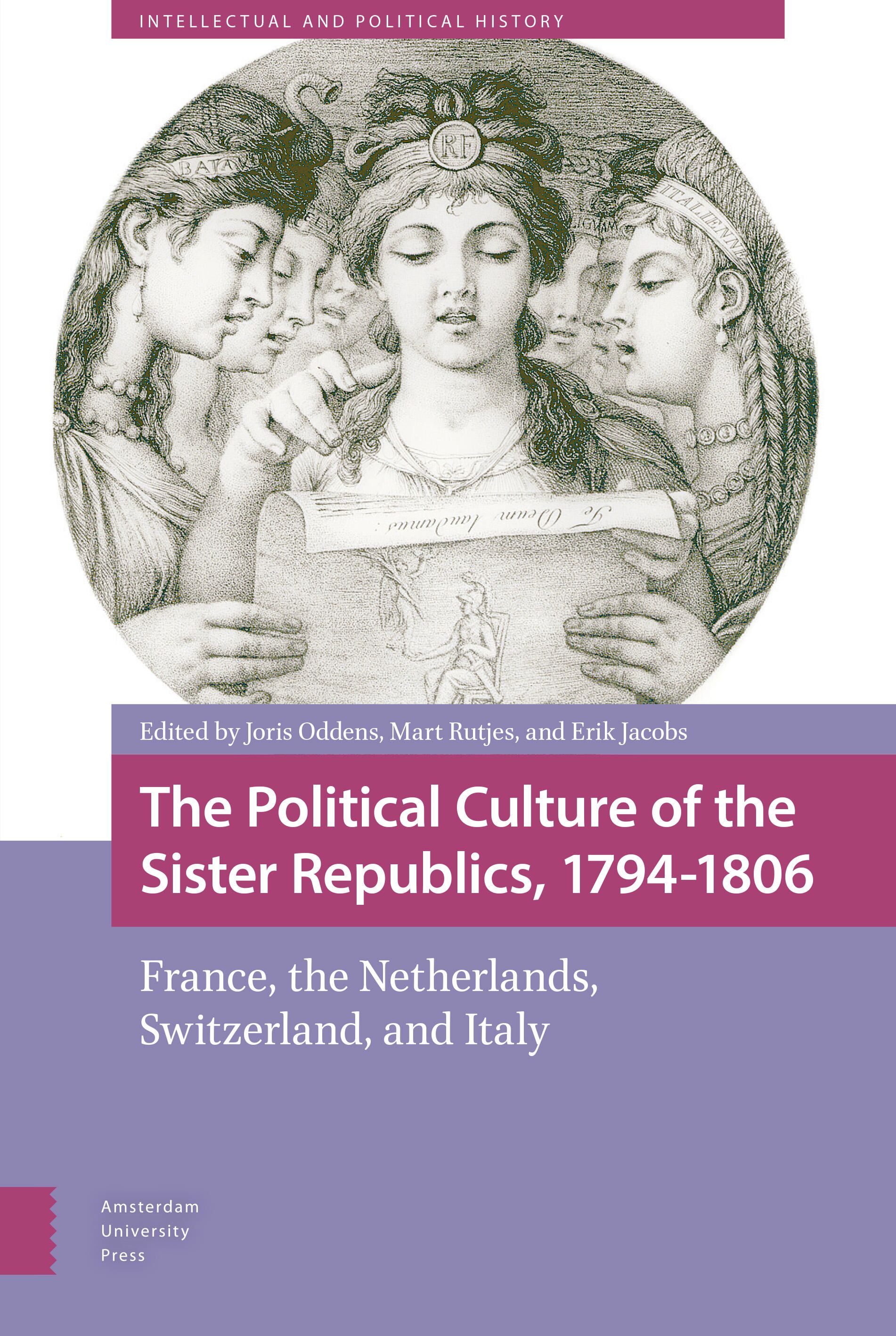
The Political Culture of the Sister Republics, 1794-1806
In this book, leading historians of the French, Batavian, Helvetic, Cisalpine, and Neapolitan revolutions bridge the gap between the historiographies of the so-called Sister Republics and explore political culture as a set of discourses or political practices. Parliamentary practices, the comparability of \"universal\" political concepts, late-eighteenth-century Republicanism, the relationship between press and politics, and the interaction between the Sister Republics and France are all examined from a comparative, transnational perspective.
eBook

\LES JUGES JUGEZ, SE JUSTIFIANTS\ (1663) AND EDMUND LUDLOW'S PROTESTANT NETWORK IN SEVENTEENTH-CENTURY SWITZERLAND
This article aims to locate English republican thought and writing in a wider European context and to understand the personal connections that aided the distribution and reception of English republican ideas abroad. It does so through the case-study of a little-known pamphlet published by the English regicide Edmund Ludlow during his exile in Switzerland after the restoration of the Stuart monarchy in 1660. Les juges jugez, se justifiants (1663) was a French translation of the dying speeches and other miscellaneous texts of some of the English regicides, produced in Geneva and subsequently printed in Yverdon with the help of Ludlow's local Protestant network. Rather than propagating a secular republican ideology, Ludlow offered his work to a European Protestant audience in the language of Geneva, promoting a primarily religious cause in an attempt to make martyrs out of political activists. It is therefore to Ludlow's Protestant networks that we need to turn to find out more about the transmission of English republican ideas in francophone Europe and beyond.
Journal Article
REBELLION, RESISTANCE, AND A SWISS BRUTUS?
Early sixteenth-century Germany and Switzerland witnessed, amongst their peasants, a growing dissatisfaction with economic exploitation and the increasing power of political rulers. The Protestant Reformation at the time had a profound influence on the moulding of this dissatisfaction into a right to demand the enforcement of divine justice. The Swiss reformer, Huldrych Zwingli, provided parallels for the demands of the peasants, while the German reformers, Martin Luther and Philip Melanchthon, criticized the rebellious methods of the peasantry. Against this background the young Swiss reformer, Heinrich Bullinger, responded more positively towards the claims of the peasants by opposing the views of the Lutheran reformers in his play ‘Lucretia and Brutus’. In this drama, Bullinger propounds the first steps towards the development of his federal theory of politics by advancing the idea of oath-taking as the mechanism for transforming the monarchy into a Christian republic. The idea of oath-taking was destined to become a most important device in early modern politics, used to combat tyranny and to promote the idea of republicanism.
Journal Article


A Laboratory of Liberty: The Transformation of Political Culture in Republican Switzerland, 1750—1848
Rapport reviews A Laboratory of Liberty: The Transformation of Political Culture in Republican Switzerland, 1750-1848 by Marc H. Lerner.
Book Review
Against War and Empire: Geneva, Britain, and France in the Eighteenth Century. (The Lewis Walpole Series in Eighteenth-Century Culture and History.)
Lerner reviews Against War and Empire: Geneva, Britain, and France in the Eighteenth Century by Richard Whatmore.
Book Review