
Catalogue Search | MBRL


Are you sure you want to remove the book from the shelf?

{{itemTitle}}
109,709
result(s) for
"Research Finance"
Sort by:

Investing in Financial Research
Every day, people around the world make financial decisions. They choose to invest in a stock, sell their holdings in a mutual fund or buy a condominium. These decisions are complex and financially tricky-even for financial professionals. But the literature available on financial research is dated and narrowly focused without any real practical application. Until now there's been a gap in the literature: a book that shows you how to conduct a step by step comprehensive financial investigation that ends in a decision.
This book gives you that how.
Investing In Financial Research is a guidebook for conducting financial investigations and lays out Cheryl Strauss Einhorn's AREA Method-a research and decision-making system that uniquely controls for bias, focuses on the incentives of others and expands knowledge while improving judgement-and applies it to investigating financial situations. AREA is applicable to all sorts of financial sleuthing, whether for investment analysis or investigative journalism. It allows you to be the expert in your own life.
The AREA Method provides you with:
-Defined tasks that guide and focus your research on your vision of success;
-A structure that isolates your sources, giving you insight into their perspectives, biases and incentives;
-Investigative resources, tips and techniques to upgrade your research and analysis beyond document-based sources;
-Exercises to foster creativity and originality in your thinking;
-A sequence and framework that brings your disparate pieces of research together to build your confidence and conviction about your financial decision.
eBook
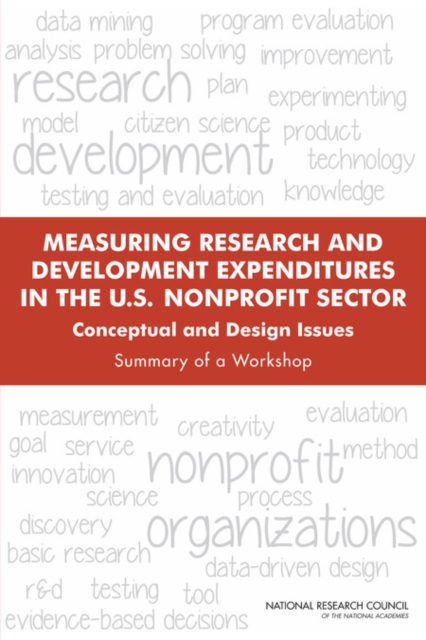
Measuring Research and Development Expenditures in the U.S. Nonprofit Sector
National Center for Science and Engineering Statistics (NCSES) of the National Science Foundation is responsible for national reporting of the research and development (R&D) activities that occur in all sectors of the United States economy. For most sectors, including the business and higher education sectors, NCSES collects data on these activities on a regular basis. However, data on R&D within the nonprofit sector have not been collected in 18 years, a time period which has seen dynamic and rapid growth of the sector. NCSES decided to design and implement a new survey of nonprofits, and commissioned this workshop to provide a forum to discuss conceptual and design issues and methods.
Measuring Research and Development Expenditures in the U.S. Nonprofit Sector: Conceptual and Design Issues summarizes the presentations and discussion of the workshop. This report identifies concepts and issues for the design of a survey of R&D expenditures made by nonprofit organizations, considering the goals, content, statistical methodology, data quality, and data products associated with this data collection. The report also considers the broader usefulness of the data for understanding the nature of the nonprofit sector and their R&D activities. Measuring Research and Development Expenditures in the U. S. Nonprofit Sector will help readers understand the role of nonprofit sector given its enormous size and scope as well as its contribution to identifying new forms of R&D beyond production processes and new technology.
eBook

A bibliometric analysis of quality research papers in Islamic finance: evidence from Web of Science
PurposeThe purpose of this study is to provide quantitative information on the growth of Islamic finance literature. The study focused on publishing trends, countries producing research on Islamic finance, key authors, major contributing organizations, authorship patterns, keywords and articles with the highest citations.Design/methodology/approachBibliometric analysis is applied to analyse the growth and publishing trends in Islamic finance literature. The Web of Science (WoS) database was used to extract bibliometric data covering the period 1939–2019 for Islamic finance literature.FindingsThe study finds that Islamic finance research has gained remarkable momentum in the literature. However, such growth is largely manifested in Malaysia because of a conducive atmosphere for this type of research. Interestingly, the study finds that the three most productive journals are located in the UK and Malaysia, while Professor M. Kabir Hassan from the University of New Orleans, the USA appears to head the list of authors with 23 publications on Islamic finance.Practical implicationsThis study provides up-to-date literature on the current state of Islamic finance in the world; as a result, it supports the development of policies by the Islamic finance industry. The findings of the study also serve as a reference point for Islamic finance training and educational institutions.Originality/valueIslamic finance is an emerging financial discipline; as such, there is a need for more awareness of this financial system in the world. Muslim-majority countries, especially Saudi Arabia, Turkey, Indonesia, the United Arab Emirates (UAE), Pakistan and Bahrain, have to include Islamic finance in their curriculum and establish research institutions and research journals. In addition, Arabic language journals should be indexed in WoS and/or Scopus to provide a high-quality publication platform. This study provides a more comprehensive bibliometric analysis on the growth of Islamic finance literature (1939–2019) in the WoS database; most of the prior studies have covered relatively few areas of focus and a lower range of years in some cases.
Journal Article


The CTSA Program at NIH
In 2006 the National Institutes of Health (NIH) established the Clinical and Translational Science Awards (CTSA) Program, recognizing the need for a new impetus to encourage clinical and translational research. At the time it was very difficult to translate basic and clinical research into clinical and community practice; making it difficult for individual patients and communities to receive its benefits. Since its creation the CTSA Program has expanded, with 61 sites spread across the nation's academic health centers and other institutions, hoping to provide catalysts and test beds for policies and practices that can benefit clinical and translation research organizations throughout the country.
The NIH contracted with the Institute of Medicine (IOM) in 2012 to conduct a study to assess and provide recommendations on appropriateness of the CTSA Program's mission and strategic goals and whether changes were needed. The study was also address the implementation of the program by the National Center for Advancing Translational Sciences (NCATS) while exploring the CTSA's contributions in the acceleration of the development of new therapeutics. A 13-member committee was established to head this task; the committee had collective expertise in community outreach and engagement, public health and health policy, bioethics, education and training, pharmaceutical research and development, program evaluation, clinical and biomedical research, and child health research.
The CTSA Program at NIH: Opportunities for Advancing Clinical and Translational Research is the result of investigations into previous program evaluations and assessments, open-session meetings and conference class, and the review of scientific literature. Overall, the committee believes that the CTSA Program is significant to the advancement of clinical and translational research through its contributions. The Program would benefit from a variety of revisions, however, to make it more efficient and effective.
eBook