
Catalogue Search | MBRL


Are you sure you want to remove the book from the shelf?

{{itemTitle}}
241
result(s) for
"Resemblance (Philosophy)"
Sort by:

Likeness and likelihood in the Presocratics and Plato
\"The Greek word eoikos can be translated in various ways. It can be used to describe similarity, plausibility or even suitability. This book explores the philosophical exploitation of its multiple meanings by three philosophers, Xenophanes, Parmenides and Plato. It offers new interpretations of the way that each employs the term to describe the status of their philosophy, tracing the development of this philosophical use of eoikos from the fallibilism of Xenophanes through the deceptive cosmology of Parmenides to Plato's Timaeus. The central premise of the book is that, in reflecting on the eoikos status of their accounts, Xenophanes, Parmenides and Plato are manipulating the contexts and connotations of the term as it has been used by their predecessors. By focusing on this continuity in the development of the philosophical use of eoikos, the book serves to enhance our understanding of the epistemology and methodology of Xenophanes, Parmenides and Plato's Timaeus\"-- Provided by publisher.
BOOK
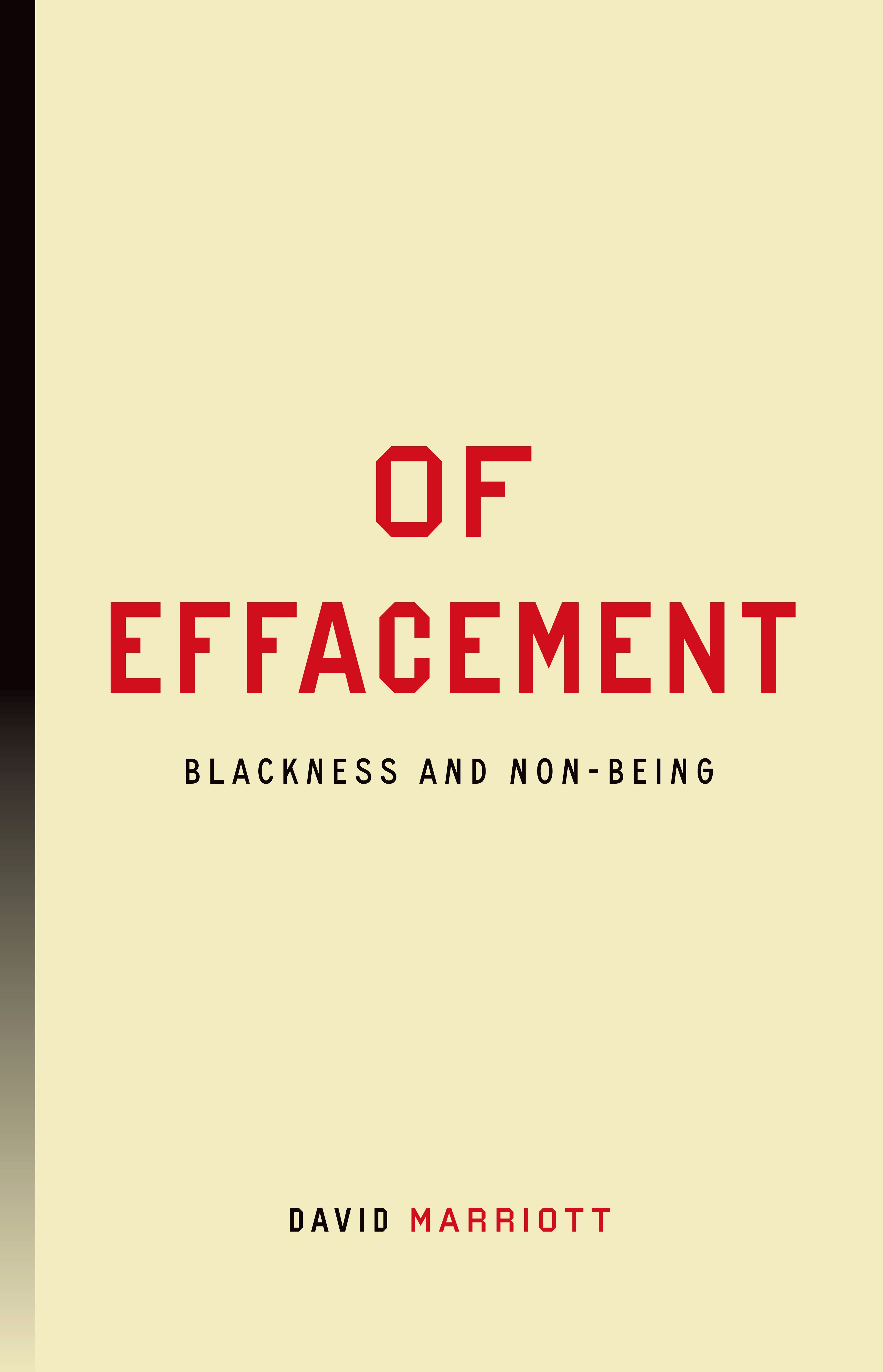
Of Effacement
In Of Effacement, David Marriott endeavors to demolish established opinion about what blackness is and reorient our understanding of what it is not in art, philosophy, autobiography, literary theory, political theory, and psychoanalysis. With the critical rigor and polemical bravura which he displayed in Whither Fanon? Marriott here considers the relationships between language, judgement and effacement, and shows how effacement has become the dominant force in anti-blackness.
Both skeptically and emphatically, Marriott presents a series of radical philosophical engagements with Fanon's \"is not\" (n'est pas) and its \"black\" political truth. How does one speak—let alone represent—that which is without existence? Is blackness n'est pas because it has yet to be thought as blackness? And if so, when Fanon writes of blackness, that it is n'est pas (is not), where should one look to make sense of this n'est pas? Marriott anchors these questions by addressing the most fundamental perennial questions concerning the nature of freedom, resistance, mastery, life, and liberation, via a series of analyses of such key figures as Huey Newton, Nietzsche, Malcolm X, Edward Said, Georges Bataille, Stuart Hall, and Lacan. He thus develops the basis for a reading of blackness by recasting its effacement as an identity, while insisting on it as a fundamental question for philosophy.
eBook

Culture and Identity through English as a Lingua Franca
The use of English as a global lingua franca has given rise to new challenges and approaches in our understanding of language and communication. One area where ELF (English as a lingua franca) studies, both from an empirical and theoretical orientation, have the potential for significant developments is in our understanding of the relationships between language, culture and identity. ELF challenges traditional assumptions concerning the purposed 'inexorable' link between a language and a culture. Due to the multitude of users and contexts of ELF communication the supposed language, culture and identity correlation, often conceived at the national level, appears simplistic and naïve. However, it is equally naïve to assume that ELF is a culturally and identity neutral form of communication. All communication involves participants, purposes, contexts and histories, none of which are 'neutral'. Thus, we need new approaches to understanding the relationship between language, culture and identity which are able to account for the multifarious and dynamic nature of ELF communication.
eBook

\It's Exactly Like That\: Bearing Resemblance in Alice Oswald's Memorial–A Response to Linne/Niederhoff and Hahnemann
This article examines Alice Oswald's use of simile in Memorial: A Version of Homer's Iliad (2011). While critical attention has tended to focus on the ways in which Oswald has cut apart and redistributed elements of her original, with particular emphasis on how she has adapted the Iliad's epic similes, I argue that the shards of often anachronistic simile that Oswald has introduced into her descriptions of the dead invite the reader to discover new kinds of connection between ancient and contemporary experience. Building on work published in Connotations by Lena Linne and Burkhard Niederhoff, as well as the response to their article by Carolin Hahnemann, I argue that Memorial's paratactic poetics invite the reader to explore not only emotional but also deeply intellectual points of engagement with Oswald's canny adaptation.
Journal Article

Vector similarity measures of hesitant fuzzy linguistic term sets and their applications
In decision making, similarity measure and distance between two objects are crucial to be able to determine the relationship between those objects. Many researchers have received much attention for their research on this subject. In this study, we propose two novel similarity measures between hesitant fuzzy linguistic term sets (HFLTSs). In addition, two extensions of Technique for Order of Preference by Similarity to Ideal Solution (TOPSIS) are proposed in the hesitant fuzzy linguistic environments. Furthermore, an example of an application concerning traditional Chinese medical diagnosis and an MCDM problem have been given to illustrate the applicability and validation of these similarity measures of HFLTSs. Furthermore, the results of examples demonstrate that the Dice and Jaccard similarity measures are more reasonable than the cosine similarity measure with respect to HFLTSs.
Journal Article

Identity Landscapes
Beginning from the notion that self is constructed, contributors in Identity Landscapes: Contemplating Place and the Construction of Self are particularly interested in how relationships with place inform identity development.
eBook

Lava
One woman's journey into her own past becomes inextricably linked with the tides of global history in this wickedly funny, strikingly lyrical and explosive debut play. Winner of the 2022 Susan Smith Blackburn Prize.
eBook


Digital Me
The internet is where trans people have come to become. Creating an identity in digital space can be important for how trans people learn about themselves, their communities, and the possibilities available to them. While the internet and digital space is not the only way of coming to understand oneself in a community, it is a space of liberatory possibility and creativity. There is room to invent what may not yet exist for gender on the edges of what many consider to be \"real.\" For many, digital life can be the site of play, joy, and connection –even while the internet is not a harm-free space nor universally available. This book seeks to understand the complexities at play in the digital realm and the implications that have for gender, digital life, and higher education.
eBook
Identidad y Zozobra
Long description: En el contexto del Congreso Internacional de Americanistas que tuvo lugar en El Salvador en julio de 2015, la Universidad de Viena y la Universidad Autónoma del Estado de México organizaron de manera conjunta un simposio en el que se discutía la relación entre identidad y zozobra o, en otras palabras, la relación entre identidades e incertidumbres de colectividades e individuos, tomando para ello diversos enfoques desde las disciplinas de literatura y filosofía. ¿Qué se puede decir de este empeño de estar continuamente “en busca de rostro para reconocerse uno y reconocer al Otro”? La mayoría de las reflexiones en torno a esta pregunta que se encuentran en el presente volumen fueron presentadas en dicha reunión.
Biographical note: Dr. MMag. Jana Pocrnja MA es doctora en filología románica por la Universidad de Viena. Ha realizado varias estancias de investigación en Paris, Alicante, Córdoba, Madrid y en México. Es profesora, traductora, autora, investigadora y maestra de conferencias. Sus principales líneas de investigación se centran en aspectos relacionados con la filosofía y la teoría de la literatura, así como ha llevado a cabo diferentes trabajos dentro de los estudios culturales.
eBook