
Catalogue Search | MBRL


Are you sure you want to remove the book from the shelf?

{{itemTitle}}
4,560
result(s) for
"Resignation from office"
Sort by:

The fall of Boris Johnson : the full story
As a politician Boris Johnson seemed propelled by his own ambition, rising to prime minister. He won an era defining general election in 2019 where he smashed Labour's Red Wall after he promised to 'Get Brexit Done'. But after guiding Britain through the COVID-19 pandemic his leadership was beset by a series of scandals, leaks and lies. As Boris lurched from crisis to crisis, his downfall still came as a swift and unexpected surprise. Sebastian Payne tells the essential behind-the-scenes story, charting the series of scandals that felled Johnson; from the blocked suspension of Owen Paterson to Partygate, and finally the Chris Pincher allegations, which were the final death blow. This is the full narrative of the political betrayals, rivalries and resignations that led to the dramatic Conservative coup.
Book

Eyewitness to Watergate : a documentary history for students
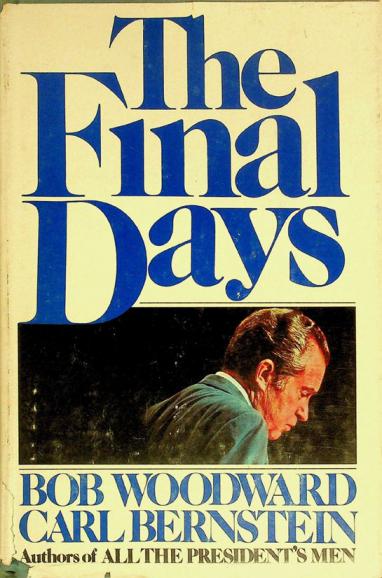
Decades after the resignation of President Nixon, the impact of the Watergate scandal continues to affect the institutional power of the president of the United States. This landmark event is a major subject of in-depth study at the high school and college levels. Now, CQ Press has published the definitive resource on this event for students researching this political era in U.S. history.Eyewitness to Watergate traces the events, characters, and outcomes of one of the greatest scandals in U.S. political history. No other work for the high school researcher contains so rich a collection of primary government documents, vital news stories from the time period, and expert, unbiased commentary and analysis.Through a unique combination of primary source documents and historical journalism from the period, Eyewitness to Watergate weaves together and engaging narrative of the scandal and its aftermath. Headnote materials explain the context of the documents, draw parallels to contemporary events in U.S. government, and provide updated information on the key players involved in the scandal.Primary source materials include transcripts from hearings, impeachment proceedings, special prosecutor’s activities, federal court proceedings, and presidential communications. This comprehensive yet affordably priced new volume will serve as a valuable resource in high school, undergraduate, and public libraries.
eBook

The Labor Market for Directors and Externalities in Corporate Governance
This paper studies how directors' reputational concerns affect board structure, corporate governance, and firm value. In our setting, directors affect their firms' governance, and governance in turn affects firms' demand for new directors. Whether the labor market rewards a shareholder-friendly or management-friendly reputation is determined in equilibrium and depends on aggregate governance. We show that directors' desire to be invited to other boards creates strategic complementarity of corporate governance across firms. Directors' reputational concerns amplify the governance system: strong systems become stronger and weak systems become weaker. We derive implications for multiple directorships, board size, transparency, and board independence.
Journal Article
Essentials. Government & civics. Watergate and Nixon's resignation
In the 1970s, President Richard Nixon's reelection campaign led to a break-in at the Watergate Hotel in Washington, D.C., sparking investigations that changed U.S. politics forever.
Streaming Video

Haig's Coup
When General Alexander M. Haig Jr. returned to the White House on May 3, 1973, he found the Nixon administration in worse shape than he had imagined. President Richard Nixon, reelected in an overwhelming landslide just six months earlier, had accepted the resignations of his top aides-the chief of staff H. R. Haldeman and the domestic policy chief John Ehrlichman-just three days earlier. Haldeman and Ehrlichman had enforced the president's will and protected him from his rivals and his worst instincts for four years. Without them, Nixon stood alone, backed by a staff that lacked gravitas and confidence as the Watergate scandal snowballed. Nixon needed a savior, someone who would lift his fortunes while keeping his White House from blowing apart. He hoped that savior would be his deputy national security adviser, Alexander Haig, whom he appointed chief of staff. But Haig's goal was not to keep Nixon in office-it was to remove him. InHaig's Coup,Ray Locker uses recently declassified documents to tell the true story of how Haig orchestrated Nixon's demise, resignation, and subsequent pardon. A story of intrigues, cover-ups, and treachery, this incisive history shows how Haig engineered the \"soft coup\" that ended our long national nightmare and brought Watergate to an end.
eBook

The Impact of Individual and Collective Performance on Ministerial Tenure
Government ministers in Parliamentary democracies are career politicians for whom public service is an important source of motivation. The length of their tenure is controlled by the Prime Minister. We test a simple Principal-Agent model of parliamentary government in which the Prime Minister evaluates her ministers according to information available to her that is related to their performance. We study the effects of individual and collective ministerial performance on the length of time a minister serves in British government over the period 1945–97. We use the number of resignation calls for a minister as an individual performance indicator and the cumulative number of such calls as an indicator of government performance. A minister’s hazard rate increases sharply after the first individual call for resignation and is decreasing in the cumulative number of resignation calls. These results are consistent with the Principal-Agent model and with the use of relative performance evaluation by the Prime Minister.
Journal Article

The Corrective Effect of Ministerial Resignations on Government Popularity
Using data from the United Kingdom, we estimate the effects of ministerial resignation on government popularity. We test a counterfactual argument that resignations should have a corrective effect, that is, there is an increase in popularity following a resignation when taking into account the negative effect on popularity of the resignation issue. We get empirical estimates by using the age of ministers involved in resignation issues as an instrument. Our IV estimates provide empirical support for the corrective effect.
Journal Article
Economist video. Boris Johnson resigns : what happens next?
After weeks of clinging on, Boris Johnson has agreed to resign as British prime minister. What happens now, and what challenges will his successor face?
Streaming Video

Convictions Leave Italy's Civil Protection in Chaos
Italy's government lacks experts to advise it on natural hazards following the conviction last week of six scientists and a government official for advice they gave ahead of the deadly earthquake in L'Aquila in 2009. Following the convictions of six scientists and a government official for advice they gave ahead of the deadly earthquake in L'Aquila in 2009, the president and several members of the National Commission for the Forecast and Prevention of Major Risks have resigned. Now, as Italy is flooded with outside protests to the convictions, it is left without experts to advise it on natural hazards.
Journal Article