
Catalogue Search | MBRL


Are you sure you want to remove the book from the shelf?

{{itemTitle}}
803
result(s) for
"Respect for persons."
Sort by:

Respecting others
\"Being respectful means that we behave in a way that shows the people around us that we care about their feelings and rights. Children will learn ways to show respect to others using manners, obeying laws, showing empathy, and having respect for yourself too.\"--Provided by publisher.
Book

Law and Revolution in South Africa: uBuntu, Dignity, and the Struggle for Constitutional Transformation
The relation between law and revolution is one of the most pressing questions of our time. As one country after another has faced the challenge that comes with the revolutionary overthrow of past dictatorships, how one reconstructs a new government is a burning issue. South Africa, after a long and bloody armed struggle and a series of militant uprisings, negotiated a settlement for a new government and remains an important example of what a substantive revolution might look like. The essays collected in this book address both the broader question of law and revolution and some of the specific issues of transformation in South Africa.
eBook

Humanness and dehumanization
What does it mean to be human? Why do people dehumanize others (and sometimes themselves)? These questions have only recently begun to be investigated in earnest within psychology. This volume presents the latest thinking about these and related questions from research leaders in the field of humanness and dehumanization in social psychology and related disciplines. Contributions provide new insights into the history of dehumanization, its different types, and new theories are proposed for when and why dehumanization occurs. While people's views about what humanness is, and who has it, have long been known as important in understanding ethnic conflict, contributors demonstrate its relevance in other domains, including medical practice, policing, gender relations, and our relationship with the natural environment. Cultural differences and similarities in beliefs about humanness are explored, along with strategies to overcome dehumanization.
BOOK

Dignity Rights
The right to dignity is now recognized in most of the world's constitutions, and hardly a new constitution is adopted without it. Over the last sixty years, courts in Latin America, Europe, Asia, Africa, the Middle East, and North America have developed a robust jurisprudence of dignity on subjects as diverse as health care, imprisonment, privacy, education, culture, the environment, sexuality, and death. As the range and growing number of cases about dignity attest, it is invoked and recognized by courts far more frequently than other constitutional guarantees.Dignity Rightsis the first book to explore the constitutional law of dignity around the world. Erin Daly shows how dignity has come not only to define specific interests like the right to humane treatment or to earn a living wage, but also to protect the basic rights of a person to control his or her own life and to live in society with others. Daly argues that, through the right to dignity, courts are redefining what it means to be human in the modern world. As described by the courts, the scope of dignity rights marks the outer boundaries of state power, limiting state authority to meet the demands of human dignity. As a result, these cases force us to reexamine the relationship between the individual and the state and, in turn, contribute to a new and richer understanding of the role of the citizen in modern democracies.
eBook

We all have value : a story of respect
\"Idil has a problem. She loves hanging out with her friends Pete and Ben--but lately, Pete hasn't been very nice to Ben. Pete doesn't let Ben have a turn talking or playing. Can Idil help Pete see that the way he's treating Ben isn't right?\"--Publisher description.
Book
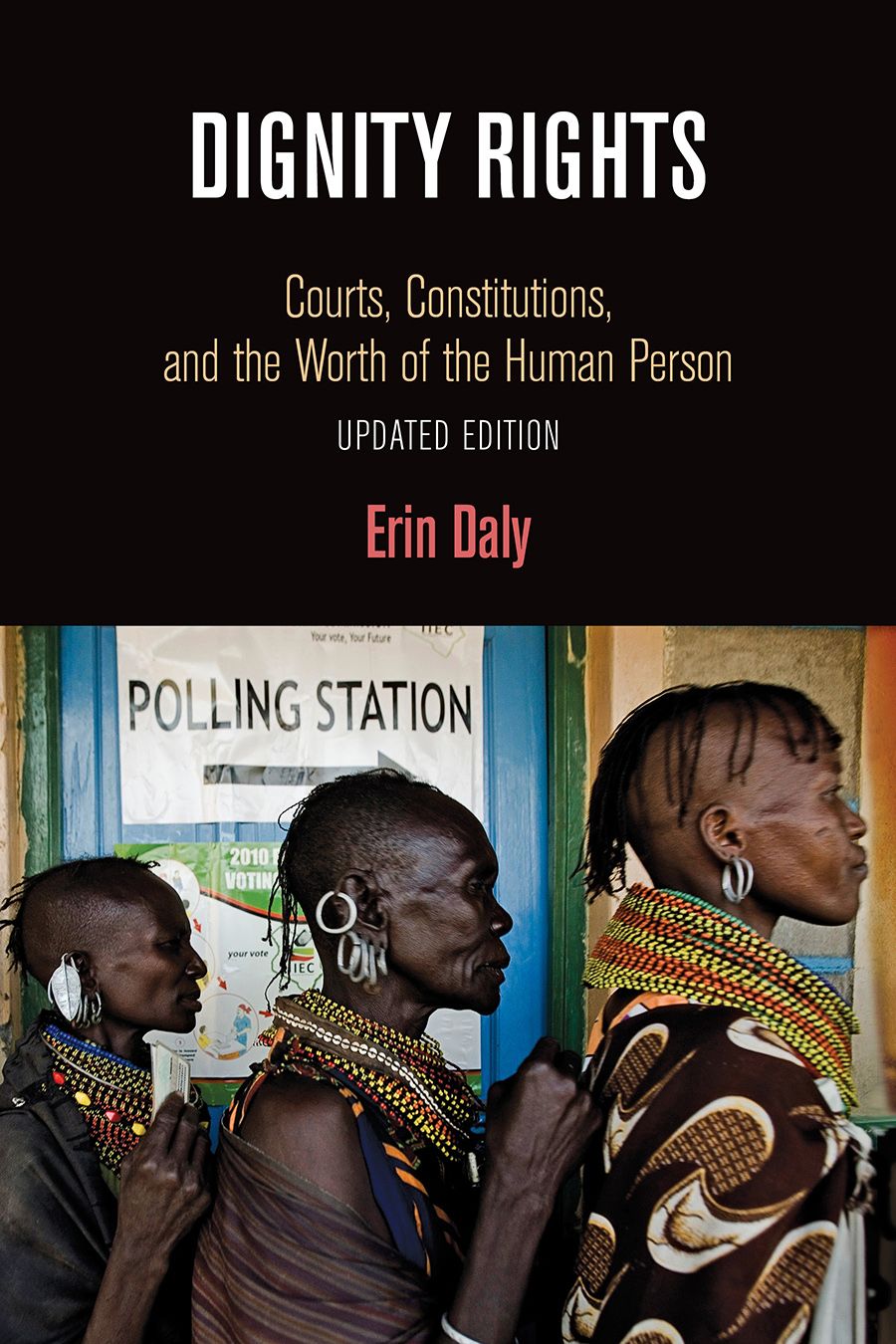
Dignity Rights
This ground-breaking book examines how judicial interpretations of dignity redefine what it means to be human in the modern world. It features a new preface by the author, in which she articulates how, over the past decade, dignity rights cases have evolved to incorporate the convergence of human rights and environmental rights.
eBook


Human dignity in bioethics and law
Dignity is often denounced as hopelessly amorphous or incurably theological: as feel-good philosophical window-dressing, or as the name given to whatever principles give you the answer that you think is right. This is wrong, says Charles Foster: dignity is not only an essential principle in bioethics and law; it is really the only principle. In this ambitious, paradigm-shattering but highly readable book, he argues that dignity is the only sustainable Theory of Everything in bioethics.
eBook


Human Dignity and the Foundations of International Law
International lawyers have often been interested in the link between their discipline and the foundational issues of jurisprudential method, but little that is systematic has been written on this subject. In this book, an attempt is made to fill this gap by focusing on issues of concept-formation in legal science in general with a view to their application to the specific concerns of international law. In responding to these issues, the author argues that public international law seeks to establish and institutionalise a system of authoritative judgment whereby the conditions by which a community of states can co-exist and co-operate are ensured. A state, in turn, must be understood as ultimately deriving legitimacy from the pursuit of the human dignity of the community it governs, as well as the dignity of those human beings and states affected by its actions in international relations. This argument is in line with a long and now resurgent Kantian tradition in legal and political philosophy. The book shows how this approach is reflected in accepted paradigm cases of international law, such as the United Nations Charter. It then explains how this approach can provide insights into the theoretical foundations of these accepted paradigms, including our understanding of the sources of international law, international legal personality and the design of global institutions.
eBook