
Catalogue Search | MBRL


Are you sure you want to remove the book from the shelf?

{{itemTitle}}
24
result(s) for
"Revolutionaries -- China -- Language"
Sort by:


Words and Their Stories
In spite of dislocations and ruptures in China's revolutionary language, to rethink this discourse is to revisit a history in terms of sedimented layers of linguistic meanings and political aspirations. Earlier meanings of revolutionary words may persist or coexist with non-revolutionary rivals. Recovery of the vital uses of key revolutionary words projects critical alternatives in which contemporary capitalist myths can be contested.
eBook

Translating and transplanting revolution: the circulation of discourses on the American Revolution between China and Japan
The American Revolution, as recent studies have shown, was appropriated by Chinese revolutionaries to use in their anti-Manchu propaganda in the early twentieth century. Few scholars have fully recognised Japan's important role in mediating Chinese revolutionaries’ understanding of the American Revolution. This article aims to bridge the gaps in existing scholarship through a close reading of Chinese and Japanese writings on the American Revolution in the nineteenth and early twentieth centuries. I will show that Chinese and Japanese elites’ understanding of the American Revolution was structured by the changing power relations between China, Japan, and the West. Before Chinese and Japanese elites internalised the ideology of Western cultural superiority, the former inspired the latter to see the American Revolution through a Confucian lens. After the ideology of Western cultural superiority became entrenched in Japan, Japanese elites reinterpreted the American Revolution through the lens of Western ideas of liberty, civil rights, and popular sovereignty. Their new interpretation, in turn, inspired Chinese revolutionaries in Meiji Japan to view the American Revolution as a model for their anti-Manchu revolution in the 1900s when the ideology of Western cultural superiority started to take root in China.
Journal Article

Old Shanghai and the Clash of Revolution
Life in Shanghai played out against a backdrop of shifting political maneuvers until World War II burned off the patina that had made 'Old Shanghai' a world unto itself. In this personal history we follow one man through Japans conquest of Shanghai in 1937 to the Chinese civil war and Communist takeover, Maos desperate attempts to modernize a medieval country and Deng Xiaopings opening the economy but not social freedoms. The protagonist lees burgeoning corruption and makes it to the United States to see for himself what the tales of freedom and democracy might offer.
eBook

Sino-Japanese Cultural Diplomacy in the 1950s: The Making and Reception of the Matsuyama Ballet’s The White-Haired Girl
In 1955, Japan’s Matsuyama Ballet staged the first ballet adaptation of the Chinese land reform drama The White-Haired Girl in Tokyo, laying the foundation for Chinese revolutionary ballet. This is the first study in English to explore the Matsuyama Ballet production in detail. Employing Chinese-language sources from the production’s 1958 tour to China, this article explores the historical making, performance, and reception of the Matsuyama Ballet’s The White-Haired Girl and situates it in the context of Sino-Japanese relations during the 1950s. The article argues that the production resulted from a longer history of interactions between Japan, China, and the Soviet Union and that its interpretation of The White-Haired Girl story served as a bridge between the 1950 Chinese feature film and the 1971 Chinese ballet film. It also argues that Chinese responses to the production demonstrate significant differences between Japanese and Chinese discourses about Sino-Japanese friendship in the 1950s.
Journal Article

An unfinished Republic
In this cogent and insightful reading of China's twentieth-century political culture, David Strand argues that the Chinese Revolution of 1911 engendered a new political life--one that began to free men and women from the inequality and hierarchy that formed the spine of China's social and cultural order. Chinese citizens confronted their leaders and each other face-to-face in a stance familiar to republics worldwide. This shift in political posture was accompanied by considerable trepidation as well as excitement. Profiling three prominent political actors of the time--suffragist Tang Qunying, diplomat Lu Zhengxiang, and revolutionary Sun Yatsen--Strand demonstrates how a sea change in political performance left leaders dependent on popular support and citizens enmeshed in a political process productive of both authority and dissent.
eBook

Searching for Red Songs: The Politics of Revolutionary Nostalgia in Contemporary China
Applying a novel approach based on online query volume data, this study provides the first large-scale portrait of revolutionary nostalgia among the Chinese, undertaking an empirical analysis of how the aggregate level of nostalgia is shaped. For each Chinese province, we use the normalized frequency of searches for red songs on Baidu, the most widely used online search engine in China, to quantify the local level of nostalgia. We find that the evolving trends of nostalgia among the provinces are similar but stratified. The results from the dynamic panel data analysis using the Generalized Method of Moments indicate that revolutionary nostalgia is significantly affected by a set of socio-economic determinants, including GDP per capita, income inequality, social development, legal development and the degree of globalization.
Journal Article
From Two Camps to Three Worlds: The Party Worldview in PRC Textbooks (1949–1966)
The worldview as reflected in the textbooks of the People's Republic of China during 1949–1966 centred on Party-led nationalism, anti-imperialism and anti-colonialism. This article emphasizes both the continuities and changes in nationalist ideology during the Republican and Maoist periods. First, textbooks in Maoist China presented the imperialist powers as shifting away from Britain, Russia and Japan under the KMT government and towards the United States (since 1949) and the Soviet Union (since the 1960s), and emphasized class struggle. Second, the CCP had far greater control over the production of textbooks than the KMT. In this sense, the CCP truly carried out “partified” (danghua) education, a goal shared by the KMT which it never had the ability to achieve. In addition, “the language of Cultural Revolution” appeared with the outbreak of the Korean War. In other words, the education that cultivated revolutionary successors began in the early 1950s.
Journal Article
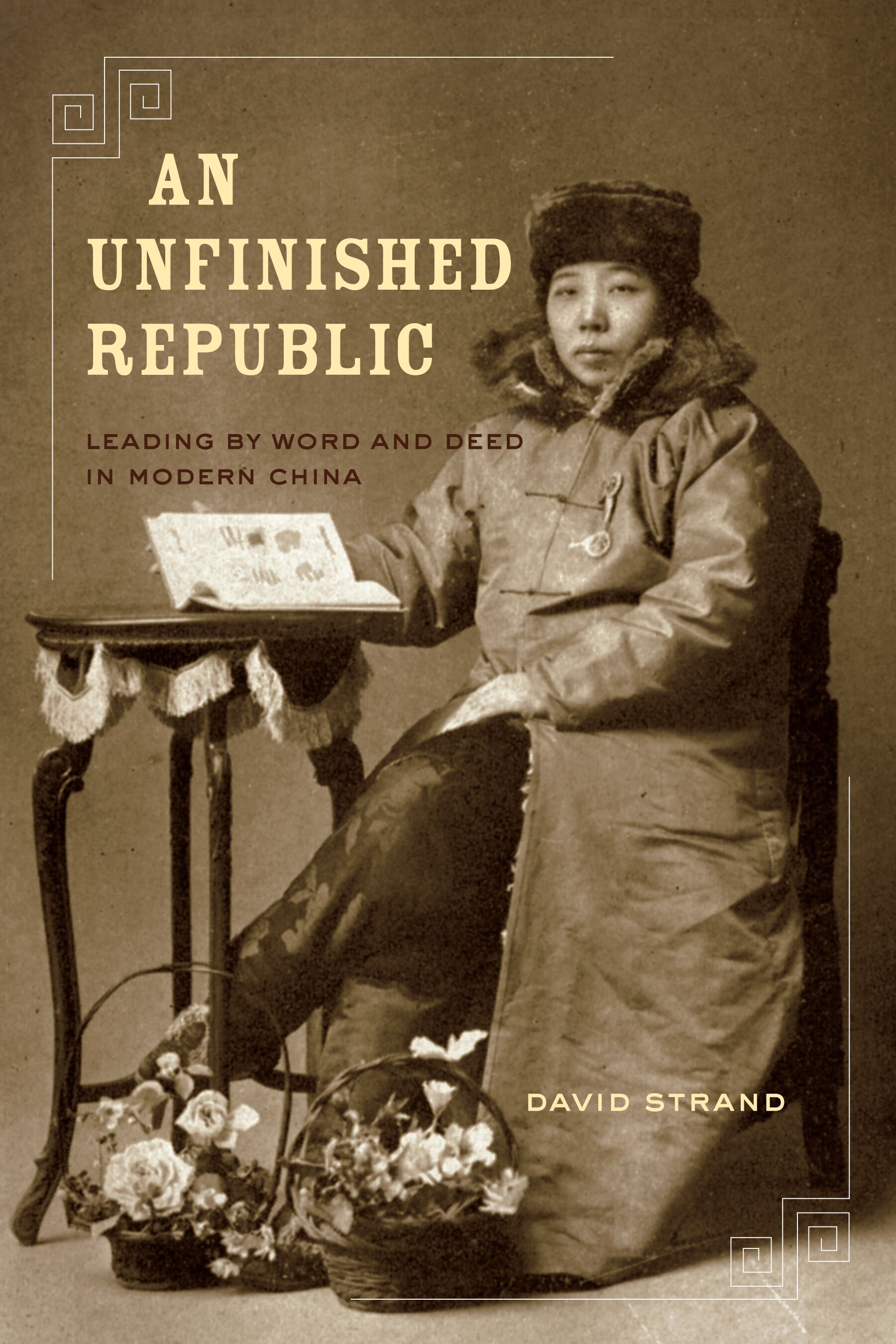
An Unfinished Republic
In this cogent and insightful reading of China’s twentieth-century political culture, David Strand argues that the Chinese Revolution of 1911 engendered a new political life—one that began to free men and women from the inequality and hierarchy that formed the spine of China’s social and cultural order. Chinese citizens confronted their leaders and each other face-to-face in a stance familiar to republics worldwide. This shift in political posture was accompanied by considerable trepidation as well as excitement. Profiling three prominent political actors of the time—suffragist Tang Qunying, diplomat Lu Zhengxiang, and revolutionary Sun Yatsen—Strand demonstrates how a sea change in political performance left leaders dependent on popular support and citizens enmeshed in a political process productive of both authority and dissent.
eBook