
Catalogue Search | MBRL


Are you sure you want to remove the book from the shelf?

{{itemTitle}}
62
result(s) for
"Revolutionary literature, English"
Sort by:


Literatures of Exile in the English Revolution and its Aftermath, 1640-1690
Original and thought-provoking, this collection sheds new light on an important yet understudied feature of seventeenth-century England's political and cultural landscape: exile. Through an essentially literary lens, exile is examined both as physical departure from England-to France, Germany, the Low Countries and America-and as inner, mental withdrawal. In the process, a strikingly wide variety of contemporary sources comes under scrutiny, including letters, diaries, plays, treatises, translations and poetry. The extent to which the richness and disparateness of these modes of writing militates against or constructs a recognisable 'rhetoric' of exile is one of the book's overriding themes. Also under consideration is the degree to which exilic writing in this period is intended for public consumption, a product of private reflection, or characterised by a coalescence of the two. Importantly, this volume extends the chronological range of the English Revolution beyond 1660 by demonstrating that exile during the Restoration formed a meaningful continuum with displacement during the civil wars of the mid-century. This in-depth and overdue study of prominent and hitherto obscure exiles, conspicuously diverse in political and religious allegiance yet inextricably bound by the shared experience of displacement, will be of interest to scholars in a range of disciplines.
Philip Major teaches English at Birkbeck College, University of London. He has published widely on seventeenth-century literature and is currently writing a monograph on the works of Thomas, 3rd Lord Fairfax.
Contents: Foreword, Lisa Jardine; Introduction, Philip Major; Exiles, expatriates, and travellers: towards a cultural and intellectual history of the English abroad, 1640-1660, Timothy Raylor; Disruptions and evocations of family amongst Royalist exiles, Ann Hughes and Julie Sanders; A broken broker in Antwerp: William Aylesbury and the Duke of Buckingham's goods, 1648-1650, Katrien Daemen-de Gelder and J.P. Vander Motten; A tortoise in the shell: Royalist and Anglican experience of exile in the 1650s, Marika Keblusek; Exile, apostasy and Anglicanism in the English Revolution, Sarah Mortimer; Exile in Europe during the English Revolution and its literary impact, Nigel Smith; Abraham Cowley and the ends of poetry, Christopher D'Addario; 'Not sure of safety': Hobbes and exile, James Loxley; 'A poor exile stranger': William Goffe in New England, Philip Major; 'The good old cause for which I suffer': the life of a regicide in exile, Jason Peacey; Works cited; Index.
eBook


The Cambridge Companion to Writing of the English Revolution
This collection of fifteen essays by leading scholars examines the extraordinary diversity and richness of the writing produced in response to, and as part of, the upheaval in the religious, political and cultural life of the nation which constituted the English Revolution. The turmoil of the civil wars fought out from 1639 to 1651, the shock of the execution of Charles I, and the uncertainty of the succeeding period of constitutional experiment were enacted and refigured in writing which both shaped and was shaped by the tumultuous times. The various strategies of this battle of the books are explored through essays on the course of events, intellectual trends and the publishing industry; in discussions of canonical figures such as Milton, Marvell, Bunyan and Clarendon; and in accounts of women's writing and of fictional and non-fictional prose. A full chronology, detailed guides to further reading and a glossary are included.
eBook

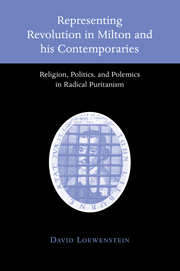
Representing Revolution in Milton and his Contemporaries
David Loewenstein's Representing Revolution in Milton and his Contemporaries is a wide-ranging exploration of the interactions of literature, polemics and religious politics in the English Revolution. Loewenstein highlights the powerful spiritual beliefs and religious ideologies in the polemical struggles of Milton, Marvell and their radical Puritan contemporaries during these revolutionary decades. By examining a wide range of canonical and non-canonical writers - John Lilburne, Winstanley the Digger and Milton, amongst others - he reveals how radical Puritans struggled with the contradictions and ambiguities of the English Revolution and its political regimes. His portrait of a faction-riven, violent seventeenth-century revolutionary culture is an original and significant contribution to our understanding of these turbulent decades and their aftermath. By placing Milton's great poems in the context of the period's radical religious politics, it should be of interest to historians as well as literary scholars.
eBook

W is for Webster : Noah Webster and his American dictionary
\"A picture book biography of Noah Webster.\"-- Provided by publisher.
BOOK

Unsex'd Revolutionaries
Using historical and feminist psycho-linguistic studies as a base, Ty explores some of the complexities encountered in the writings of Mary Wollstonecraft, Mary Hays, Helen Maria Williams, Elizabeth Inchbald, and Charlotte Smith
eBook

The complete works of Gerrard Winstanley
This is the first edition of the complete works of Gerrard Winstanley (1609-76), the foremost radical English thinker and activist of the English Revolution. It is the only edition to observe the standards of modern scholarly editing. The editorial team combines the expertise of acclaimed prize-winning literary scholars and a leading historian of seventeenth-century England. It sets a new standard in the presentation of controversial prose of the period of the English Civil War. Itssubstantial introduction establishes Winstanley's distinctive contributions to political thought and radical religion and elucidates his literary achievements, while the annotation elucidates the wealth of his biblical allusion and his engagement with the politics of his day. This edition ensuresWinstanley's standing as one of the most significant prose writers and radical thinkers of early modern England. All scholars and students of English literature, history, religion, and political thought will want to use this book.
eBook