
Catalogue Search | MBRL


Are you sure you want to remove the book from the shelf?

{{itemTitle}}
31
result(s) for
"Revolutions -- Arab countries -- History -- 21st century"
Sort by:

A rage for order : the Middle East in turmoil, from Tahrir Square to ISIS
\"A closely-reported work of literary journalism on the Arab Spring and its troubled aftermath\"-- Provided by publisher.
BOOK

The Arab spring
In this landmark book, Hamid Dabashi argues that the revolutionary uprisings from Morocco to Iran and from Syria to Yemen were driven by a 'delayed defiance' - a point of rebellion against domestic tyranny and globalized disempowerment alike - that signifies no less than the end of Postcolonialism.
eBook

The new Arab wars : uprisings and anarchy in the Middle East
\"Less than twenty-four months after the hope-filled Arab uprising, the popular movement had morphed into a dystopia of resurgent dictators, failed states, and civil wars. Egypt's epochal transition to democracy ended in a violent military coup. Yemen and Libya collapsed into civil war, while Bahrain erupted in smothering sectarian repression. Syria proved the greatest victim of all, ripped apart by internationally fueled insurgencies and an externally supported, bloody-minded regime. Amidst the chaos, a virulently militant group declared an Islamic State, seizing vast territories and inspiring terrorism across the globe. What happened? The New Arab Wars is a profound illumination of the causes of this nightmare. It details the costs of the poor choices made by regional actors, delivers a scathing analysis of Western misreadings of the conflict, and condemns international interference that has stoked the violence. Informed by commentators and analysts from the Arab world, Marc Lynch's narrative of a vital region's collapse is both wildly dramatic and likely to prove definitive. Most important, he shows that the region's upheavals have only just begun--and that the hopes of Arab regimes and Western policy makers to retreat to old habits of authoritarian stability are doomed to fail.\"-- Book jacket.
Book
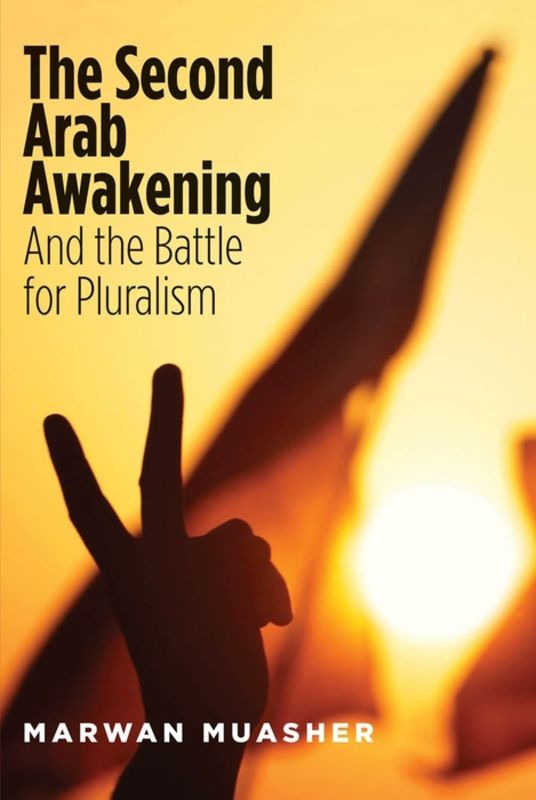
The Second Arab Awakening
This important book is not about immediate events or policies or responses to the Arab Spring. Instead, it takes a long, judicious view of political change in the Arab world, beginning with the first Awakening in the nineteenth century and extending into future decades when-if the dream is realized-a new Arab world defined by pluralism and tolerance will emerge.
Marwan Muasher, former foreign minister of Jordan, asserts that all sides-the United States, Europe, Israel, and Arab governments alike-were deeply misguided in their thinking about Arab politics and society when the turmoil of the Arab Spring erupted. He explains the causes of the unrest, tracing them back to the first Arab Awakening, and warns of the forces today that threaten the success of the Second Arab Awakening, ignited in December 2010. Hope rests with the new generation and its commitment to tolerance, diversity, the peaceful rotation of power, and inclusive economic growth, Muasher maintains. He calls on the West to rethink political Islam and the Arab-Israeli conflict, and he discusses steps all parties can take to encourage positive state-building in the freshly unsettled Arab world.
eBook

Arabic literature in a posthuman world : proceedings of the 12th Conference of the European Association for Modern Arabic Literature (EURAMAL), May 2016, Oslo
Arabic Literature in a Posthuman World explores Arabic literary production after the so-called ?Arab Spring?. 23 specialists of modern Arabic literature analyze the many ways in which contemporary Arab authors view and comment on a world that is dramatically changing and disintegrating, a world full of violent conflict, social instability, ideological vacuum and political collapse where there does not seem to be any place for humanity any more. The spread of new technologies and media added, this world not only appears inhumane, but also posthuman, a world of monstrosity in which mankind no longer controls its own destiny. Authors react to this with a writing of a new quality that makes the old humanist project of an Arab nah?a appear as a failed utopia.0A first section focuses on the increased interest that authors assign to the past as a shaper of the present. The other sections highlight the many subversive techniques with which the writers try to reassert humanity against the overall trend of de-humanization. The spectrum spans from ?Contested Spaces over Science Fiction and Dystopia? and methods of ?Countering/Resisting Fragmentation?, ?Dispersal?, ?Loss?, ?Oblivion?, to ?Satire and Rap?. The volume is the first to explore what Ihab Hassan?s term posthuman(ism), widely debated only in and for Western contexts so far, may mean in other parts of the world
Book

Arab Spring
Beginning in January 2011, the Arab world exploded in a vibrant demand for dignity, liberty, and achievable purpose in life, rising up against an image and tradition of arrogant, corrupt, unresponsive authoritarian rule. These previously unpublished, country-specific case studies of the uprisings and their still unfolding political aftermaths identify patterns and courses of negotiation and explain why and how they occur.
The contributors argue that in uprisings like the Arab Spring negotiation is \"not just a 'nice' practice or a diplomatic exercise.\" Rather, it is a \"dynamically multilevel\" process involving individuals, groups, and states with continually shifting priorities—and with the prospect of violence always near. From that perspective, the essayists analyze a range of issues and events—including civil disobedience and strikes, mass demonstrations and nonviolent protest, and peaceful negotiation and armed rebellion—and contextualize their findings within previous struggles, both within and outside the Middle East. The Arab countries discussed include Algeria, Bahrain, Egypt, Libya, Morocco, Syria, Tunisia, and Yemen. The Arab Spring uprisings are discussed in the context of rebellions in countries like South Africa and Serbia, while the Libyan uprising is also viewed in terms of the negotiations it provoked within NATO.
Collectively, the essays analyze the challenges of uprisers and emerging governments in building a new state on the ruins of a liberated state; the negotiations that lead either to sustainable democracy or sectarian violence; and coalition building between former political and military adversaries.
Contributors: Samir Aita (Monde Diplomatique), Alice Alunni (Durham University), Marc Anstey* (Nelson Mandela University), Abdelwahab ben Hafaiedh (MERC), Maarten Danckaert (European-Bahraini Organization for Human Rights), Heba Ezzat (Cairo University), Amy Hamblin (SAIS), Abdullah Hamidaddin (King's College), Fen Hampson* (Carleton University), Roel Meijer (Clingendael), Karim Mezran (Atlantic Council), Bessma Momani (Waterloo University), Samiraital Pres (Cercle des Economistes Arabes), Aly el Raggal (Cairo University), Hugh Roberts (ICG/Tufts University), Johannes Theiss (Collège d'Europe), Siniša Vukovic (Leiden University), I. William Zartman* (SAIS-JHU). [* Indicates group members of the Processes of International, Negotiation (PIN) Program at Clingendael, Netherland]
eBook

The Arab uprisings explained
Why did Tunisian protests following the self-immolation of Mohammed Bouazizi lead to a massive wave of uprisings across the entire Arab world? Who participated in those protests, and what did they hope to achieve? Why did some leaders fall in the face of popular mobilization while others found ways to survive? And what have been the lasting results of the contentious politics of 2011 and 2012? The Arab uprisings pose stark challenges to the political science of the Middle East, which for decades had focused upon the resilience of entrenched authoritarianism, the relative weakness of civil society, and what seemed to be the largely contained diffusion of new norms and ideas through new information technologies. In this volume, leading scholars in the field take a sharp look at the causes, dynamics, and effects of the Arab uprisings. Compiled by one of the foremost experts on Middle East politics and society, The Arab Uprisings Explained offers a fresh rethinking of established theories and presents a new framework through which scholars and general readers can better grasp the fast-developing events remaking the region. These essays not only advance the study of political science in the Middle East but also integrate the subject seamlessly into the wider political science literature. Deeply committed to the study of this region and working out the kinks of the discipline, the contributors to this volume help scholars and policymakers across the world approach this unprecedented historical period smartly and effectively.
eBook

The Arab Spring and Arab Thaw
What were the unifying principles or strategies that governed the protest movements that swept the Middle East and North Africa in the spring of 2011?
Who were the protestors and how did the different authoritarian regimes respond to them?
How did regional and international institutions react to a region in turmoil?
The Arab Spring and Arab Thaw; Unfinished Revolutions and the Quest for Democracy addresses these questions by examining a range of successful and unsuccessful protest strategies and counter revolutionary tactics employed by protestors and autocratic regimes. Contributors explore the reactions of the USA, EU and Arab League to events in the region and provide insight as to the gendered dimensions of the struggle along with the ethnic and tribal divisions that continue to impact the post-revolt period. By addressing these critical queries the book demonstrate how the Arab Spring has evolved into a protracted Arab Thaw that continues to profoundly affect regional and international politics.
eBook

The Arab spring : new patterns for democracy and international law
This edited volume explores some of the key international law issues to have arisen from the events which comprised the 'Arab Spring.'.
eBook
