
Catalogue Search | MBRL


Are you sure you want to remove the book from the shelf?

{{itemTitle}}
1,624
result(s) for
"Revolutions Great Britain."
Sort by:


Bengal Industries and the British Industrial Revolution (1757-1857)
This book seeks to enlighten two grey areas of industrial historiography. Although Bengal industries were globally dominant on the eve of the industrial revolution, no detailed literature is available about their later course of development. A series of questions are involved in it. Did those industries decline during the spells of British industrial revolution? If yes, what were their reasons? If not, the general curiosity is: On which merits could those industries survive against the odds of the technological revolution? A thorough discussion on these issues also clears up another area of dispute relating to the occurrence of deindustrialization in Bengal, and the validity of two competing hypotheses on it, viz. i) the mainstream hypothesis of market failures, and ii) the neo-marxian hypothesis of imperialistic state interventions
eBook


The men who lost America : British leadership, the American Revolution, and the fate of the empire
A unique account of the American Revolution, told from the perspective of the leaders who conducted the British war effort.
eBook


The English Atlantic in an Age of Revolution, 1640–1661
Between 1640 and 1660, England, Scotland, and Ireland faced civil war, invasion, religious radicalism, parliamentary rule, and the restoration of the monarchy. Carla Gardina Pestana offers a sweeping history that systematically connects these cataclysmic events and the development of the infant plantations from Newfoundland to Surinam. By 1660, the English Atlantic emerged as religiously polarized, economically interconnected, socially exploitative, and ideologically anxious about its liberties. War increased both the proportion of unfree laborers and ethnic diversity in the settlements. Neglected by London, the colonies quickly developed trade networks, especially from seafaring New England, and entered the slave trade. Barbadian planters in particular moved decisively toward slavery as their premier labor system, leading the way toward its adoption elsewhere. When by the 1650s the governing authorities tried to impose their vision of an integrated empire, the colonists claimed the rights of \"freeborn English men,\" making a bid for liberties that had enormous implications for the rise in both involuntary servitude and slavery. Changes at home politicized religion in the Atlantic world and introduced witchcraft prosecutions. Pestana presents a compelling case for rethinking our assumptions about empire and colonialism and offers an invaluable look at the creation of the English Atlantic world.
eBook

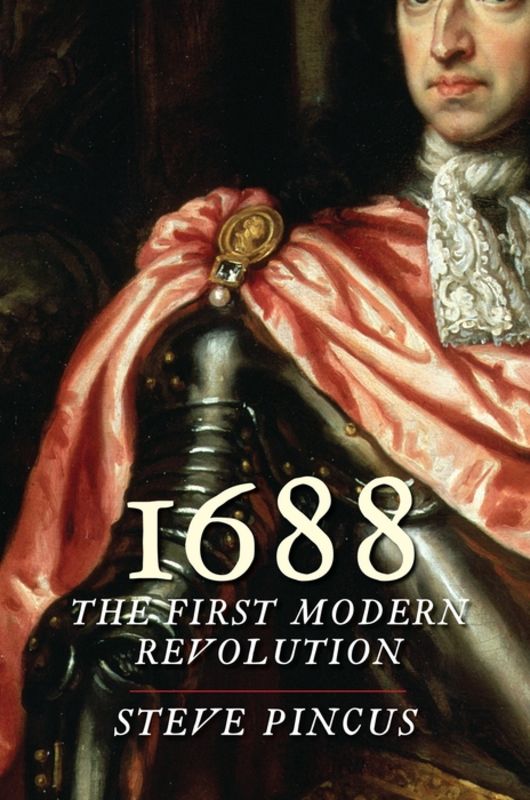
1688
For two hundred years historians have viewed England's Glorious Revolution of 1688-1689 as an un-revolutionary revolution-bloodless, consensual, aristocratic, and above all, sensible. In this brilliant new interpretation Steve Pincus refutes this traditional view.
By expanding the interpretive lens to include a broader geographical and chronological frame, Pincus demonstrates that England's revolution was a European event, that it took place over a number of years, not months, and that it had repercussions in India, North America, the West Indies, and throughout continental Europe. His rich historical narrative, based on masses of new archival research, traces the transformation of English foreign policy, religious culture, and political economy that, he argues, was the intended consequence of the revolutionaries of 1688-1689.
James II developed a modernization program that emphasized centralized control, repression of dissidents, and territorial empire. The revolutionaries, by contrast, took advantage of the new economic possibilities to create a bureaucratic but participatory state. The postrevolutionary English state emphasized its ideological break with the past and envisioned itself as continuing to evolve. All of this, argues Pincus, makes the Glorious Revolution-not the French Revolution-the first truly modern revolution. This wide-ranging book reenvisions the nature of the Glorious Revolution and of revolutions in general, the causes and consequences of commercialization, the nature of liberalism, and ultimately the origins and contours of modernity itself.
eBook

Levellers
The Leveller movement of the 1640s campaigned for religious toleration and a radical remaking of politics in post-civil war England. This book, the first full-length study of the Levellers for fifty years, offers a fresh analysis of the originality and character of Leveller thought. Challenging received ideas about the Levellers as social contract theorists and Leveller thought as a mere radicalisation of parliamentarian thought, Foxley shows that the Levellers' originality lay in their subtle and unexpected combination of different strands within parliamentarianism. The book takes full account of recent scholarship, and contributes to historical debates on the development of radical and republican politics in the civil war period, the nature of tolerationist thought, the significance of the Leveller movement and the extent of the Levellers' influence in the ranks of the New Model Army.
eBook

Childhood and Child Labour in Industrial England
The purpose of this collection is to bring together representative examples of the most recent work that is taking an understanding of children and childhood in new directions. The two key overarching themes are diversity: social, economic, geographical, and cultural; and agency: the need to see children in industrial England as participants - even protagonists - in the process of historical change, not simply as passive recipients or victims. Contributors address such crucial subjects as the varied experience of work; poverty and apprenticeship; institutional care; the political voice of children; child sexual abuse; and children and education. This volume, therefore, includes some of the best, innovative work on the history of children and childhood currently being written by both younger and established scholars.
eBook