
Catalogue Search | MBRL


Are you sure you want to remove the book from the shelf?

{{itemTitle}}
3,628
result(s) for
"Rhetorical Criticism"
Sort by:

Arguing, obeying and defying : a rhetorical perspective on Stanley Milgram's obedience experiments
\"Stanley Milgram's obedience experiments are among the most influential and controversial scientific studies ever conducted. The experiments are commonly understood to have shown how easily people can be led into harming another person, simply as a result of following orders. Recently, however, Milgram's studies have been subjected to a sustained critique and re-evaluation. This book draws on the vast stock of audio recordings from Milgram's experiments to reveal how these experiments can be understood as occasions for argumentation and rhetoric, rather than showing how passive subjects can be led into simply doing as they are told. In doing so, it reconsiders what we understand by 'obedience' and extends how social psychologists have understood rhetoric itself\"-- Provided by publisher.
Book

Paul and the Resurrected Body
A new reading of Pauline theology, ethics, and eschatology grounded in social-identity theory and sociorhetorical criticism
Readers often think of Paul's attitude toward the resurrection of the body in individual terms: a single body raised as the climax of an individual's salvation. InPaul and the Resurrected Body: Social Identity and Ethical Practice, Matt O'Reilly makes the case that, for Paul, the social dimension of future bodily resurrection is just as important, if not more so. Through a close reading of key texts in the letters to the Corinthians, Romans, and Philippians, O'Reilly argues that resurrection is integral to Paul's understanding of Christian social identity. In Paul's theological reasoning, a believer's hope for the future depends on being identified as part of the people of God who will be resurrected.
Features
A clarification of the eschatological basis for Paul's ethical expectations
Exploration of the social significance of Paul's theological reasoning
An integration of ancient rhetorical theory with contemporary social-identity theory
eBook
Dining with John : communal meals and identity formation in the Fourth Gospel and its historical and cultural context
This book provides an analysis of the role of food, drink and meals in the Fourth Gospel, in the formation of early Christian identity, and of the historical circumstances in which Johannine meal practices may have developed.
eBook
The Multilingual Jesus and the Sociolinguistic World of the New Testament
In The Multilingual Jesus and the Sociolinguistic World of the New Testament, Hughson Ong provides a comprehensive study of the sociolinguistic dynamics that compose the speech community of ancient Palestine, including its historical linguistic shifts and geographical linguistic landscape.
eBook
The Exorcism Stories in Luke-Acts
This 2004 book in English integrates detailed literary criticism of the exorcism stories in Luke-Acts with wide-ranging comparative study of ancient sources on demonology, spirit affliction and exorcistic healing. Methods from systemic functional linguistics and critical theory are explained and then applied to each story. Careful focus is placed on each narrative's linguistic functions and also on relevant aspects of its literary co-text and the wider context of culture. Implications of the analysis for the new perspective on Luke-Acts, especially the implied author's relationship with Judaism, are explored in relation to the Lukan stories' original context of reception. Largely neglected interfaces between Luke's narrative representation of exorcism and emerging academic discourse about religious experience, shamanism, health care in antiquity, ritual performance and ancient Jewish systems of impurity are probed in ways that shed fresh light on this supremely alien part of the Lukan writings.
eBook

Friendship and Benefaction in James
Now available from SBL Press
Employing social description, social scientific models, and rhetorical analysis, Alicia J. Batten argues that the letter of James is conversant with the topic of friendship within Greek and Roman literature, as well as within various texts of early Christianity. She illustrates how James drew upon some of the language and concepts related to friendship with an intriguing density to advocate resistance to wealth, avoidance of rich patrons, and reliance upon God.
Features:
Use of friendship, benefaction, and patronage as lenses through which James and related texts can be viewedA strong case for how the letter appels to the language and ideas of friendship with regard to God's relationships with humansExploration of the relationship between the book of James and the teachings of Jesus
eBook

The Paul-Apollos Relationship and Paul’s Stance toward Greco-Roman Rhetoric
Research into the social and rhetorical background of the Corinthian church, shows that the Corinthians were evaluating their leaders based on their rhetorical prowess, seeking to associate with those who would enhance their status and honour. The coherence of Paul’s argument in 1 Corinthians 1-4 is evaluated, particularly by showing how Paul’s discourse of the cross and Sophia relate to the issue of the dissensions in the Corinthian ekklesia. Once demonstrated that there is a misunderstanding of wisdom amongst church leaders at the basis of the dissensions, a redefinition of the wisdom offered in Corinthians is required. In what could be considered the locus of Paul’s theology of proclamation (i.e., 1 Corinthians 2:1-5), he rejects any employment of worldly wisdom in his proclamation of the cross for theological reasons and will not allow himself or other leaders to be drawn into this game of personality cult and honour enhancement. Such conclusions then raise the question of the role played by Apollos’ name in Paul’s argument against dissensions. After a review of several possible views, it is concluded-based primarily on exegetical grounds and refusing to engage in hermeneutical speculations-that Paul had a congenial relationship with Apollos. If any distinction is drawn between the two, it was solely the Corinthians’ fault, who viewed their preachers in competitive rather than complementary terms.
eBook
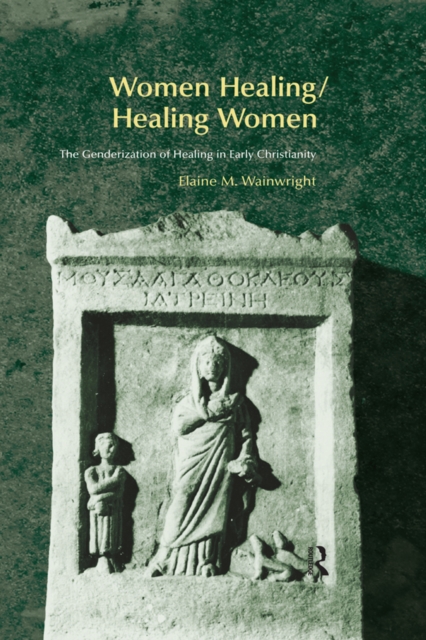
Women Healing/Healing Women
'Women Healing/ Healing Women' begins with a search for women who were healers in the Graeco-Roman world of the late Hellenistic and early Roman period. Women healers were honoured in inscriptions and named by medical writers, and were familiar enough to be stereotyped in plays and other writings. What emerges by the first century of the Common Era is a world in which women functioned as healers but where healing becomes a contested site for gender relations. By the time the gospels are written the place of women as healers is effectively erased. The book uses the historical and cultural evidence to re-read the gospel texts and discover healers in a woman pouring out ointment, healed women bearing on their bodies the language describing Jesus, and even in women possessed by demons.
eBook
Galatians
Paul's letter to the Galatians, sometimes known as the Magna Carta of Christian liberty, is central to the understanding of the relation of Paul and the Law and is packed with crucial historical, social and theological material.Philip F. Esler provides a detailed and accessible interpretation of the text, which draws on contemporary and modern literary models. He outlines the problems often associated with reading Galatians, the context of the text, the rhetoric of the text and the intercultural and social implications of Galatians. Galatians includes comprehensive indices of ancient sources and modern sources, detailed references and an appendix discussing Paul's attitude to the Law in Romans 5.20-21.Galatians presents a succinct and emminently readable analysis of a dense and important New Testament text.
eBook
