
Catalogue Search | MBRL


Are you sure you want to remove the book from the shelf?

{{itemTitle}}
62
result(s) for
"Richard Cobden"
Sort by:
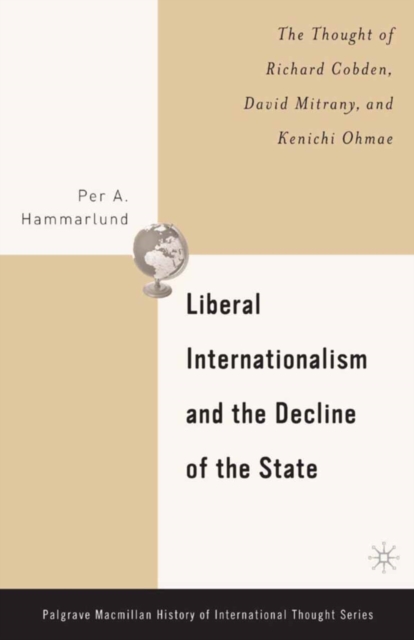
Liberal internationalism and the decline of the state : the thought of Richard Cobden, David Mitrany, and Kenichi Ohmae
This book provides a critical analysis of the liberal ideas of the decline of the state through a historical comparison. It takes special note of the implications of state failure to control economic growth and market exigencies for international relations. The book is divided into three sections. The first analyzes Cobden, Mitrany, and Ohmae's empirical claims, the second looks at their normative judgements and the third looks at their predictive assertions. It concludes that the three primarily propose normative arguments for less state involvement in economic and international relations but conceal them in empirical and predictive assertions. The liberal idea of the decline of the state is more of an ideological statement in response to political, social, and economic trends than an objective observation of an empirically verifiable fact.
eBook

Richard Cobden's German Diaries
No detailed description available for \"Richard Cobden's German Diaries\".
eBook
Cure for Russia Hate
The Anglo tradition of hating Russia started in earnest in the 1830s. In 1836, Richard Cobden wrote a pamphlet challenging the development. A portion (about a third) is presented here.
Journal Article

Disraeli and Cobden: ‘The Manchester School’ in Fact and Fiction
The mid-nineteenth century’s leading Conservative and pre-eminent Radical politicians (Disraeli and Cobden) at first glance have little in common save for the year of their birth in 1804, the legacy of major scholarly editions of their letters and both having been the subject of 21st-century exhibitions (Oxford, 2004 and Manchester, 2023). Only one letter between the two survives, an indication of their personal, social, and political distance but in their lifetimes, each acted as a constant symbolic antitype for the other. Disraeli’s ‘Young England’ novels (and celebrated visits to Manchester, in part organized by Cobden) pointedly sought to regenerate the ideal of aristocratic government in the heart of industrial Britain, while his linguistic invention of the ‘Manchester school’ found its personification in the Radical manufacturer and leader of the Anti-Corn Law League, Richard Cobden. Their political confrontation within and outside Parliament neatly encapsulated the rivalry between land and industry, protection and free trade, aristocracy and middle-class identity, the territorial constitution and the ‘commercial principle’, national greatness or cosmopolitan utopianism, rule by the ‘gentlemen of England’ or its subversion by the Manchester-led democratic tide. This study of two preeminent Victorian politicians, rarely if ever paired together, yields therefore unexpected insights into ideological conflict and political practice as well as their artistic representation.
Journal Article

Classical Liberalism and the Industrial Working Class
Thomas Hodgskin (1787–1869) is today a largely unknown figure, sometimes considered to be a forerunner of Karl Marx. Yet a closer look at Hodgskin’s works reveals that he was actually a committed advocate of laissez-faire economics and enthusiastic about labor-saving machinery and the Industrial Revolution, with a genuine interest in the well-being of the working classes. This book places him in the tradition of classical liberalism, where he belongs—as a disciple of Adam Smith, but even less tolerant of government power than Smith was.
Classical Liberalism and the Industrial Working Class: The Economic Thought of Thomas Hodgskin will be of interest to advanced students and scholars in the history of economic thought, economic history and the history of political thought.
eBook

Richard Cobden as a Middle-Class Hero: Public Speaking and Political Debate in Victorian Britain
This paper explores Richard Cobden’s parliamentary career, political thinking, and activism as illustrating the role of debate and the value of dissent in nineteenthcentury British political culture. Cobden was unusual among British politicians of the time; he was a self-made man, experienced traveller, and middle-class hero, yet managed to retain a seat in Parliament between 1841 and 1865 (with a two-year interval outside Parliament between 1857–59). One of my aims is to reassess Cobden’s significance as a politician. I ask in what ways he was seen by contemporaries as an ambivalent figure who represented both radical, democratic activism as the leader of the anti-Corn Law League and a moderate cosmopolitanism as a professional politician, and the role that public speaking played in fostering his profile. My reading may challenge some contemporary interpretations, providing a balanced portrait of Cobden as an activist and politician genuinely concerned with the general welfare of all European countries rather than exclusively the interests of Great Britain (Gott, 1988: 90–101). Focusing on Cobden and the success of the anti-Corn Law League is also a way of exploring how material culture and public speaking were linked in Victorian Britain. Cobden’s popularity can be explained as a result of his eminence as a public speaker, yet discussing his popularity cannot be reduced to his rhetorical abilities. Representations of Cobden’s image and the different anti-Corn Law League symbols in a variety of objects constitute an opportunity to explore the role of nonverbal aspects in the political culture at the time. This paper takes on board Joseph Meisel’s claim that historians have neglected nineteenth-century public speaking culture, while it suggests that, at least when considering Cobden as a study case, verbal and nonverbal communication converge (Meisel, 2001: 2).
Journal Article

The Correspondence of Henry D. Thoreau
This is the inaugural volume in the first full-scale scholarly edition of Thoreau's correspondence in more than half a century. When completed, the edition's three volumes will include every extant letter written or received by Thoreau--in all, almost 650 letters, roughly 150 more than in any previous edition, including dozens that have never before been published.
Correspondence 1contains 163 letters, ninety-six written by Thoreau and sixty-seven to him. Twenty-five are collected here for the first time; of those, fourteen have never before been published. These letters provide an intimate view of Thoreau's path from college student to published author. At the beginning of the volume, Thoreau is a Harvard sophomore; by the end, some of his essays and poems have appeared in periodicals and he is at work onA Week on the Concord and Merrimack RiversandWalden. The early part of the volume documents Thoreau's friendships with college classmates and his search for work after graduation, while letters to his brother and sisters reveal warm, playful relationships among the siblings. In May 1843, Thoreau moves to Staten Island for eight months to tutor a nephew of Emerson's. This move results in the richest period of letters in the volume: thirty-two by Thoreau and nineteen to him. From 1846 through 1848, letters about publishing and lecturing provide details about Thoreau's first years as a professional author. As the volume closes, the most ruminative and philosophical of Thoreau's epistolary relationships begins, that with Harrison Gray Otis Blake. Thoreau's longer letters to Blake amount to informal lectures, and in fact Blake invited a small group of friends to readings when these arrived.
Following every letter, annotations identify correspondents, individuals mentioned, and books quoted, cited, or alluded to, and describe events to which the letters refer. A historical introduction characterizes the letters and connects them with the events of Thoreau's life, a textual introduction lays out the editorial principles and procedures followed, and a general introduction discusses the significance of letter-writing in the mid-nineteenth century and the history of the publication of Thoreau's letters. Finally, a thorough index provides comprehensive access to the letters and annotations.
eBook

The Roman Predicament
Modern America owes the Roman Empire for more than gladiator movies and the architecture of the nation's Capitol. It can also thank the ancient republic for some helpful lessons in globalization. So argues economic historian Harold James in this masterful work of intellectual history.
The book addresses what James terms \"the Roman dilemma\"--the paradoxical notion that while global society depends on a system of rules for building peace and prosperity, this system inevitably leads to domestic clashes, international rivalry, and even wars. As it did in ancient Rome, James argues, a rule-based world order eventually subverts and destroys itself, creating the need for imperial action. The result is a continuous fluctuation between pacification and the breakdown of domestic order.
James summons this argument, first put forth more than two centuries ago in Adam Smith'sWealth of Nationsand Edward Gibbon'sDecline and Fall of the Roman Empire, to put current events into perspective. The world now finds itself staggering between a set of internationally negotiated trading rules and exchange--rate regimes, and the enforcement practiced by a sometimes-imperial America. These two forces--liberal international order and empire--will one day feed on each other to create a shakeup in global relations, James predicts. To reinforce his point, he invokes the familiarbon motonce applied to the British Empire:\"When Britain could not rule the waves, it waived the rules.\"
Despite the pessimistic prognostications of Smith and Gibbon, who saw no way out of this dilemma, James ends his book on a less depressing note. He includes a chapter on one possible way in which the world could resolve the Roman Predicament--by opting for a global system based on values as opposed to rules.
eBook
Studios must share piracy burden: iiNet
He said that in one week alone, iiNet received more than 3,000 pages of allegations of copyright violations by iiNet customers. \"If all the notices iiNet received from film studios over a five month period were printed it would take 180 large folders and more than 12 trolleys to bring them into the court,\" Mr [Richard Cobden] said. \"iiNet doesn't want to be the judge, jury and executioner, it wants the studios to do their own dirty work.\"
Newsletter
FED: Industry group push for fitness centres to pay more for music
SYDNEY, March 16 AAP - The Australian recording industry has begun its legal battle for fitness centres to pay more than the current \"trifling\" amount for music pumped out during workout classes. PPCA barrister, Richard Cobden, SC, told the tribunal this \"trifling or nominal amount\" equates to about 6.5 cents per person for a class of 15, and only 2.4 cents per person for a class of 40. Lauretta Stace, chief executive of Fitness Australia, the industry group representing most fitness centres, described the claim as \"nothing more than a greedy grab for cash\".
Newsletter