
Catalogue Search | MBRL


Are you sure you want to remove the book from the shelf?

{{itemTitle}}
10,655
result(s) for
"Richmond"
Sort by:

Race and masculinity in Southern memory
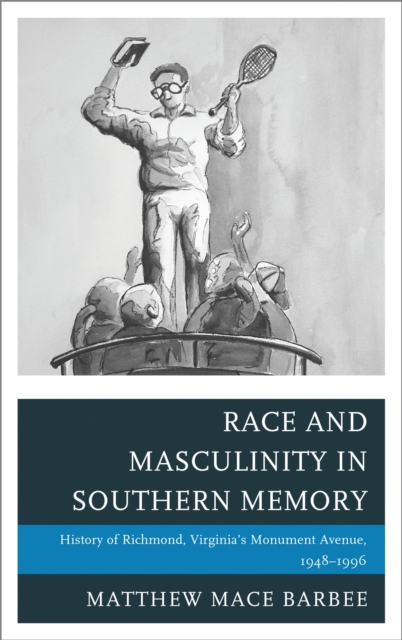
In Race and Masculinity in Southern Memory Matthew Mace Barbee explores the long history of Richmond, Virginia’s iconic Monument Avenue. As a network of important memorials to Confederate leaders located in the former capitol of the Confederacy, Monument Avenue has long been central to the formation of public memory in Virginia and the U.S. South. It has also been a site of multiple controversies over what, who, and how Richmond’s past should be commemorated. This book traces the evolution of Monument Avenue by analyzing public discussions of its memorials and their meaning. It pays close attention to the origins of Monument Avenue and the first statues erected there, including memorials to Robert E. Lee and Jefferson Davis. Barbee provides a detailed and focused analysis of the evolution of Monument Avenue and public memory in Richmond from 1948 to 1996 through the Civil Rights Movement and the Civil War Centennial, and up to the memorial to Arthur Ashe erected in 1996. An African-American native of Richmond, Ashe was an international tennis champion and advocate for human rights. The story of how a monument to him ended up in a space previously reserved for statues of Confederate leaders helps us understand the ways Richmond has grappled with its past, especially the histories of slavery, Jim Crow, and Civil Rights.
eBook

Lincoln's lady spymaster : the untold story of the abolitionist Southern belle who helped win the Civil War
\"A historical account of wealthy Southern belle Elizabeth Van Lew, whose espionage for Abraham Lincoln and the Union helped win the Civil War\"-- Provided by publisher.
BOOK

Civil War Weather in Virginia
This work fills a tremendous gap in our available knowledge in a fundamental area of Civil War studies, that of basic quotidian information on the weather in the theater of operations in the vicinity of Washington, D.C., and Richmond, Virginia. Krick adds to the daily records kept by amateur meteorologists in these two locations. Anecdotal descriptions of weather found in contemporary soldiers’ dairies and correspondence combines these scattered records into a chronology of weather information that also includes daybreak and sunset times for each day. The information in Civil War Weather in Virginia is indispensable for students of the Civil War in the vital northern Virginia/Maryland theater of operations.
eBook


The Body in the Reservoir
Centered on a series of dramatic murders in nineteenth- and early twentieth-century Richmond, Virginia,The Body in the Reservoiruses these gripping stories of crime to explore the evolution of sensationalism in southern culture.In Richmond, as across the nation, the embrace of modernity was accompanied by the prodigious growth of mass culture and its accelerating interest in lurid stories of crime and bloodshed. But while others have emphasized the importance of the penny press and yellow journalism on the shifting nature of the media and cultural responses to violence, Michael Trotti reveals a more gradual and nuanced story of change. In addition, Richmond's racial makeup (one-third to one-half of the population was African American) allows Trotti to challenge assumptions about how black and white media reported the sensational; the surprising discrepancies offer insight into just how differently these two communities experienced American justice.An engaging look at the connections between culture and violence, this book gets to the heart--or perhaps the shadowy underbelly--of the sensational as the South became modern.
eBook


The Separate City
A ground-breaking collaborative study merging perspectives from history, political science, and urban planning,The Separate Cityis a trenchant analysis of the development of the African-American community in the urban South. While similar in some respects to the racially defined ghettos of the North, the districts in which southern blacks lived from the pre-World War II era to the mid-1960s differed markedly from those of their northern counterparts. The African- American community in the South was (and to some extent still is) a physically expansive, distinct, and socially heterogeneous zone within the larger metropolis. It found itself functioning both politically and economically as a \"separate city\" -- a city set apart from its predominantly white counterpart.
Within the separate city itself, internal conflicts reflected a structural divide between an empowered black middle class and a larger group comprising the working class and the disadvantaged. Even with these conflicts, the South's new black leadership gained political control in many cities, but it could not overcome the economic forces shaping the metropolis. The persistence of a separate city admitted to the profound ineffectiveness of decades of struggle to eliminate the racial barriers with which southern urban leaders -- indeed all urban America -- continue to grapple today.
eBook

