
Catalogue Search | MBRL


Are you sure you want to remove the book from the shelf?

{{itemTitle}}
6
result(s) for
"Right and left (Political science) - Germany (West) - History"
Sort by:
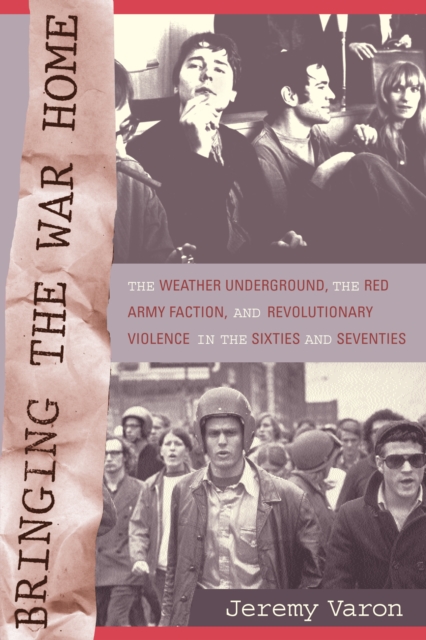
Bringing the War Home
In this first comprehensive comparison of left-wing violence in the United States and West Germany, Jeremy Varon focuses on America's Weather Underground and Germany's Red Army Faction to consider how and why young, middle-class radicals in prosperous democratic societies turned to armed struggle in efforts to overthrow their states. Based on a wealth of primary material, ranging from interviews to FBI reports, this book reconstructs the motivation and ideology of violent organizations active during the 1960s and 1970s. Varon conveys the intense passions of the era--the heat of moral purpose, the depth of Utopian longing, the sense of danger and despair, and the exhilaration over temporary triumphs. Varon's compelling interpretation of the logic and limits of dissent in democratic societies provides striking insights into the role of militancy in contemporary protest movements and has wide implications for the United States' current \"war on terrorism.\" Varon explores Weatherman and RAF's strong similarities and the reasons why radicals in different settings developed a shared set of values, languages, and strategies. Addressing the relationship of historical memory to political action, Varon demonstrates how Germany's fascist past influenced the brutal and escalating nature of the West German conflict in the 60s and 70s, as well as the reasons why left-wing violence dropped sharply in the United States during the 1970s. Bringing the War Home is a fascinating account of why violence develops within social movements, how states can respond to radical dissent and forms of terror, how the rational and irrational can combine in political movements, and finally how moral outrage and militancy can play both constructive and destructive roles in efforts at social change.
eBook

After the Red Army faction
Masterminded by women, the Red Army Faction (RAF) terrorized West Germany from the 1970s to the 1990s. Afterimages of its leaders persist in the works of pivotal artists and writers, including Gerhard Richter, Elfriede Jelinek, and Slavoj iek. Why were women so prominent in the RAF? What does the continuing cultural response to the German armed struggle tell us about the representation of violence, power, and gender today? Engaging critical theory, Charity Scribner addresses these questions and analyzes signal works that point beyond militancy and terrorism. This literature and art discloses the failures of the Far Left and registers the radical potential that RAF women actually forfeited. After the Red Army Faction maps out a cultural history of militancy and introduces \"postmilitancy\" as a new critical term. As Scribner demonstrates, the most compelling examples of postmilitant culture don't just repudiate militancy: these works investigate its horizons of possibility, particularly on the front of sexual politics. Objects of analysis include as-yet untranslated essays by Theodor Adorno and Jürgen Habermas, as well as novels by Friedrich Dürrenmatt and Judith Kuckart, Johann Kresnik's Tanztheaterstück Ulrike Meinhof, and the blockbuster exhibition Regarding Terror at the Berlin Kunst-Werke. Scribner focuses on German cinema, offering incisive interpretations of films by Margarethe von Trotta, Volker Schlöndorff, and Fatih Akin, as well as the international box-office success The Baader-Meinhof Complex. These readings disclose dynamic junctures among several fields of inquiry: national and sexual identity, the disciplining of the militant body, and the relationship between mass media and the arts.
eBook

West Germany and the Global Sixties
The anti-authoritarian revolt of the 1960s and 1970s was a watershed in the history of the Federal Republic of Germany. The rebellion of the so-called '68ers' - against cultural conformity and the ideological imperatives of the Cold War, against the American war in Vietnam, and in favor of a more open accounting for the crimes of the Nazi era - helped to inspire a dialogue on democratization with profound effects on German society. Timothy Scott Brown examines the unique synthesis of globalizing influences on West Germany to reveal how the presence of Third World students, imported pop culture from America and England, and the influence of new political doctrines worldwide all helped to precipitate the revolt. The book explains how the events in West Germany grew out of a new interplay of radical politics and popular culture, even as they drew on principles of direct-democracy, self-organization and self-determination, all still highly relevant in the present day.
eBook

For Reich and Volksgemeinschaft—Against the World Conspiracy: Antisemitism and Sovereignism in the Federal Republic of Germany Since 1945
Sovereignists are convinced that states in which they live are not sovereign as they are secretly controlled by a foreign power. They strive for pseudo-state, individual, and/or group-specific sovereignty. Authorities in Germany have only been systematically observing sovereignist groups for a few years. Since the founding of the Federal Republic in 1949, right-wing extremist sovereignist groups have been disseminating the idea that the state was part of a “Jewish world conspiracy” against the German volk. Their leaders not only advocate for the restoration of German sovereignty (as a German Reich or by establishing new German states), but also deny the Holocaust and want to liberate themselves from the “New World Order.” Based on the analysis of statements by key participants, this article demonstrates that antisemitism has been a central ideological element within German sovereignism.
Journal Article


The Minister and the Terrorist
Germans always knew that their foreign minister, Joschka Fischer, had been a leftist activist in the 1960s and 1970s. More controversial were recent disclosures that he had once assaulted a police officer and may have had links to terrorists. Fischer's evolution is the tale of a generation that changed Germany--and then itself.
Magazine Article