
Catalogue Search | MBRL


Are you sure you want to remove the book from the shelf?

{{itemTitle}}
107
result(s) for
"Right-wing extremists -- Europe"
Sort by:


European and American Extreme Right Groups and the Internet
How do right-wing extremist organizations throughout the world use the Internet as a tool for communication and recruitment? What is its role in identity-building within radical right-wing groups and how do they use the Internet to set their agenda, build contacts, spread their ideology and encourage mobilization? This important contribution to the field of Internet politics adopts a social movement perspective to address and examine these important questions. Conducting a comparative content analysis of more than 500 extreme right organizational web sites from France, Germany, Italy, Spain, the United Kingdom and the United States, it offers an overview of the Internet communication activities of these groups and systematically maps and analyses the links and structure of the virtual communities of the extreme right. Based on reports from the daily press the book presents a protest event analysis of right wing groups' mobilisation and action strategies, relating them to their online practices. In doing so it exposes the new challenges and opportunities the Internet presents to the groups themselves and the societies in which they exist.
eBook

Entangled far rights : a Russian-European intellectual romance in the twentieth century
\"Since the Ukrainian crisis in 2014, Russia's support to the European far right--and to a variety of populist leaders more globally--has become a cornerstone of the West's perception of Moscow as a \"spoiler\" on the international scene. The fact that Russia's most fervent supporters are now to be found on the right of the ideological spectrum should not be a surprise. The European far right has always had Russophile tendencies, but these were obscured during the Cold War, when rightist politics were most of all anti-Communist. Entangled Far Rights traces the \"intellectual romance\" that existed between European far right groups and their Russian-Soviet counterparts during the twentieth century and accounts for their recent re-emergence\"-- Provided by publisher.
Book
Digital media strategies of the far right in Europe and the United States
With the leverage of digital reproducibility, historical messages of hate are finding new recipients with breathtaking speed and scope.The rapid growth in popularity of right-wing extremist groups in response to transnational economic crises underscores the importance of examining in detail the language and political mobilization strategies of.
eBook

Far-right politics in Europe
In Europe today, staunchly nationalist parties such as France's National Front and the Austrian Freedom Party are identified as far-right movements, though supporters seldom embrace that label. More often, \"far-right\" is pejorative, used by liberals to tar these groups with the taint of fascism, Nazism, and other discredited ideologies. Jean-Yves Camus and Nicolas Lebourg's critical look at the far right throughout Europe--from the United Kingdom to France, Germany, Poland, Italy, and elsewhere--reveals a pre-history and politics more complex than the stereotypes suggest and warns of the challenges these movements pose to the EU's liberal-democratic order. The European far right represents a confluence of many ideologies: nationalism, socialism, anti-Semitism, authoritarianism. In the first half of the twentieth century, the radical far right achieved its apotheosis in the regimes of fascist Italy and Nazi Germany. But far-right movements have evolved significantly since 1945, as Far-Right Politics in Europe makes clear. The 1980s marked a turning point in political fortunes, as national-populist parties began winning seats in European parliaments. Since the terrorist attacks of 9/11, a new wave has unfurled, one that is explicitly anti-immigrant and Islamophobic in outlook. Though Europe's far-right parties differ in important respects, they are motivated by a common sense of mission: to save their homelands from the corrosive effects of multiculturalism and globalization by creating a closed-off, ethnically homogeneous society. Members of these movements are increasingly determined to gain power through legitimate electoral means. In democracies across Europe, they are succeeding.-- Provided by publisher
Book

Right-Wing Radicalism Today
This book highlights recent developments in the radical right providing comparative analysis of current extremist activity in Eastern and Western Europe and the United States. It reveals the growing amount of connections and continuities of rightwing movements and ideologies across national borders. Subjects covered include:
Who joins radical right parties and why?
Recent developments in parties in Eastern & Western Europe
The transatlantic cross-fertilisation of ideological perspectives
How the US extreme-right has changed since the emergence of the Tea Party movement
This will be essential reading for all students and scholars within an interest in the contemporary radical right and extremism.
eBook


Cleavage Politics and the Populist Right
Over the last two decades, right-wing populist parties in Western Europe have gained sizable vote shares and power, much to the fascination and consternation of political observers. Meshing traditionalism and communitarian ideals, right-wing populist parties have come to represent a polar normative ideal to the New Left in Western Europe. In his dynamic studyCleavage Politics and the Populist Right,Simon Bornschier applies a cultural as well as political dimension to analyze the parties of both the right and left in six countries. He develops a theory that integrates the role of political conflict around both established cleavages and party strategies regarding new divisions to explain the varying fortunes of the populist right.
eBook

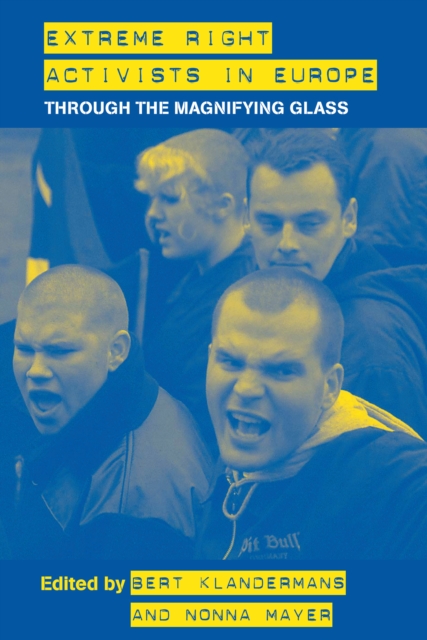
Extreme Right Activists in Europe
Since the 1980s, one of the main political changes in Western Europe has been the electoral upsurge of extreme right-wing parties. However, while the electoral support of these movements has been studied extensively, their membership has largely been ignored. This book examines who joins the extreme right and why?Drawing upon extensive research and featuring contributions from distinguished social psychologists and political scientists, this book provides the most detailed comparative study yet published of the psychology of right-wing extremist activists. Countries discussed include Germany, The Netherlands, Italy, Belgium and France.
eBook