
Catalogue Search | MBRL


Are you sure you want to remove the book from the shelf?

{{itemTitle}}
29,755
result(s) for
"Risk Statistical methods."
Sort by:


Modeling, measuring and managing risk
This book is the first in the market to treat single- and multi-period risk measures (risk functionals) in a thorough, comprehensive manner. It combines the treatment of properties of the risk measures with the related aspects of decision making under risk.
eBook


Risk Assessment - Tools, Techniques, and Their Applications (2nd Edition)
Since the first edition of the book was published there have been several changes in the types of risk individuals, businesses, and governments are being exposed to. Cyber-attacks are more frequent and costly and lone-wolf style terrorist attacks are more common; events not addressed in the first edition. The book continues to provide a resource that leads the reader through a risk assessment and shows them the proper tools to be used at the various steps in the process. This book also provides students studying safety and risk assessment a resource that assists them in understanding the various risk assessment tools and presents readers with a toolbox of techniques that can be used to aid them in analyzing conceptual designs, completed designs, procedures and operational risk. On top of the ten new chapters the new edition also includes expanded case studies and real-life examples; coverage on risk assessment software like SAPPHIRE and RAVEN; and end-of-chapter questions for students with a solutions manual for academic adopters.
eBook

Mathematics and statistics for financial risk management
\"This is an excellent book to grasp the basics of financial risk management. Everything in the book is explained from scratch and the concepts are very well exemplified with real life situations. Accompanied with a website filled with excel sheets for application, the book is great for future course material. This Second Edition of Mathematics and Statistics for Financial Risk Management includes 2 new chapters. The first chapter is on Bayesian Analysis and covers Bayes' Theorem, Many State Problems, Continuous Distributions, Bayesian Networks, and Bayesian Networks versus Correlation Matrices. The second new chapter is on Hypothesis Testing & Confidence Intervals and is on The Sample Mean Revisited, Sample Variance Revisited, Confidence Intervals, Hypothesis Testing, Chebyshev's Inequality, and Application: VaR. All chapters will have problems for testing and answers online\"-- Provided by publisher.
Book
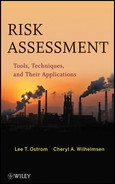
Risk assessment : tools, techniques, and their applications
All the tools needed to perform a thorough risk assessment-whether you're working in insurance, forensics, engineering, or public safety Risk analysis is the method of analyzing the dangers to individuals, businesses, and government agencies posed by potential natural and man-made hazards. The central task of the risk assessor is predicting the success of a project. This includes isolating the entire spectrum of adverse events that can derail a project or threaten the health and safety of individuals, organizations, and the environment. Designed as a practical, in-the-field toolkit, Risk Assessment details every aspect of how a risk assessment is performed, showing the proper tool to be used at various steps in the process, as well as locating the tool that best fits the risk assessment task at hand. Examining not only the very nature of risks and consequences, with fascinating historical examples, the book progresses from simple to more complex risk assessment techniques used by the authors in their daily work, all presented in a form that can be readily adapted to any number of real-life situations: Ecological Risk Assessment Task Analysis Techniques Preliminary Hazards Analysis Failure Mode and Effects Analysis Human Reliability Analysis Critical Incident Technique With numerous industry-specific case studies, as well as additional case studies for risk assessments for a restaurant and a process plant, the book provides readers with complete examples of how each of the techniques can be used in a variety of real-world situations. Including downloadable worksheets and other useful assessment materials, as well as guidance on using PRA software, this unparalleled reference offers all the tools and techniques needed to conduct a thorough and accurate assessment of risk.
eBook
Uncertainty in risk assessment
Explores methods for the representation and treatment of uncertainty in risk assessment In providing guidance for practical decision-making situations concerning high-consequence technologies (e.g., nuclear, oil and gas, transport, etc.), the theories and methods studied in Uncertainty in Risk Assessment have wide-ranging applications from engineering and medicine to environmental impacts and natural disasters, security, and financial risk management. The main focus, however, is on engineering applications. While requiring some fundamental background in risk assessment, as well as a basic knowledge of probability theory and statistics, Uncertainty in Risk Assessment can be read profitably by a broad audience of professionals in the field, including researchers and graduate students on courses within risk analysis, statistics, engineering, and the physical sciences. Uncertainty in Risk Assessment: * Illustrates the need for seeing beyond probability to represent uncertainties in risk assessment contexts. * Provides simple explanations (supported by straightforward numerical examples) of the meaning of different types of probabilities, including interval probabilities, and the fundamentals of possibility theory and evidence theory. * Offers guidance on when to use probability and when to use an alternative representation of uncertainty. * Presents and discusses methods for the representation and characterization of uncertainty in risk assessment. * Uses examples to clearly illustrate ideas and concepts.
eBook
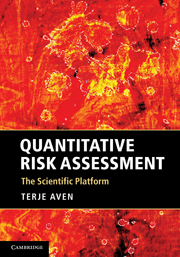
Quantitative Risk Assessment
Quantitative risk assessments cannot eliminate risk, nor can they resolve trade-offs. They can, however, guide principled risk management and reduction - if the quality of assessment is high and decision makers understand how to use it. This book builds a unifying scientific framework for discussing and evaluating the quality of risk assessments and whether they are fit for purpose. Uncertainty is a central topic. In practice, uncertainties about inputs are rarely reflected in assessments, with the result that many safety measures are considered unjustified. Other topics include the meaning of a probability, the use of probability models, the use of Bayesian ideas and techniques, and the use of risk assessment in a practical decision-making context. Written for professionals, as well as graduate students and researchers, the book assumes basic probability, statistics and risk assessment methods. Examples make concepts concrete, and three extended case studies show the scientific framework in action.
eBook

Mathematics and statistics for financial risk management
Mathematics and Statistics for Financial Risk Management is a practical guide to modern financial risk management for both practitioners and academics.Now in its second edition with more topics, more sample problems and more real world examples, this popular guide to financial risk management introduces readers to practical quantitative.
eBook
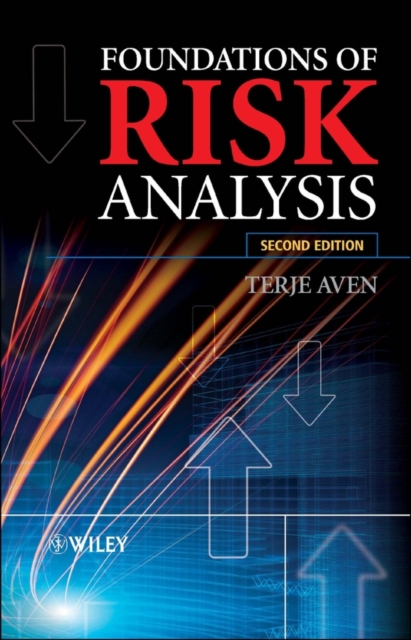
Foundations of risk analysis
Foundations of Risk Analysis presents the issues core to risk analysis - understanding what risk means, expressing risk, building risk models, addressing uncertainty, and applying probability models to real problems.
eBook