
Catalogue Search | MBRL


Are you sure you want to remove the book from the shelf?

{{itemTitle}}
248
result(s) for
"Roadside architecture."
Sort by:

Totally wacky roadside attractions
\"Introduces the reader to wacky roadside attractions\"-- Provided by publisher.
Book
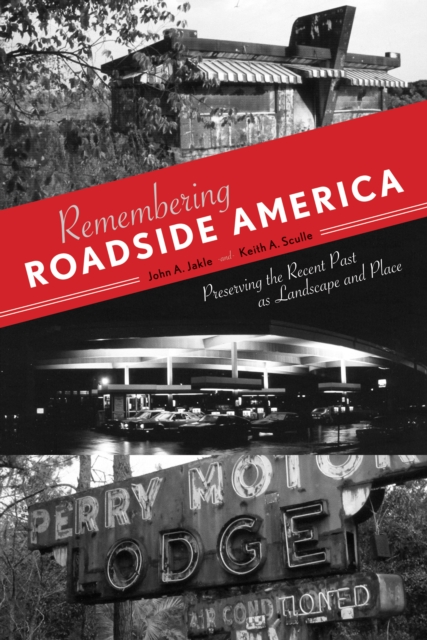
Remembering Roadside America
The use of cars and trucks over the past century has remade
American geography—pushing big cities ever outward toward
suburbanization, spurring the growth of some small towns while
hastening the decline of others, and spawning a new kind of
commercial landscape marked by gas stations, drive-in
restaurants, motels, tourist attractions, and countless other
retail entities that express our national love affair with the
open road. By its very nature, this landscape is ever changing,
indeed ephemeral. What is new quickly becomes old and is soon
forgotten. In this absorbing book, John Jakle and Keith Sculle
ponder how “Roadside America” might be remembered,
especially since so little physical evidence of its earliest
years survives. In straightforward and lively prose,
supplemented by copious illustrations—historic and modern
photographs, advertising postcards, cartoons,
roadmaps—they survey the ways in which automobility has
transformed life in the United States. Asking how we might best
commemorate and preserve this part of our past—which has
been so vital economically and politically, so significant to
the cultural aspirations of ordinary Americans, yet so often
ignored by scholars who dismiss it as kitsch—they propose
the development of an actual outdoor museum that would treat
seriously the themes of our roadside history. Certainly,
museums have been created for frontier pioneering, the rise of
commercial agriculture, and the coming of water- and
steam-powered industrialization and transportation, especially
the railroad. Is now not the time, the authors ask, for a
museum forcefully exploring the automobile’s emergence
and the changes it has brought to place and landscape? Such a
museum need not deny the nostalgic appeal of roadsides past,
but if done properly, it could also tell us much about what the
authors describe as “the most important kind of place yet
devised in the American experience.”
John A. Jakle is Emeritus Professor of Geography at the
University of Illinois, Urbana-Champaign. Keith A. Sculle is
the former head of research and education at the Illinois
Historic Preservation Agency. They have coauthored such books
as
America’s Main Street Hotels: Transiency and
Community in the Early Automobile Age; Motoring: The Highway
Experience in America; Fast Food: Roadside Restaurants in the
Automobile Age; and
The Gas Station in America.
eBook

Preserving Our Not-So-Distant Past? Chester Liebs’s contribution to the ‘archaeology’ of the everyday
The paper retraces part of the career of Chester Liebs (b. 1945), a multifaceted figure in twentieth-century American heritage preservation. A landscape historian, preservationist, and professor, Liebs is a photographic chronicler of U.S. cultural landscapes. Just a decade after the passage of the National Historic Preservation Act (1966), he issued a call for the field to broaden its scope, which led to the founding of the still-active Society for Commercial Archeology in 1977. Drawing parallels with industrial archaeology, he argued for the patrimonial value of commercial roadside forms – fast-food outlets, motels, gas stations, neon signs – structures vanishing yet increasingly appreciated. His landmark book Main Street to Miracle Mile (1985) advanced the idea of preserving not only individual buildings but also the wider landscapes shaped by car culture. Drawing on dialogue with Liebs, the essay examines his work and theories, tracing the connections and forces that contributed to shaping one strand of American cultural orientations toward the legacy of the recent past.
Journal Article


Minnesota Marvels
Only in Minnesota can you snap a Polaroid of a fifty-five-foot-tall grinning green man with a size seventy-eight shoe or marvel at the spunk of a Swede who dedicated his life to spinning a gigantic ball of twine. Minnesota Marvels is a tour of the inspired, bizarre, sometimes gruesome, brilliant, scandalous, and funny sites around the state. Conveniently organized by town name and illustrated throughout, Minnesota Marvels is the perfect light-hearted guide for entertaining road trips. _x000B_
eBook

Roadside Crosses in Contemporary Memorial Culture
A fifteen-year-old high school cheerleader is killed while driving on a dangerous curve one afternoon. By that night, her classmates have erected a roadside cross decorated with silk flowers, not as a grim warning, but as a loving memorial. In this study of roadside crosses, the first of its kind, Holly Everett presents the history of these unique commemoratives and their relationship to contemporary memorial culture. The meaning of these markers is presented in the words of grieving parents, high school students, public officials, and private individuals whom the author interviewed during her fieldwork in Texas. Everett documents over thirty-five memorial sites with twenty-five photographs representing the wide range of creativity. Examining the complex interplay of politics, culture, and belief, she emphasizes the importance of religious expression in everyday life and analyzes responses to death that this tradition. Roadside crosses are a meeting place for communication, remembrance, and reflection, embodying on-going relationships between the living and the dead. They are a bridge between personal and communal pain–and one of the oldest forms of memorial culture. Scholars in folklore, American studies, cultural geography, cultural/social history, and material culture studies will be especially interested in this study.
eBook

Balaenoptera musculus
Proctor shares an extraordinary encounter when a real blue whale breached in Moss Landing CA during the filming of a BBC nature program called Big Blue. For their scope, songs, mystery and mythology, ferocity and vulnerability, whales have inspired writers from Melville to William Steig. Once you start thinking about whales, you find them (or echoes of them) everywhere. The whale's TV cameo represented a radical accomplishment by conservationists and the sublime endurance of nature.
Journal Article


Moore Unmoored
Charles Moore's 1960s writings craft a theory of architecture and landscape jammed with the insights of the theme park, roadside attraction, and freeway. Moore dismissed formal architectural languages, like the Beaux Arts or International Style, but didn't seek alternative inspiration in either sci-fi technology or low-fi agrarian crafts. Presaging the postmodern, he sought out buildings and landscapes that resounded the swagger of pop culture. Reading his texts, we bear witness to a sensual groping for particulars, and, quite often, peculiarities, in a California culture obsessed with the end of continent and containment.
Journal Article