
Catalogue Search | MBRL


Are you sure you want to remove the book from the shelf?

{{itemTitle}}
1,438
result(s) for
"Robotics Social aspects."
Sort by:


Robot Ethics
Robots today serve in many roles, from entertainer to educator to executioner. As robotics technology advances, ethical concerns become more pressing: Should robots be programmed to follow a code of ethics, if this is even possible? Are there risks in forming emotional bonds with robots? How might society--and ethics--change with robotics? This volume is the first book to bring together prominent scholars and experts from both science and the humanities to explore these and other questions in this emerging field. Starting with an overview of the issues and relevant ethical theories, the topics flow naturally from the possibility of programming robot ethics to the ethical use of military robots in war to legal and policy questions, including liability and privacy concerns. The contributors then turn to human-robot emotional relationships, examining the ethical implications of robots as sexual partners, caregivers, and servants. Finally, they explore the possibility that robots, whether biological-computational hybrids or pure machines, should be given rights or moral consideration. Ethics is often slow to catch up with technological developments. This authoritative and accessible volume fills a gap in both scholarly literature and policy discussion, offering an impressive collection of expert analyses of the most crucial topics in this increasingly important field.
eBook

Rule of the robots : how artificial intelligence will transform everything
\"If you have a smartphone, you have AI in your pocket. It's everywhere online. And it has already changed how doctors diagnose disease as well as how you interact with friends or read the news. But In Rule of the Robots, Silicon Valley tech entrepreneur Martin Ford argues that true disruption is yet to come, as AI ceases to be a tool applied to specific problems, and becomes a utility: the industrial foundation upon which practically all activity-personal, economic, and political-is based. Ford calls it an \"electricity of intelligence.\" Not so long ago, running a machine required animals, or access to water, and was completely unportable. Electricity turned power into a utility-something cheap and omnipresent. The change enabled us to do work wherever we wanted, and it radically altered every aspect of life, from our diets to our jobs to our entertainment. In Rule of the Robots, Ford shows how AI-heretofore as specialized as a water mill was 200 years ago-is breaking free from its bonds, becoming as ubiquitous and simple to use as a power jack and an extension cord. No one would begin any enterprise, no matter how minor, without power or running water. Ford argues the same will go for AI in the future: the police will rely on it as they surveil us; our business partners as they decide how to work with us and their own customers; schools as they weigh how to teach our children; and probably even you, as you try to juggle the tasks of work and home. This is no mere tech tour of today. Ford has already proven incredibly prescient about the future of AI and work in Rise of the Robots. Thanks to his connections in the AI community, Ford isn't simply reporting on tools, like deep neural networks, that already exist: he is able to map out the course of the technology's future as well; who's full of hot air and who might delivery on what they've promised. That access enables him to see what is likely to change in the near term, and what will take longer, giving us time to implement the necessary political and social measures to ensure that society shapes its own future, rather than simply being driven by the consequences of our technology. Those consequences will be profound. Running water eradicated a great many diseases from our midst, and electricity banished darkness. Ubiquitous AI promises empowerment, but it also threatens to infantilize us. In the right hands, as Ford shows, AI should help us best coronavirus and escape the worst consequences of climate change. In the wrong ones, it will empower totalitarianism and put us all out of work. We are in the midst of the ultimate disruption. Rule of the Robots is the essential guide to not just whether we thrive in it, but even if we just manage to survive\"-- Provided by publisher.
Book

Robots Won't Save Japan
Robots Won't Save Japan
addresses the Japanese government's efforts to develop care
robots in response to the challenges of an aging population, rising
demand for eldercare, and a critical shortage of care
workers. Drawing on ethnographic research at key sites of
Japanese robot development and implementation, James Wright reveals
how such devices are likely to transform the practices,
organization, meanings, and ethics of caregiving if implemented at
scale.
This new form of techno-welfare state that Japan is prototyping
involves a reconfiguration of care that deskills and devalues care
work and reduces opportunities for human social interaction and
relationship building. Moreover, contrary to expectations that care
robots will save labor and reduce health care expenditures, robots
cost more money and require additional human labor to tend to the
machines. As Wright shows, robots alone will not rescue Japan from
its care crisis. The attempts to implement robot care instead point
to the importance of looking beyond such techno-fixes to consider
how to support rather than undermine the human times, spaces, and
relationships necessary for sustainably cultivating good care.
eBook


Gaze in Human-Robot Communication
Gaze in Human-Robot Communication is a volume collecting recent research studying gaze behaviour in human-robot interaction (HRI). The selected articles draw inspiration from related research into gaze in human-human interaction in fields ranging from ethnography to neuroscience. The major themes of these articles include: the experimental investigation of human responses to robot gaze, the investigation of the impact of coordinating gaze acts with speech, and the development of hardware and software technologies for enabling robot gaze. This volume provides an excellent introduction to the depth and breadth of this growing research area in HRI. The highly interdisciplinary nature of the work presented should make it of interest both to robotics researchers and to researchers from other fields with an interest in the role of gaze in communication.Originally published in Interaction Studies Vol. 14:3 (2013).
eBook

Living with robots
Living with Robots recounts a foundational shift in the field of robotics, from artificial intelligence to artificial empathy, and foreshadows an inflection point in human evolution. Today's robots engage with human beings in socially meaningful ways, as therapists, trainers, mediators, caregivers, and companions. Social robotics is grounded in artificial intelligence, but the field's most probing questions explore the nature of the very real human emotions that social robots are designed to emulate. Social roboticists conduct their inquiries out of necessity--every robot they design incorporates and tests a number of hypotheses about human relationships. Paul Dumouchel and Luisa Damiano show that as roboticists become adept at programming artificial empathy into their creations, they are abandoning the conventional conception of human emotions as discrete, private, internal experiences. Rather, they are reconceiving emotions as a continuum between two actors who coordinate their affective behavior in real time. Rethinking the role of sociability in emotion has also led the field of social robotics to interrogate a number of human ethical assumptions, and to formulate a crucial political insight: there are simply no universal human characteristics for social robots to emulate. What we have instead is a plurality of actors, human and nonhuman, in noninterchangeable relationships. As Living with Robots shows, for social robots to be effective, they must be attentive to human uniqueness and exercise a degree of social autonomy. More than mere automatons, they must become social actors, capable of modifying the rules that govern their interplay with humans.-- Provided by publisher
Book
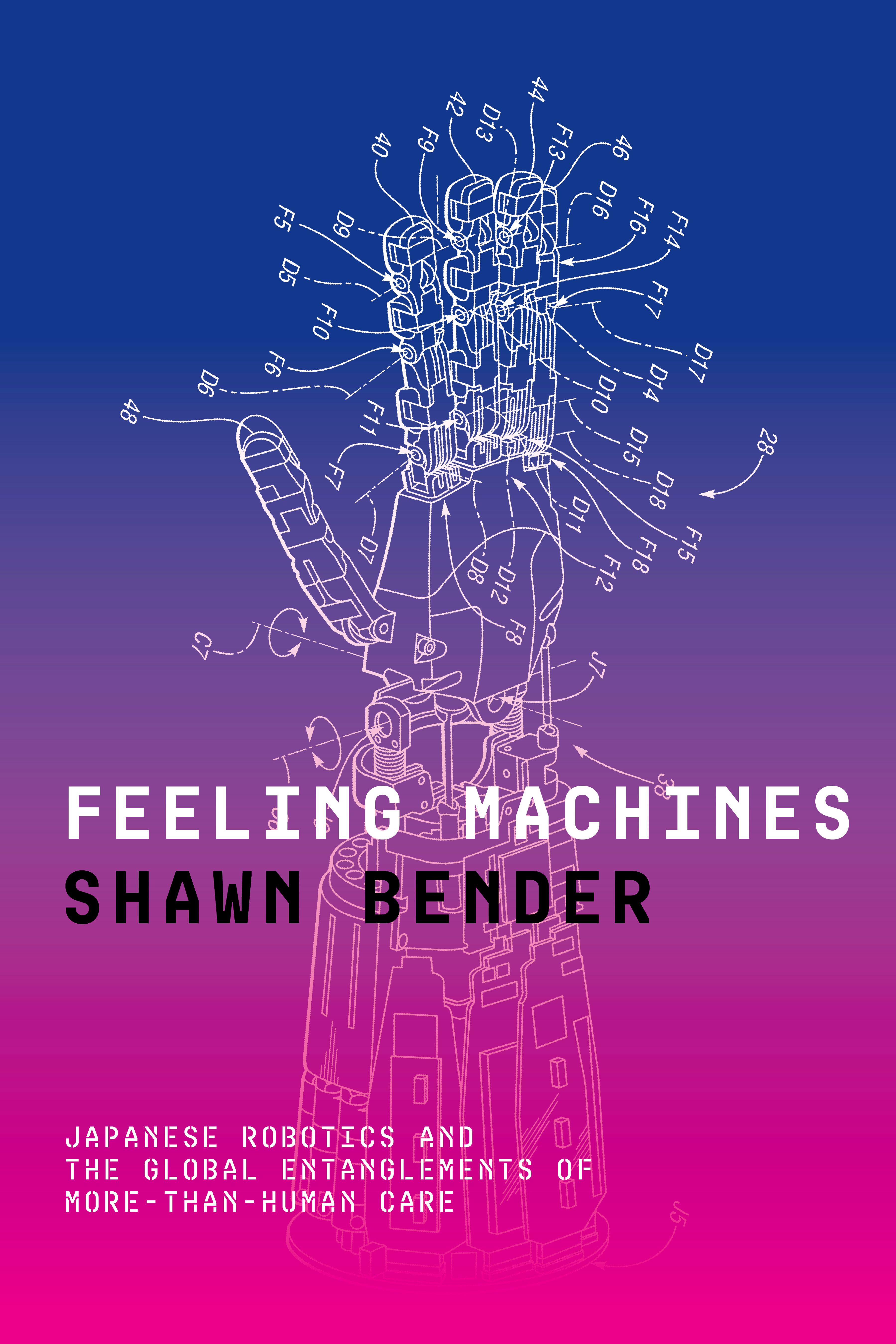
Feeling machines : Japanese robotics and the global entanglements of more-than-human care
In recent years, debates over healthcare have accompanied rapid advances in technology, from the expansion of telehealth services to artificial intelligence driven diagnostics. In this book, Shawn Bender delves into the world of Japanese robots engineered for care. Care robots (kaigo robotto) emerged early in the 21st century, when roboticists began converting assembly line technologies into responsive machines for older adults and people with disabilities. These robots are meant to be felt and programmed to feel. While some greet them with enthusiasm, others fear that they might replace a fundamentally human task. Based on fieldwork in Japan, Denmark, and Germany, Bender traces the emergence of care robots in Japan and examines their impact on therapeutic practice around the world. Social science scholarship on robotics tends to be either speculative—imagining life together with robots—or experimental—observing robot-human interaction in laboratories or through short-term field studies. Instead, Bender follows roboticists developing technologies in Japan, and travels with the robots themselves into everyday sites of care, tracking the integration of robots into institutional care and the connection of care practice to robotics development. By exploring the application of Japanese robotics across the globe, Feeling Machines highlights the entanglements of therapeutic practice and technological innovation in an age of more-than-human care.
eBook


Tecnología, robótica y sus implicaciones éticas
Tecnología, robótica y sus implicaciones éticas.
eBook