
Catalogue Search | MBRL


Are you sure you want to remove the book from the shelf?

{{itemTitle}}
176
result(s) for
"Robots autonomes."
Sort by:

Sensory systems for robotic applications
Thanks to advances in sensing and computer vision technologies, robots can be found today in healthcare, medicine and the industry. Topics covered in this edited book include various types of sensors used in robotics, sensing schemes, sensing technologies and their applications including robotics, prosthetics, wearables and healthcare. Written for those working in robotics, sensor technologies and electronics, and their applications in robotics, haptics, prosthetics, wearable and interactive systems, cognitive engineering, neuro-engineering, computational neuroscience, medicine, and healthcare technologies.
BOOK

Artificial Intelligence in Wireless Robotics
Robots, autonomous vehicles, unmanned aerial vehicles, and smart factory, will significantly change human living style in digital society. Artificial Intelligence in Wireless Robotics introduces how wireless communications and networking technology enhances facilitation of artificial intelligence in robotics, which bridges basic multi-disciplinary knowledge among artificial intelligence, wireless communications, computing, and control in robotics. A unique aspect of the book is to introduce applying communication and signal processing techniques to enhance traditional artificial intelligence in robotics and multi-agent systems. The technical contents of this book include fundamental knowledge in robotics, cyber-physical systems, artificial intelligence, statistical decision and Markov decision process, reinforcement learning, state estimation, localization, computer vision and multi-modal data fusion, robot planning, multi-agent systems, networked multi-agent systems, security and robustness of networked robots, and ultra-reliable and low-latency machine-to-machine networking. Examples and exercises are provided for easy and effective comprehension. Engineers wishing to extend knowledge in the robotics, AI, and wireless communications, would be benefited from this book. In the meantime, the book is ready as a textbook for senior undergraduate students or first-year graduate students in electrical engineering, computer engineering, computer science, and general engineering students. The readers of this book shall have basic knowledge in undergraduate probability and linear algebra, and basic programming capability, in order to enjoy deep reading.
eBook

Robotic Navigation and Mapping with Radar
Focusing on autonomous robotic applications, this cutting-edge resource offers you a practical treatment of short-range radar processing for reliable object detection at the ground level. This unique book demonstrates probabilistic radar models and detection algorithms specifically for robotic land vehicles. It examines grid based robotic mapping with radar based on measurement likelihood estimation. You find detailed coverage of simultaneous localization and Map Building (SLAM) - an area referred to as the Holy Grailù of autonomous robotic research. The book derives an extended Kalman Filter SLAM algorithm which exploits the penetrating ability of radar. This algorithm allows for the observation of visually occluded objects, as well as the usual directly observed objects, which contributes to a robot 's position and the map state update. Moreover, you discover how the Random Finite Set (RFS) provides a more appropriate approach for representing radar based maps than conventional frameworks.
eBook
AI and IoT-Based Intelligent Automation in Robotics
The 24 chapters in this book provides a deep overview of robotics and the application of AI and IoT in robotics.It contains the exploration of AI and IoT based intelligent automation in robotics.The various algorithms and frameworks for robotics based on AI and IoT are presented, analyzed, and discussed.
eBook
New Autonomous Systems
The idea of autonomous systems that are able to make choices according to properties which allow them to experience, apprehend and assess their environment is becoming a reality. These systems are capable of auto-configuration and self-organization. This book presents a model for the creation of autonomous systems based on a complex substratum, made up of multiple electronic components that deploy a variety of specific features. This substratum consists of multi-agent systems which act continuously and autonomously to collect information from the environment which they then feed into the global system, allowing it to generate discerning and concrete representations of its surroundings. These systems are able to construct a so-called artificial corporeity which allows them to have a sense of self, to then behave autonomously, in a way reminiscent of living organisms.
eBook
Data Mining for Social Robotics
This book explores an approach to social robotics based solely on autonomous unsupervised techniques and positions it within a structured exposition of related research in psychology, neuroscience, HRI, and data mining. The authors present an autonomous and developmental approach that allows the robot to learn interactive behavior by imitating.
eBook
Robot wars
This documentary, produced by Mark Horstman, is about a competition for autonomous robots.
Streaming Video

Le temps des robots est-il venu ?
« Un robot dans chaque foyer ». Voilà ce que prédit Bill Gates pour les années à venir ! Mais au fait, d'où viennent ces robots qui s'invitent chaque jour un peu plus dans notre vie quotidienne ? Tâches domestiques, transports, loisirs, soins... lesquels en font déjà partie intégrante ? Sont-ils plus performants que les humains ? Emploi, sécurité, relations humaines... : peuvent-ils s'avérer dangereux ? Et à l'avenir, jusqu'où iront-ils ? Autant de questions auxquelles cet ouvrage apporte des réponses, basées sur des entretiens avec des roboticiens et informaticiens reconnus.
eBook
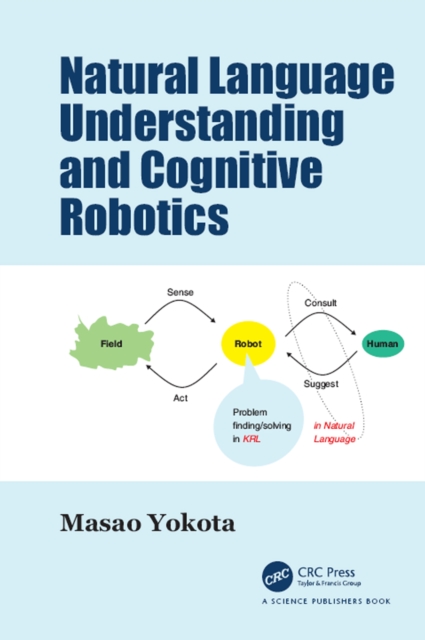
Natural Language Understanding and Cognitive Robotics
In the not so distant future, we can expect a world where humans and robots coexist and interact with each other. For this to occur, we need to understand human traits, such as seeing, hearing, thinking, speaking, etc., and institute these traits in robots. The most essential feature necessary for robots to achieve is that of integrative multimedia understanding (IMU) which occurs naturally in humans. It allows us to assimilate pieces of information expressed through different modes such as speech, pictures, gestures, etc.
The book describes how robots acquire traits like natural language understanding (NLU) as the central part of IMU. Mental image directed semantic theory (MIDST) is its core, and is based on the hypothesis that NLU is essentially the processing of mental image associated with natural language expressions, namely, mental-image based understanding (MBU). MIDST is intended to model omnisensory mental image in human and to afford a knowledge representation system in order for integrative management of knowledge subjective to cognitive mechanisms of intelligent entities such as humans and robots based on a mental image model visualized as ‘Loci in Attribute Spaces’ and its description language L md (mental image description language) to be employed for predicate logic with a systematic scheme for symbol-grounding. This language works as an interlingua among various kinds of information media, and has been applied to several versions of the intelligent system interlingual understanding model aiming at general system (IMAGES). Its latest version, i.e. conversation management system (CMS) simulates MBU and comprehends the user’s intention through dialogue to find and solve problems, and finally, provides a response in text or animation.
The book is aimed at researchers and students interested in artificial intelligence, robotics, and cognitive science. Based on philosophical considerations, the methodology will also have an appeal in linguistics, psychology, ontology, geography, and cartography.
Key Features:
Describes the methodology to provide robots with human-like capability of natural language understanding (NLU) as the central part of IMU
Uses methodology that also relates to linguistics, psychology, ontology, geography, and cartography
Examines current trends in machine translation
Table of Contents:
Introduction
Anna - an ideal home robot
Intuitive human-robot interaction
Integrative multimedia understanding and natural language understanding
Knowledge and cognition
Natural Language Processing Viewed from Semantics
Trends in machine translation
Case study of current MT systems (as of October, 2018)
Fundamentals for Robotic NLU
NLU in accordance with semiotics
Syntactic analysis
Semantic analysis and pragmatic analysis
Robust NLU
Response synthesis
Syntax and semantics of discourse
Cognitive Essentials for Midst
Functional model of human mind
Human knowledge and cognitive propensities
Semantics and mental image
QSIs (quasi-symbolic images) and human concept system
Primitive quasi-symbolic images
Perception of causality
Semantic articulation and QSI connectors
Negation of mental image
Imaginary space region
Computational Model of Mental Image
Atomic locus as primitive QSI
Temporal conjunctions as QSI connectors
Empty event
Attributes and Standards
Formal System
Semantic principle of L md
Syntax of L md
Tempo-logical connectives
Formulation of event concepts
Formulation of laws of the world
Fundamental Postulates and Inference Rules for Deductive System
Properties of Loci
Inference rules for deduction
Tempo-logical deduction with TLCs
Human-Specific Semantics of 4d Language as Mental Images
Conventional approaches to 4D language understanding
4D language semantics as mental images
Formulation of concepts of spatial prepositions
Properties of static 4D concepts as human intuitive mental images
Reversal operation on spatial change event concepts as mental images
Problem Finding and Solving in Formal System
Definition of problem and task
Creation problem finding and solving
Maintenance problem finding and solving
Human Language Understanding by Robots
Two-staged robotic NLU
Robotic concept system for iHRI
Compound concept system for robots
Robot manipulation as cross-media operation via L md
Aware computing in robots
Homogeneous/Inhomogeneous Communication
4d Language Understanding for Cognitive Robotics
Requirements for robotic NLU
Logical Adequacy of L md
Translation between NL and L md
Reasoning in L md
Anchoring via L md
Behavioralization via L md
Systematic interpretation of L md
Multilingual Operation Via L md
Meaning definition
Optimization of grammatical description for word meaning definition
Language operation via L md
Question answering through L md
Computational Model of Japanese for NLU
Brief description of basic Japanese
Phrase structure grammar for Japanese
Dependency grammar for Japanese
Sentence and discourse of Japanese
Sentence types of Japanese and phrasing
Implementation of Mental-Image Based Understanding
Configuration of CMS
MBU versus conventional NLU
Stimulus sentences to CMS and human subjects
Mental image based understanding by CMS
Problem finding and solving in CMS
Awareness control of CMS
Conclusions
References
This is an excellent resource for scientists and engineers looking to develop a deep natural language understanding system for application in robotics, currently one of the most critical areas of development for artificial intelligence technologies. The book is very well written and easy to follow for readers with a good background in artificial intelligence or natural language processing. The considerable number of examples and diagrams included make this volume particularly valuable for students. The examples illustrating machine understanding of Japanese offer an exciting bonus for readers engaged in machine translation or computational linguistics.
-- J. Brzezinski, McHenry County College, Choice, 2020 Vol. 58 No. 2
Masao Yokota received a Bachelor degree from Kyushu Institute of Technology, and Master and Doctor degrees from Kyushu University. He is now a professor of informatics at Fukuoka Institute of Technology. His research focus is on AI, especially in integrative multimedia understanding by robots in being as 'natural' as humans where natural language understanding (NLU) plays the central role. He has proposed 'Mental Image Directed Semantic Theory (MIDST)' based on a hypothesis that NLU in humans is mental image processing. MIDST provides an omnisensory mental image model and a formal language called ' L md (Language for Mental Image Description)'. This formal language has been already implemented on several versions of the intelligent system IMAGES including integrative multimedia understanding system IMAGES-M and conversation management system CMS. Dr. Yokota has authored numerous articles on AI and was the leader of many projects funded by Ministry of Education, Culture, Sports, Science and Technology, Japan (MEXT), and Fukuoka Institute of Technology (FIT).
eBook
Designing mobile autonomous robots
Designing Autonomous Mobile Robots introduces the reader to the fundamental concepts of this complex field. The author addresses all the pertinent topics of the electronic hardware and software of mobile robot design, with particular emphasis on the more difficult problems of control, navigation, and sensor interfacing. Covering topics such as advanced sensor fusion, control systems for a wide array of application sensors and instrumentation, and fuzzy logic applications, this volume is essential reading for engineers undertaking robotics projects as well as undergraduate and graduate students studying robotic engineering, artificial intelligence, and cognitive science. Its state-of-the-art treatment of core concepts in mobile robotics helps and challenges readers in exploring new avenues in an exciting field. The accompanying CD-ROM provides software routines for the examples cited as well as an electronic version of the text. *Authored by a well-know pioneer of mobile robotics*Learn how to approach the design of and complex control system with confidence
eBook