
Catalogue Search | MBRL


Are you sure you want to remove the book from the shelf?

{{itemTitle}}
260
result(s) for
"Rodgers and Hart"
Sort by:

The Musical as Drama
Derived from the colorful traditions of vaudeville, burlesque, revue, and operetta, the musical has blossomed into America's most popular form of theater. Scott McMillin has developed a fresh aesthetic theory of this underrated art form, exploring the musical as a type of drama deserving the kind of critical and theoretical regard given to Chekhov or opera. Until recently, the musical has been considered either an \"integrated\" form of theater or an inferior sibling of opera. McMillin demonstrates that neither of these views is accurate, and that the musical holds true to the disjunctive and irreverent forms of popular entertainment from which it arose a century ago. Critics and composers have long held the musical to the standards applied to opera, asserting that each piece should work together to create a seamless drama. But McMillin argues that the musical is a different form of theater, requiring the suspension of the plot for song. The musical's success lies not in the smoothness of unity, but in the crackle of difference. While disparate, the dancing, music, dialogue, and songs combine to explore different aspects of the action and the characters. Discussing composers and writers such as Rodgers and Hammerstein, Stephen Sondheim, Kander and Ebb, Leonard Bernstein, and Jerome Kern, The Musical as Drama describes the continuity of this distinctively American dramatic genre, from the shows of the 1920s and 1930s to the musicals of today.
eBook

We'll have Manhattan : the early work of Rodgers and Hart
Richard Rodgers and Lorenz Hart collaborated on more than forty shows before Hart’s death, contributing dozens of classic song hits to the Great American Songbook. This book focuses on the early period of their collaboration, before the huge successes of the 1930s. From 1919, when they met, until their brief flirtation with Hollywood in the early thirties, their output was prodigious, progressive, and experimental. During this period they developed their style and an approach to writing musicals that would be fundamental to the development of the form. Despite this, despite their numerous celebrated songs and the many Broadway and West End successes they enjoyed, the 1920s shows remain little known and important archives of their work little explored. Not just a historical study of their first collaborative years, this book also offers an accessible but authoritative study of their material, documenting the early shows and providing a critical and analytical commentary on their songwriting practice and its influence on the subsequent development of the American musical. In particular, the book explores three main themes: the way they developed a language of song whose techniques anticipate the development of the integrated musical; the way they increasingly understood their work as part of an industry, accommodating the needs of production into their creative practice; and the way their individual characters emerge throughout their careers as formative influences on the shows they would create. With a supporting cast including Herb Fields, Lew Fields, George Gershwin, Busby Berkeley, and Florenz Ziegfeld, this book places Rodgers and Hart at the center of a burgeoning art form.
eBook

Lots going on at Stageloft // Musical celebration of Rodgers & Hart is well presented
STURBRIDGE - If you think your Friday night was eventful, compare it with what was happening at the Stageloft Repertory Theater in Sturbridge. Stageloft's production of \"Rodgers & Hart: A Musical Celebration\" gives credence to the adage that they don't write songs like that anymore. A talented cast of six performers moves gracefully, sometimes hilariously, through a portion of the famous repertoire crafted by composer Richard Rodgers and lyricist Lorenz Hart for Broadway and Hollywood. Songs \"like that\" may not be written anymore, but they're certainly worth reviving. This show is great fun, especially the way it will unexpectedly turn convention on its ear. For example, the traditional ballad \"Isn't It Romantic?\" is supplied a devilish twist, as the singers slide from one partner to another, always peering over the shoulder of their current lover for someone better to come along.
Newspaper Article
No call-waiting for cleric who uses drama as God's tool
The Rev. Eric K. Wefald heard the call to pursue a religious life early on, although the course of a true calling doesn't always run smoothly. \"I can remember (the call) when I was even 6 years old. But then I forgot. And it wasn't until I was in college that I remembered that calling, and a lot of other things came together, so it became clear that this was the way God wanted to use me,\" said Wefald, associate pastor of Good Shepherd Lutheran Church in Westboro. While he was being called to the ministry, Wefald received another calling at a young age. This, too, could be called dramatic. It was the call of the stage.
Newspaper Article
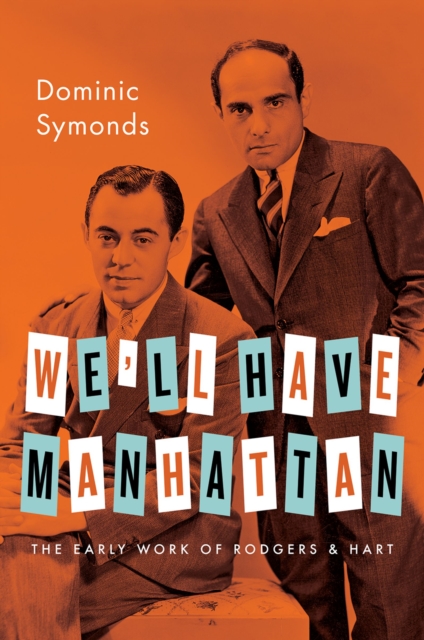
We'll have Manhattan: the early work of Rodgers and Hart, 1919-1931
Richard Rodgers and Lorenz Hart are one of the defining duos of musical theater, contributing dozens of classic songs to the Great American Songbook and working together on over 40 shows before Hart's death. With hit after hit on both Broadway and the West End, they produced many of the celebrated songs of the '20s and '30s--such as \"Manhattan,\" \"The Lady is a Tramp,\" and \"Bewitched\"--that remain popular favorites with great cultural resonance today. Yet the early years of these iconic collaborators have remained largely unexamined. We'll Have Manhattan: The Early Work of Rodgers Hart provides unprecedented insight into the first, formative period of Rodgers and Hart's collaboration. Author Dominic Symonds examines the pair and their work from their first meeting in 1919 to their brief flirtation with Hollywood in the early 1930s as they left the theater to explore sound film. During this time, their output was prodigious, progressive, and experimental. They developed their characteristic style and a new approach to musical theater writing that provided the groundwork for the development of the Broadway musical. Symonds also analyzes the theme of identity that runs throughout Rodgers and Hart's work, how the business side of the theater affected their artistic output, and their continued experimentation with a song's dramatic role within a narrative. We'll Have Manhattan goes beyond a biographical or historical look at Rodgers and Hart's early years--it's also an accessible but authoritative study of their material. Symonds documents their early shows and provides deft critical and analytical commentary on their evolving practice and its influence on the subsequent development of the American musical. Fans of musical theater and devotees of Rodgers and Hart will find this definitive exploration of their early works to be an essential addition to their Broadway library.
eBook

Balanchine’s “Bach Ballet” and the Dances of Rodgers and Hart’s On Your Toes
This article uncovers an unrealized “Bach Ballet” by choreographer George Balanchine previously unexamined by scholars of music or dance. Inspired by tap dancer Paul Draper and conceived of by Balanchine’s patron Lincoln Kirstein, this work is probably an early inspiration for the choreographer’s now iconic ballet Concerto Barocco (1941, set to J. S. Bach’s D-minor concerto for two violins, BWV 1043). This “Bach Ballet” provides an occasion to reevaluate the aesthetic and institutional stakes of Balanchine’s better-known endeavor from the same period: his well-regarded dances for Richard Rodgers and Lorenz Hart’s musical comedy On Your Toes, in which the worlds of classical music and ballet collide with popular music and dance. New insights into the dramaturgical function and reception of the dances in On Your Toes offer a way to revisit the show’s status as an early exemplar of “integrated” musical comedy and to understand the musical’s engagement with the phenomenon of Russian ballet in New Deal America. This essay analyzes the musical’s three dances—the Princess Zenobia ballet, the “On Your Toes” number, and the concluding Slaughter on Tenth Avenue—as an allegory of Balanchine’s Americanization as a choreographer. This complex of projects provides a fresh perspective on how Balanchine’s personal contact with a range of dancers (white and African-American, tap and ballet performers) affected his development as a choreographer and in the process helped realize, if inadvertently, the erstwhile goal of Balanchine and Kirstein’s ballet enterprise: to reinvent the art form in a native idiom.
Journal Article

