
Catalogue Search | MBRL


Are you sure you want to remove the book from the shelf?

{{itemTitle}}
39,210
result(s) for
"Rogers, John"
Sort by:

Psychology : essential thinkers, classic theories, and how they inform your world
Bridging the gap between the theoretical and real-life, Bonior looks at the biggest names, ideas, and studies in the history of psychology and translates their meaning to everyday situations and relationships.
Book

Including a Symposium on 50 Years of the Union for Radical Political Economics
Volume 37A of Research in the History of Economic Thought and Methodology features a symposium edited by Tiago Mata, celebrating 50 years of the Union of Radical Political Economics. It also includes an essay by Mauro Boianovsky, and is accompanied by a series of reflections from esteemed colleagues, all focused on Arthur Lewis and the classical foundation of development economics. The Volume further includes an important new archival contribution (edited and introduced by Malcolm Rutherford) from the papers of Alvin Hansen, in which the famous Harvard economist reflects on the contributions of his teacher, John R. Commons, on the occasion of the latter's 70th birthday in November 1932.
eBook
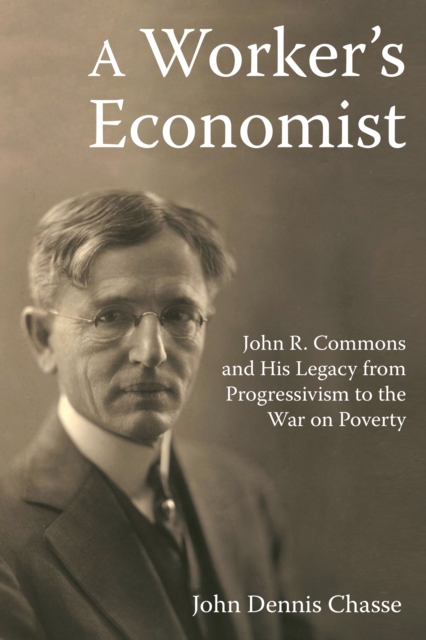
A Worker's Economist
John R. Commons is one of the few reformers of the past century whose major works are still actively read, whose ideas are still debated, and whose principles are still applied to the analysis of contemporary problems. His life spanned the years of America’s “Great Transformation,” from a nation of shopkeepers, farmers, and small towns to one of giant corporations, landless laborers, and crowded cities. He became involved in almost every aspect of America’s response to the damaging side effects of that transformation.
A Worker’s Economist begins with John Commons’ childhood and education and continues through his life as a scholar, teacher, administrator, and reformer. Commons’ list of accomplishments are great in number and overall effect. He worked on the staff of the first government commission to investigate the economic and social consequences of corporate mergers. He served as a public representative on the commission that investigated industrial violence and workplace relations. He was a participant observer in America’s largest and most historic mineworkers’ strike. He wrote and administered the nation’s first constitutional worker compensation law. He developed principles of social reform and public administration that his students carried into the design and administration of the Social Security system as well as Lyndon B. Johnson’s War on Poverty.
John Dennis Chasse reviews Commons’ major works, describes the people with whom he worked, and follows the fortunes of the unions that were intrinsic to his vision of “collective democracy.” As a final testament to Commons’ importance, Chasse considers his legacy as it endures in the work of his students and beyond.
A Worker's Economist: John R. Commons and His Legacy from Progressivism to the War on Poverty
\"This is an important book, actually a very important book. [...] There is much more one could say but hopefully enough to indicate this book demands attention. Bar a tiny repetition or two (probably to assist the reader), it is also an absolute pleasure to read.\"
-Michael Quinlan Emeritus Professor of Industrial Relations University of New South Wales, Sydney, Australia
John Dennis Chasse is professor emeritus of economics at State University of New York College at Brockport. He has been writing articles about John R. Commons since 1987.
eBook

The Bible Abbreviated: Summaries in Early Modern English Bibles
Early modern English Bibles are among the most significant texts in western Christianity. They contained the translation of the Bible into English and its authorisation, they facilitated the Protestant Reformation, and their effects on English Christianity and culture are felt vividly to this day. A vital facet of these editions are paratexts: the titles, summaries, glosses, and other non-canonical additions appended to scripture to aid its organisation and interpretation. Though neglected by literary, historical, and theological scholarship, these paratexts comprised huge portions of early modern Bibles and acted as productive vehicles to disseminate politics and theologies. One such form of paratext are the casus summarii, the chapter summaries that precede many chapters in early modern Bibles. In these summaries, significant biblical events or controversial subjects were condensed, omitted, reframed, rephrased, or otherwise represented to suit the editor’s purposes. This article provides the first survey of the chapter summaries in early modern English Bibles, with a table detailing the extent to which they were copied between editions. The article focuses on the Matthew, Geneva, and KJV Bibles, with additional discussion of the Coverdale, Great, and Bishops’ Bibles. The article addresses notable aspects of this material, including practices of translation, representations of Sodom, the anglicisation of names, and the sexualisation of Eve. By explicating the origins and influences of these summaries, this article facilitates the understanding and study of paratexts and demonstrates their importance to scholarship of early modern Christianity.
Journal Article

Including a Symposium on 50 Years of the Union for Radical Political Economics
Volume 37A of Research in the History of Economic Thought and Methodologyfeatures a symposium celebrating 50 years of the Union of Radical Political Economics, and includes an archival contribution from the papers of Alvin Hansen, reflecting on the influence and contributions of John R. Commons.
Book


John Searle
Direct, combative and wide-ranging, John Searle's philosophy has made fundamental and lasting contributions to thinking in language, mind, knowledge, truth and the nature of social reality. This title offers an introduction to Searle's philosophy, providing an exposition of Searles' ideas, while also testing and exploring their implications.
eBook

Captain John H.Rogers, Texas Ranger
John Harris Rogers served in Texas law enforcement for more than four decades. He is recognised in history as one of the legendary \"Four Captains\" of the Ranger force. Paul N. Spellman presents a full-length biography of this enigmatic man.
eBook


Captain John H. Rogers, Texas Ranger
John Harris Rogers (1863-1930) served in Texas law enforcement for more than four decades, as a Texas Ranger, Deputy and U.S. Marshal, city police chief, and in the private sector as a security agent. He is recognized in history as one of the legendary “Four Captains” of the Ranger force that helped make the transition from the Frontier Battalion days into the twentieth century, yet no one has fully researched and written about his life. Paul N. Spellman now presents the first full-length biography of this enigmatic man. During his years as a Ranger, Rogers observed and participated in the civilizing of West Texas. As the railroads moved out in the 1880s, towns grew up too quickly, lawlessness was the rule, and the Rangers were soon called in to establish order. Rogers was nearly always there. Likewise he participated in some of the most dramatic and significant events during the closing years of the Frontier Battalion: the Brown County fence cutting wars; the East Texas Conner Fight; the El Paso/Langtry Prizefight; the riots during the Laredo Quarantine; and the hunts for Hill Loftis and Gregorio Cortez. Rogers was the lawman who captured Cortez to close out one of the most infamous chases in Texas history. Unlike the more gregarious Bill McDonald, Captain Rogers had a quiet manner that kept him from the public limelight; nevertheless, he, John Brooks, and John Hughes shared the same experiences as McDonald during the almost two decades they led the Ranger companies. Unique to Rogers’ career was his devout Christian faith that was on display on almost all occasions. Rogers was wont to use the Bible as often as his six-gun, both with dramatic effect. That and his constant devotion to his family set him apart from the usual lawmen of that era. He was a man of the law and a man of God, a rare combination at the turn of the century.
eBook