
Catalogue Search | MBRL


Are you sure you want to remove the book from the shelf?

{{itemTitle}}
43
result(s) for
"Roman anglais -- 20e siècle -- Histoire et critique"
Sort by:

Circus of dreams : adventures in the 1980s literary world
\"Something extraordinary happened to the UK literary scene in the 1980s. In the space of eight years, a generation of young British writers took the literary novel into new realms of setting, subject matter and style, challenging - and almost eclipsing - the Establishment writers of the 1950s. It began with two names - Martin Amis and Ian McEwan - and became a flood: Julian Barnes, William Boyd, Graham Swift, Salman Rushdie, Jeanette Winterson and Pat Barker among them. The rise of the newcomers coincided with astonishing changes in the way books were published - and the ways in which readers bought them and interacted with their authors. Suddenly, authors of serious fiction were like rock stars, fashionable, sexy creatures, shrewdly marketed and feted in public...Through this exciting, hectic period, the journalist and author John Walsh played many parts: literary editor, reviewer, interviewer, prize judge and TV pundit. He met and interviewed numerous literary stars, attended the best launch parties and digested all the gossip and scandal of the time. In Circus of Dreams he reports on what he found, first with wide-eyed delight and then with a keen eye on what drove this glorious era. The result is a unique hybrid of personal memoir, oral history, literary investigation and elegy for a golden age.\" -- Provided by publisher.
Book

Bodies of Tomorrow
Anxieties about embodiment and posthumanism have always found an outlet in the science fiction of the day. In Bodies of Tomorrow , Sherryl Vint argues for a new model of an ethical and embodied posthuman subject through close readings of the works of Gwyneth Jones, Octavia Butler, Iain M. Banks, William Gibson, and other science fiction authors. Vint’s discussion is firmly contextualized by discussions of contemporary technoscience, specifically genetics and information technology, and the implications of this technology for the way we consider human subjectivity.
Engaging with theorists such as Michel Foucault, Judith Butler, Anne Balsamo, N. Katherine Hayles, and Douglas Kellner, Bodies of Tomorrow argues for the importance of challenging visions of humanity in the future that overlook our responsibility as embodied beings connected to a material world. If we are to understand the post-human subject, then we must acknowledge our embodied connection to the world around us and the value of our multiple subjective responses to it. Vint’s study thus encourages a move from the common liberal humanist approach to posthuman theory toward what she calls ‘embodied posthumanism.’ This timely work of science fiction criticism will prove fascinating to cultural theorists, philosophers, and literary scholars alike, as well as anyone concerned with the ethics of posthumanism.
eBook
Infernal Paradise
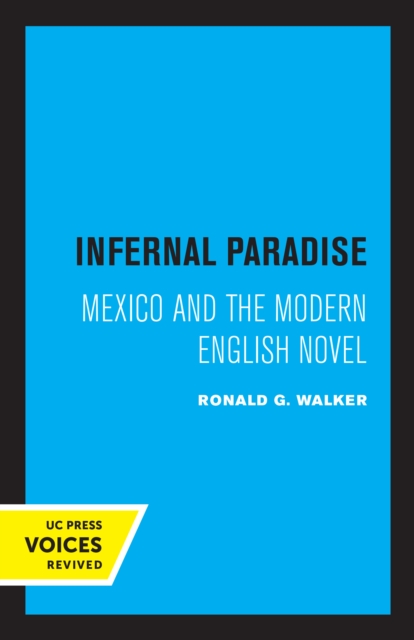
The allure of Mexico in modern English fiction is a compelling and underexplored subject, particularly in the works of D. H. Lawrence, Aldous Huxley, Evelyn Waugh, Graham Greene, and Malcolm Lowry. These authors, drawn to Mexico's mystique, crafted major novels that explore the country's unique cultural, social, and political landscape. Infernal Paradise examines how Mexico influenced their artistic visions and how their experiences in the country shaped significant literary works, such as The Plumed Serpent, Eyeless in Gaza, The Power and the Glory, and Under the Volcano. By delving into both the travel writings and novels of these authors, the analysis seeks to understand the dual processes of encountering Mexico firsthand and transforming those encounters into fiction. The book is structured to first contextualize the writers' fascination with Mexico, focusing on the country's dramatic landscapes, revolutionary ideals, and the enigmatic presence of its indigenous culture. The travel writings of Lawrence, Huxley, Greene, Waugh, and Lowry offer a bridge between their immediate experiences and the novels that followed, reflecting the initial reactions that evolved into deeper insights. The writers' personal motives for visiting Mexico--ranging from Lawrence's utopian dreams to Greene and Waugh's concern for the Catholic Church's plight under socialist policies--shaped their perceptions and creative responses. Through a detailed exploration of these travel accounts and the major novels, this book illuminates how Mexico became both an infernal and paradisiacal setting in the English literary imagination, a paradox that continues to resonate in these works. An appendix further enriches the discussion by examining Ralph Bates's The Fields of Paradise, adding another dimension to the \"infernal paradise\" theme in English fiction about Mexico. This
title is part of UC Press's Voices Revived program, which commemorates University of California Press's mission to seek out and cultivate the brightest minds and give them voice, reach, and impact. Drawing on a backlist dating to 1893, Voices Revived makes high-quality, peer-reviewed scholarship accessible once again using print-on-demand technology. This title was originally published in 1978. Many titles in the Voices Revived program are also newly available as ebooks, offered at a discounted price to support wider access to scholarly work.
eBook

The Cambridge Companion to British Fiction since 1945
This Companion offers a compelling engagement with British fiction from the end of the Second World War to the present day. Since 1945, British literature has served to mirror profound social, geopolitical and environmental change. Written by a host of leading scholars, this volume explores the myriad cultural movements and literary genres that have affected the development of postwar British fiction, showing how writers have given voice to matters of racial, regional and sexual identity. Covering subjects from immigration and ecology to science and globalism, this Companion draws on the latest critical innovations to provide insights into the traditions shaping the literary landscape of modern Britain, thus making it an essential resource for students and specialists alike.
eBook

Four contemporary novelists : Angus Wilson, Brian Moore, John Fowles, V.S. Naipaul
Four Contemporary Novelists offer accounts of the fiction of Angus Wilson, Brian Moore, John Fowles, and V. S. Naipaul. The author has charted the development of each writer; identified dominant themes, controlling techniques, and informing sensibility; explained what each has tried to accomplish and compare theory to practice; provided an appropriate context for appreciation and evaluation of all parts of each canon; and made qualitative discriminations.
eBook
Setting in the East
He shows that realism arrived comparatively late to the Maritime provinces and argues that the emergence of a realist style corresponded with a dramatic period of economic and cultural disruption during which the Eastern provinces were transformed from one Canada's most developed, prosperous, and promising regions into one characterized by chronic underemployment and underdevelopment. The region is thus torn between its memory of an earlier, more traditional social order and its present experience as a modern industrial society. These tensions are embedded in the Maritime character and have affected not only the lives of its people but the imaginations and texts of its writers. The stories of Thomas Raddall, Hugh MacLennan, Charles Bruce, Ernest Buckler, Alden Nowlan, Alistair MacLeod, Donna Smyth, Budge Wilson, and David Adams Richards have been deeply influenced by the cultural shifts they have observed. In the last two decades a host of new literary voices has emerged, and Creelman also explores the works of such writers as Ann-Marie MacDonald, Lynn Coady, Nancy Bauer, Deborah Joy Corey, Carol Bruneau, Alan Wilson, Leo McKay, and Sheldon Currie. He shows that these Maritime artists share a common regional identity that shapes their narratives as they find their own paths through the tensions which envelop them.
eBook

Narrative Settlements
During the interwar period, shifting attitudes toward empire dovetailed with women's achievement of citizenship, placing women at the centre of debates about what England would be. Responding to these cultural conditions, women writers used novels of place to analyze relationships among space, self, and nation in England, thereby establishing new ways for the country to view itself.
Jennifer Poulos Nesbitt'sNarrative Settlementsresituates British women's writing between the wars in light of postcolonial theories of the novel and feminist geography. Reading works by Winifred Holtby, Vita Sackville-West, Angela Thirkell, Sylvia Townsend Warner, Rebecca West, and Virginia Woolf, Nesbitt argues that renewed attention to setting provides a methodological base for a more nuanced understanding of the aesthetic preoccupations of women writers between the wars. She provides not only attentive readings of literature during this contentious time, but a convincing argument for looking beyond modernism to locate the significance of interwar literary production.
eBook

Be a Good Soldier
In the modern era, children experiencing grief were encouraged to dry their tears and ‘be good soldiers.’ How was this phenomenon interrogated and deconstructed in the period's literature? Be a Good Soldier initiates conversation on the figure of the child in modernist novels, investigating the demand for emotional suppression as manifested later in cruelty and aggression in adulthood.
Jennifer Margaret Fraser provides sophisticated close readings of key works by Joseph Conrad, Virginia Woolf, and James Joyce, among others who share striking concerns about the concept of infantry — both as a collection of infants, and as foot soldiers of war . A phenomenon associated traditionally with Freud, Fraser instead uses a unique, Derridean theoretical prism to provide new ways of understanding modernist concerns with power dynamics, knowledge, and meaning. Be a Good Soldier establishes a pioneering, nuanced vocabulary for further historical and cultural inquiries into modernist childhood.
eBook

Modernism and the Culture of Efficiency
Cobley's close readings of modernist British fiction by writers as diverse as Aldous Huxley, Joseph Conrad, and E.M. Forster identify characters whose attitudes and behaviour patterns indirectly manifest cultural anxieties that can be traced to the conflicted logic of efficiency.
eBook

Speculative Fictions
Herb Wyile provides a comparative analysis of the historical concerns and textual strategies of twenty novels published since the appearance of Rudy Wiebe's groundbreaking The Temptations of Big Bear in 1973. Drawing on the work of theorists and critics such as Hayden White, Mikhail Bakhtin, Fredric Jameson, Linda Hutcheon, and Michel De Certeau, Speculative Fictions examines the nature of these novels' engagement with Canadian history, historiography, and the writing of historical fiction.
eBook