
Catalogue Search | MBRL


Are you sure you want to remove the book from the shelf?

{{itemTitle}}
21,457
result(s) for
"Romance languages"
Sort by:


Social Variation and the Latin Language
Languages show variations according to the social class of speakers and Latin was no exception, as readers of Petronius are aware. The Romance languages have traditionally been regarded as developing out of a 'language of the common people' (Vulgar Latin), but studies of modern languages demonstrate that linguistic change does not merely come, in the social sense, 'from below'. There is change from above, as prestige usages work their way down the social scale, and change may also occur across the social classes. This book is a history of many of the developments undergone by the Latin language as it changed into Romance, demonstrating the varying social levels at which change was initiated. About thirty topics are dealt with, many of them more systematically than ever before. Discussions often start in the early Republic with Plautus, and the book is as much about the literary language as about informal varieties.
eBook

Gender from Latin to Romance : history, geography, typology
This book explores grammatical gender in the Romance languages and dialects and its evolution from Latin. Michele Loporcaro investigates the significant diversity found in the Romance varieties in this regard; he draws on data from the Middle Ages to the present from all the Romance languages and dialects, discussing examples from Romanian to Portuguese and crucially also focusing on less widely-studied varieties such as Sursilvan, Neapolitan, and Asturian. The investigation first reveals that several varieties display more complex systems than the binary masculine/feminine contrast familiar from modern French or Italian. Moreover, it emerges that traditional accounts, whereby neuter gender was lost in the spoken Latin of the late Empire, cannot be correct: instead, the neuter gender underwent a range of different transformations from Late Latin onwards, which are responsible for the different systems that can be observed today across the Romance languages. The volume provides a detailed description of many of these systems, which in turns reveals a wealth of fascinating data, such as varieties where 'husbands' are feminine and others where 'wives' are masculine; dialects in which nouns overtly mark gender, but only in certain syntactic contexts; and one Romance variety (Asturian) in which it appears that grammatical gender has split into two concurrent systems.
Book

Marking past tense in second language acquisition : a theoretical model
This book presents an analysis of the difficulties faced by native speakers of English in the learning of Romance languages and in so doing proposes a comprehensive model of the acquisition of tense-aspect marking. While L1 speakers of English may quickly learn to identify and, to some extent, use the Spanish perfective and imperfective verb endings, the L2 representation of tense-aspect distinctions among both beginning and advanced learners requires a comprehensive multidimensional analysis. Through a detailed examination of new and existing empirical data, this monograph proposes a new model for examining tense-aspect marking in second language acquisition, which reconciles competing, alternative hypotheses. This comprehensive account will be of interest to academics researching second language acquisition and applied linguistics.
eBook

Verb Second in medieval Romance
\"This volume provides the first book-length study of the controversial topic of Verb Second and related properties in a range of Medieval Romance varieties. It presents an examination and analysis of both qualitative and quantitative data from Old French, Occitan, Sicilian, Venetian, Spanish, and Sardinian, in order to assess whether these were indeed Verb Second languages. Sam Wolfe argues that V-to-C movement is a point of continuity across all the medieval varieties-- unlike in the modern Romance languages-- but that there are rich patterns of synchronic and diachronic variation in the medieval period that have not previously been observed and investigated. These include differences in the syntax-pragmatics mapping, the locus of verb movement, the behavior of clitic pronouns, the syntax of subject positions, matrix/embedded asymmetries, and the null argument properties of the languages in question. The book outlines a detailed formal cartographic analysis of both the attested synchronic patterns and the diachronic evolution of Romance clausal structure. The findings have widespread implications for the understanding of both the key typological property of Verb Second and the development of Latin into the modern Romance languages\"-- Provided by publisher.
Book

Dynamics of morphological productivity : the evolution of noun classes from Latin to Italian
In Dynamics of Morphological Productivity, Francesco Gardani explores the evolution of the productivity of the noun inflectional classes of Latin and Old Italian, providing a wealth of cleverly organized empirical facts, accompanied by brilliant and groundbreaking analyses.
eBook

Romance phonetics and phonology
This volume explores several recurring topics in Romance phonetics and phonology, with a special focus on the segment, syllable, word, and phrase levels of analysis. An international team of experts and junior researchers present research that ranges from the low-level mechanical processes involved in speech production and perception to high-level representation and computation, based on data from across the Romance language family, including from varieties that are less widely studied.0The book is divided into five parts. In the first, chapters present acoustic studies, examining topics such as Italian anaphonesis and voiceless fricative sibilants in Galician, while chapters in part twoOxford linguistics turn to articulatory studies of features including three-consonant onsets in Romanian and rhotic variation in Tuscan Italian. The focus of the third part is perception, and includes studies of perceived phrasing in French and perceptual cues for individual voice quality, while part four examines phonological issues such as Galician mid-vowel reduction and sibilant voicing in Spanish. Chapters in the final part of the volume look at the effects of production and perception on issues in language acquisition. The book draws on a range of experimental and methodological approaches and will be of interest not only to scholars of Romance linguistics but also to all those working in phonetics and phonology from graduate level upwards.
Book

Studies in Historical Ibero-Romance Morpho-Syntax
This volume features fourteen papers by leading specialists on various aspects of historical morpho-syntax in the Ibero-Romance languages. In these papers, fine-grained analyses are developed to capture the richness of undiscussed or -often- previously unknown data. Comparative across the (Ibero-)Romance languages and diverse in terms of the approaches considered, ranging from cognitive-functionalist to generativist to variationist, they combine in this volume to showcase the merits of different, yet complementary, perspectives in understanding linguistic variation and language change. The gamut of phenomena scrutinised varies from morpho-phonological puzzles and word-formation to syntax and interface-related phenomena to, as a coda, methodological suggestions for future research in old Ibero-Romance; thus making it ideal reading for scholars and postgraduate students alike.
eBook

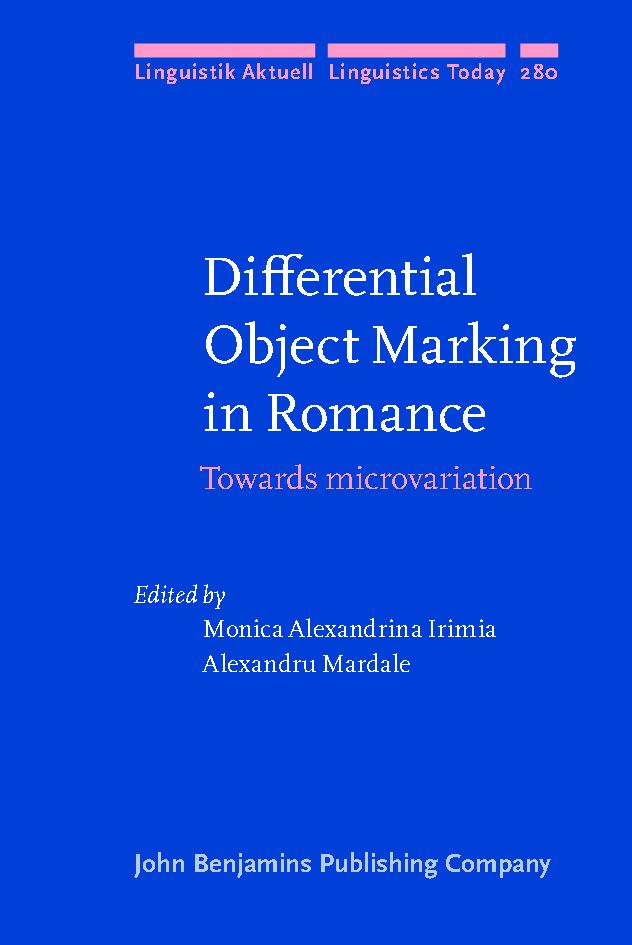
Differential Object Marking in Romance
This volume brings together original papers addressing various aspects of differential object marking in Romance languages, focusing on micro-variation, from both a descriptive and formal perspective, touching on diachrony, language contact, synchrony, and using a large set of methodologies.
eBook