
Catalogue Search | MBRL


Are you sure you want to remove the book from the shelf?

{{itemTitle}}
40
result(s) for
"Romanticism-Germany"
Sort by:


Transplanting the Metaphysical Organ: German Romanticism between Leibniz and Marx
Around 1800, German romanticism developed a philosophy this study calls \"Romantic organology.\" Scientific and philosophical notions of biological function and speculative thought converged to form the discourse that Transplanting the Metaphysical Organ reconstructs-a metaphysics meant to theorize, and ultimately alter, the structure of a politically and scientifically destabilized world.
eBook
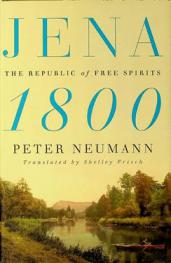
Jena 1800 : the republic of free spirits
\"The history of the German idealist oasis where discussions of revolution, literature, beliefs, romance, and concepts gave birth to the modern world\"-- Provided by publisher.
BOOK

The Cambridge Companion to German Romanticism
The late eighteenth and early nineteenth centuries saw an extraordinary flowering of arts and culture in Germany which produced many of the world's finest writers, artists, philosophers and composers. This volume, first published in 2004, offers students and specialists an authoritative introduction to that dazzling cultural phenomenon, now known collectively as German Romanticism. Individual chapters not only introduce the reader to individual writers such as Friedrich Schlegel, Novalis, Eichendorff, Heine, Hoffmann, Kleist, Schiller and Tieck, but also treat key concepts of Romantic music, painting, philosophy, gender and cultural anthropology, science and criticism in concise and lucid language. All German quotations are translated to make this volume fully accessible to a wide audience interested in how Romanticism evolved across Europe. Brief biographies and bibliographies are supplemented by a list of primary and secondary further reading in both English and German.
eBook
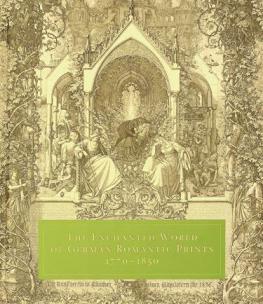
The enchanted world of German romantic prints, 1770-1850
From the 1770s through the 1840s, German, Austrian, and Swiss artists used the medium of printmaking to create works that synthesized poetry, literature, music, and the visual arts in new and captivating ways. Finding an eager audience in the growing number of educated middle-class collectors, printmakers experimented with modern technologies, such as lithography, and drew on the contemporary interest in regional folklore and traditional fairy tales to produce innovative compositions that both contributed to and reflected the dramatic cultural and political upheavals of the Romantic era. Featuring the work of more than 120 artists, including Casper David Friedrich, Ludwig Emil Grimm, Joseph Anton Koch, Philipp Otto Runge, and Johann Gottfried Schadow, this authoritative book contains many unique and never-before-published examples of prints from the Philadelphia Museum of Art's unrivaled collection.-- Source other than Library of Congress.
Book

The Long Century’s Long Shadow
The Long Century’s Long Shadow approaches German Romanticism and Weimar cinema as continuous developments, enlisting both in a narrative of reciprocal illumination. The author investigates different moments and media as connected phenomena, situated at alternate ends of the long nineteenth century but joined by their mutual rejection of the neo-classical aesthetic standard of placid and weightless poise in numerous media, including film, painting, sculpture, prose, poetry, and dance.
Connecting Weimar filmmaking to Romantic thought and practice, Kenneth S. Calhoon offers a non-technological, aesthetic genealogy of cinema. He focuses on well-known literary and artistic works, including films such as Nosferatu , Metropolis, Frankenstein , and Fantasia ; the writings of Conrad, Kafka, Goethe, and Novalis; and the paintings of Caspar David Friedrich, one of the leading artists of German Romanticism. With an eye to the modernism of which Weimar filmmaking was a part, The Long Century’s Long Shadow employs the Romantic landscape in poetry and painting as a mirror in which to regard cinema.
eBook
Brill's Companion to German Romantic Philosophy
Scholars are finally fully appreciating the philosophical significance of early German Romanticism. Brill's Companion to German Romantic Philosophy is a collection of original essays showcasing not only the philosophical achievements of romantic writers such as Schlegel and Novalis, but the sophistication, relevance, and influence of romanticism today.
eBook
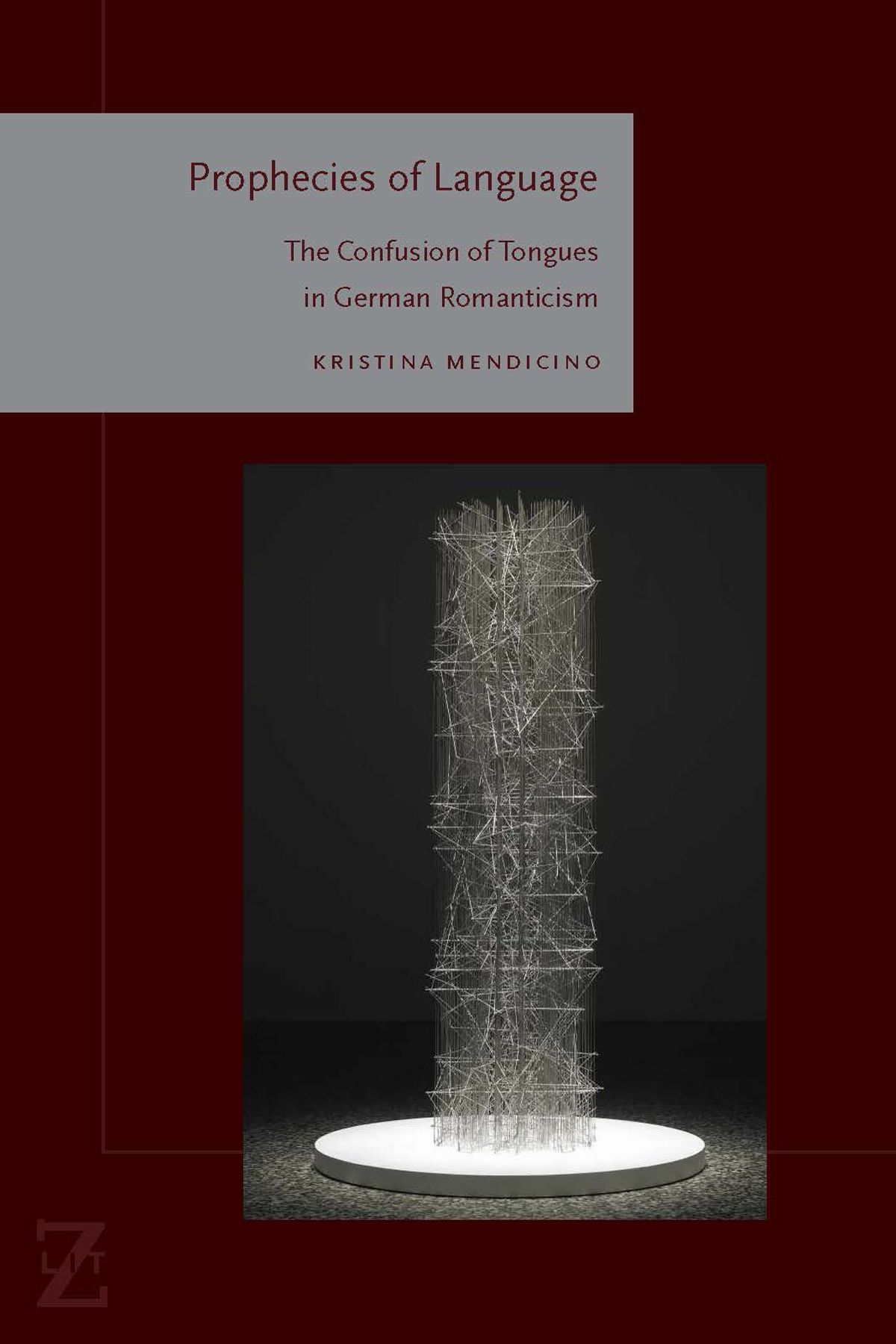
Prophecies of Language
The scenes of Babel and Pentecost, the original confusion of tongues and their redemption through translation, haunt German Romanticism and Idealism. This book begins by retracing the ways in which the task of translation, so crucial to Romantic writing, is repeatedly tied to prophecy, not in the sense of telling future events, but in the sense of speaking in the place of anotherGÇömost often unbeknownst to the speaker herself. In prophetic speech, the confusion of tongues repeats, each time anew, as language takes place unpredictably in more than one voice and more than one tongue at once. _x000D_ Mendicino argues that the relation between translation and prophecy drawn by German Romantic writers fundamentally changes the way we must approach this so-called GÇ£Age of Translation.GÇ¥ Whereas major studies of the period have taken as their point of departure the opposition of the familiar and the foreign, Mendicino suggests that Romantic writing provokes the questions: how could one read a language that is not one? And what would such a polyvocal, polyglot language, have to say about philologyGÇöboth for the Romantics, whose translation projects are most intimately related to their philological preoccupations, and for us? _x000D_ In Prophecies of Language, these questions are pursued through readings of major texts by G.W.F. Hegel, Wilhelm von Humboldt, Friedrich Schlegel, and Friedrich H+¦lderlin. These readings show how, when one questions the presupposition of works composed by individual authors in one tongue, these texts disclose more than a monoglot reading yields, namely the GÇ£plusGÇ¥ of their linguistic plurality. From such a surplus, each chapter goes on to advocate for a philology that, in and through an inclination toward language, takes neither its unity nor its structure for granted but allows itself to be most profoundly affected, addressedGÇöand afflictedGÇöby it.
eBook

Nature, ethics and gender in german romanticism and idealism
This book provides an account of the development of ideas about nature from the Early German Romantics into the philosophies of nature of Schelling and Hegel.In clear and accessible language, Alison Stone explains how the project of philosophy of nature took shape and made sense in the post-Kantian context.
eBook

Friedrich Schlegel and the Emergence of Romantic Philosophy
This book addresses the philosophical reception of early German Romanticism and offers the first in-depth study in English of the movement's most important philosopher, Friedrich Schlegel, presenting his philosophy against the background of the controversies that shaped its emergence. Elizabeth Millán-Zaibert begins by distinguishing early German Romanticism from classical German Idealism, under which it has all too often been subsumed, and then explores Schlegel's romantic philosophy (and his rejection of first principles) by showing how he responded to three central figures of the post-Kantian period in Germany—Jacobi, Reinhold, and Fichte—as well as to Kant himself. She concludes with a comprehensive critique of the aesthetic and epistemological consequences of Schlegel's thought, with special attention paid to his use of irony.
eBook