
Catalogue Search | MBRL


Are you sure you want to remove the book from the shelf?

{{itemTitle}}
37
result(s) for
"Rome (Italy) -- Buildings, structures, etc"
Sort by:

The Pantheon : from antiquity to the present
\"The Pantheon is one of the most important architectural monuments of all time. Thought to have been built by Emperor Hadrian in approximately AD 125 on the site of an earlier, Agrippan-era monument, it brilliantly displays the spatial pyrotechnics emblematic of Roman architecture and engineering. The Pantheon gives an up-to-date account of recent research on the best preserved building in the corpus of ancient Roman architecture from the time of its construction to the twenty-first century. Each chapter addresses a specific fundamental issue or period pertaining to the building; together, the essays in this volume shed light on all aspects of the Pantheon's creation, and establish the importance of the history of the building to an understanding of its ancient fabric and heritage, its present state, and its special role in the survival and evolution of ancient architecture in modern Rome\"-- Provided by publisher.
Book

The Aurelian Wall and the Refashioning of Imperial Rome, AD 271–855
This book explores the relationship between the city of Rome and the Aurelian Wall during the six centuries following its construction in the 270s AD, a period when the city changed and contracted almost beyond recognition, as it evolved from imperial capital into the spiritual center of Western Christendom. The Wall became the single most prominent feature in the urban landscape, a dominating presence which came bodily to incarnate the political, legal, administrative, and religious boundaries of urbs Roma, even as it reshaped both the physical contours of the city as a whole and the mental geographies of 'Rome' that prevailed at home and throughout the known world. With the passage of time, the circuit took on a life of its own as the embodiment of Rome's past greatness, a cultural and architectural legacy that dwarfed the quotidian realities of the post-imperial city as much as it shaped them.
eBook

Renovatio urbis
Examining the urban and architectural developments in Rome during the Pontificate of Julius II (1503-13) this book focuses on the political, religious and artistic motives behind the changes. Each chapter focuses on a particular project, from the Palazzo dei Tribunali to the Stanza della Segnatura, and examines their topographical and symbolic contexts in relationship to the broader vision of Julian Rome.
This original work explores not just historical sources relating to buildings but also humanist/antiquarian texts, papal sermons/eulogies, inscriptions, frescoes and contemporary maps. An important contribution to current scholarship of early sixteenth century Rome, its urban design and architecture.
eBook

Trajan's hollow
This publication documents 'Trajan's Hollow', a transformative reproduction of Trajan's Column in Rome, to address issues of critical importance in contemporary architectural practice: a reconsideration of architectural poch (both programmatic and material), the use of scale shift as a tool for transforming shape and content, and the role of subversive reconstruction in an era of digital scanning and replication. The publication offers an alternative model for the close reading of historical artifacts through an analysis of Trajan's Column and its material progeny, including the casts and copies of the column produced over 2,000 years and contemporary reconstructions of the column executed by the author while in residence at the American Academy in Rome. Although this second-century monument located in the heart of Rome has been the object of hundreds of years of study, 'Trajan's Hollow' uncovers aspects of the column curiously omitted amidst all this attention, manifesting the lacunae in various paradigms of historical inquiry: this work rereads the column and its legacy through the simple act of prioritizing the embodied occupation of its interior over the analysis of its exterior narrative frieze.
Book
Constantine and Rome
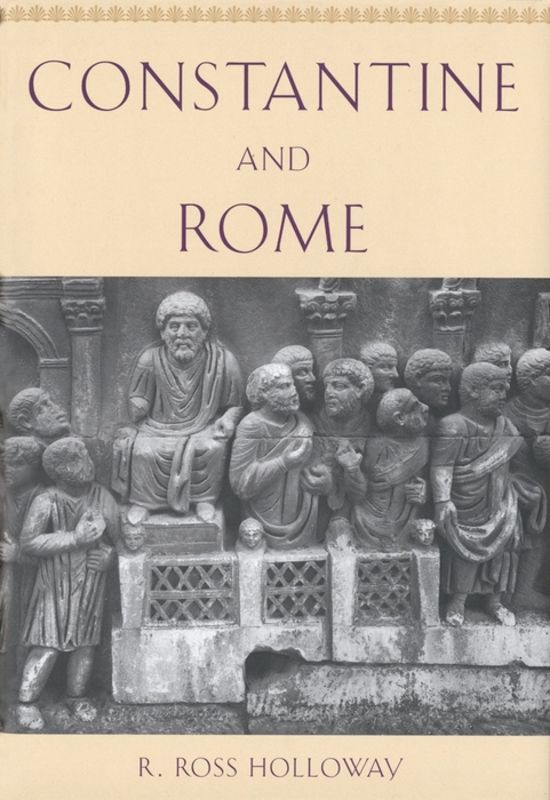
Constantine the Great (285-337) played a crucial role in mediating between the pagan, imperial past of the city of Rome, which he conquered in 312, and its future as a Christian capital. In this learned and highly readable book, R. Ross Holloway examines Constantine's remarkable building program in Rome.Holloway begins by examining the Christian Church in the period before the Peace of 313, when Constantine and his co-emperor Licinius ended the persecution of the Christians. He then focuses on the structure, style, and significance of important monuments: the Arch of Constantine and the two great Christian basilicas, St. John's in the Lateran and St. Peter's, as well as the imperial mausoleum at Tor Pignatara. In a final chapter Holloway advances a new interpretation of the archaeology of the Tomb of St. Peter beneath the high altar of St. Peter's Basilica. The tomb, he concludes, was not the original resting place of the remains venerated as those of the Apostle but was created only in 251 by Pope Cornelius. Drawing on the most up-to-date archaeological evidence, he describes a cityscape that was at once Christian and pagan, mirroring the personality of its ruler.
eBook

Palazzo della civiltلa Italiana
In 2015, the storied fashion house Fendi moved its headquarters into the Palazzo della Civilta Italiana in Rome, a stark white cube perforated by symmetrical arches. Originally commissioned as part of an exhibition on Roman civilization for the 1942 world's fair, the architects took their cues from ancient history to create a building that was quintessentially Roman yet decidedly modern, earning its nickname the Square Colosseum. Because of its striking appearance and iconic status, the palazzo subsequently made appearances in a number of films by directors such as Roberto Rossellini, Federico Fellini, and Peter Greenaway. The building remained relatively abandoned throughout much of its existence, until its recent inhabitance by the always forward-thinking house of Fendi, an experience which Karl Lagerfeld has likened to being on a spaceship transported into the future.
Book

Hospitals and Urbanism in Rome, 1200-1500
In Hospitals and Urbanism in Rome 1200 - 1500, Carla Keyvanian reconstructs three centuries of urban history by focusing on public hospitals, state institutions that were urban expressions of sovereignty, characterized by a distinguishing architecture and built in prime urban locations.
eBook


Whispering city : modern Rome and its histories
In Civilization and Its Discontents, Sigmund Freud claimed that Rome must be comprehended as \"not a human dwelling place but a mental entity,\" in which the palaces of the Caesars still stand alongside modern apartment buildings in layers of brick, mortar, and memory. \"The observer would need merely to shift the focus of his eyes, perhaps, or change his position, in order to call up a view of either the one or the other.\"In this one-of-a-kind book, historian Richard Bosworth accepts Freud's challenge, drawing upon his expertise in Italian pasts to explore the many layers of history found within the Eternal City. Often beginning his analysis with sites and monuments that can still be found in contemporary Rome, Bosworth expands his scope to review how political groups of different erasthe Catholic Church, makers of the Italian nation, Fascists, and \"ordinary\" Romans (be they citizens, immigrants, or tourists)read meaning into the city around them. Weaving in the city's quintessential figures (Garibaldi, Pius XII, Mussolini, and Berlusconi) and architectural icons (the Vatican, St. Peter's Basilica, the Victor Emmanuel Monument, and EUR) with those forgotten or unknown, Bosworth explores the many histories that whisper their rival and competing messages and seek to impose their truth upon the passing crowds. But as this delightful study will reveal, Rome, that magisterial palimpsest, has never accepted a single reading of its historic meaning.
eBook