
Catalogue Search | MBRL


Are you sure you want to remove the book from the shelf?

{{itemTitle}}
42
result(s) for
"Rome (Italy) -- Geography"
Sort by:


The Aurelian Wall and the Refashioning of Imperial Rome, AD 271–855
This book explores the relationship between the city of Rome and the Aurelian Wall during the six centuries following its construction in the 270s AD, a period when the city changed and contracted almost beyond recognition, as it evolved from imperial capital into the spiritual center of Western Christendom. The Wall became the single most prominent feature in the urban landscape, a dominating presence which came bodily to incarnate the political, legal, administrative, and religious boundaries of urbs Roma, even as it reshaped both the physical contours of the city as a whole and the mental geographies of 'Rome' that prevailed at home and throughout the known world. With the passage of time, the circuit took on a life of its own as the embodiment of Rome's past greatness, a cultural and architectural legacy that dwarfed the quotidian realities of the post-imperial city as much as it shaped them.
eBook

Rome : an urban history from antiquity to the present
\"Spanning the entire history of the city of Rome from Iron Age village to modern metropolis, this is the first book to take the long view of the Eternal City as an urban organism. Three thousand years old and counting, Rome has thrived almost from the start on self-reference, supplementing the everyday concerns of urban management and planning by projecting its own past onto the city of the moment. This is a study of the urban processes by which Rome's people and leaders, both as custodians of its illustrious past and as agents of its expansive power, have shaped and conditioned its urban fabric by manipulating geography and organizing space; planning infrastructure; designing and presiding over mythmaking, ritual, and stagecraft; controlling resident and transient populations; and exploiting Rome's standing as a seat of global power and a religious capital\"-- Provided by publisher.
Book

Rivers and the power of ancient Rome
Figuring in myth, religion, law, the military, commerce, and transportation, rivers were at the heart of Rome's increasing exploitation of the environment of the Mediterranean world. In Rivers and the Power of Ancient Rome, Brian Campbell explores the role and influence of rivers and their surrounding landscape on the society and culture of the Roman Empire. Examining artistic representations of rivers, related architecture, and the work of ancient geographers and topographers, as well as writers who describe rivers, Campbell reveals how Romans defined the geographical areas they conquered and how geography and natural surroundings related to their society and activities. In addition, he illuminates the prominence and value of rivers in the control and expansion of the Roman Empire — through the legal regulation of riverine activities, the exploitation of rivers in military tactics, and the use of rivers as routes of communication and movement. Campbell shows how a technological understanding of — and even mastery over — the forces of the river helped Rome rise to its central place in the ancient world.
eBook

The Aurelian wall and the refashioning of Imperial Rome, A.D. 271-855
\"This book explores the relationship between the city of Rome and the Aurelian wall during the six centuries following its construction in the 270s AD, a period when the city changed and contracted almost beyond recognition, as it evolved from imperial capital into the spiritual center of Western Christendom. The wall became the single most prominent feature in the urban landscape, a dominating presence which came bodily to incarnate the political, legal, administrative, and religious boundaries of urbs Roma, even as it reshaped both the physical contours of the city as a whole and the mental geographies of 'Rome' that prevailed at home and throughout the known world. With the passage of time, the circuit took on a life of its own as the embodiment of Rome's past greatness, a cultural and architectural legacy that dwarfed the quotidian realities of the post-imperial city as much as it shaped them\"--Provided by publisher.
Book

Urban Developments in Late Antique and Medieval Rome
A narrative of decline punctuated by periods of renewal has long structured perceptions of Rome's late antique and medieval history. In their probing contributions to this volume, a multi-disciplinary group of scholars provides alternative approaches to understanding the period. Addressing developments in governance, ceremony, literature, art, music, clerical education and the construction of the city's identity, the essays examine how a variety of actors, from poets to popes, productively addressed the intermittent crises and shifting dynamics of these centuries in ways that bolstered the city's resilience. Without denying that the past (both pre-Christian and Christian) consistently remained a powerful touchstone, the studies in this volume offer rich new insights into the myriad ways that Romans, between the fifth and the eleventh centuries, creatively assimilated the past as they shaped their future.
eBook

The Republican Aventine and Rome's social order
\"The Republican Aventine and Rome's Social Order is about one hill in particular, the Aventine, and its segregation from and integration into the residential fabric of Rome. My chronological focus is the Roman Republic, with studies peering into the Augustan principate. Throughout the text, all dates are BCE unless otherwise noted, and the title's reference to Roman social order reflects this monograph's twin themes: the plebs and urban stability. First, this book destabilizes the long-standing scholarly tradition that the Aventine was the citadel and headquarters for Rome's politically vibrant plebs. Second, it demonstrates that the development of the Aventine as a region mirrors the overall evolution of the urbs. The caput mundi was characterized by an extraordinary degree of socioeconomic integration, and the book concludes by proposing that this transurban heterogeneity may have contributed to the city's relative tranquility up until the final decades of the republic. This book aims to offer a deeply textured reconstruction of the Aventine as a literary and conceptual construct, on the one hand, and as a physical space, on the other. The city map is intentionally blank. Though we know which monuments stood on the Aventine in the Republic, we do not know where they stood. The ruins that have been recovered remain anonymous or assigned amid great conjecture. This book is not a topographical manual or an archaeological survey guide. It does not seek to attach famous figures to known archaeological sites or to assign residents to a map. A flurry of recent and ongoing scholarship has made that sort of work possible. The publication of the Lexicon Topographicum Urbis Romae in particular ensures that Rome's cultural geography will remain a very fertile and dynamic field within classical studies. The contribution of this monograph is that it applies fresh, critical readings to the literary tradition, material culture, and comparative urban studies, to offer a new assessment of one of Rome's canonical hills and to theorize broadly about republican Rome's residential practices\"--Preface.
Book

Migration and Mobility in the Early Roman Empire
In Migration and Mobility in the Early Roman Empire seventeen specialists in the fields of Roman social history, Roman demography and Roman economic history offer fresh perspectives on voluntary, state-organised and forced mobility during the first to early third centuries CE.
eBook
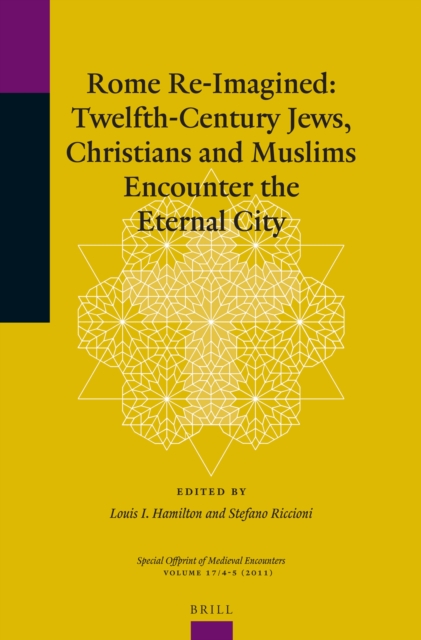
Rome re-imagined : twelfth-century Jews, Christians and Muslims encounter the Eternal City
This collection examines the image of Rome through Arabic, Greek, Hebrew, Latin, and Persian descriptions of the eternal city. Placing the twelfth-century renaissance into a Mediterranean context. The city of Rome is revealed as a multi-vocal object of desire and a contested ideal.
eBook

Hagiography, Historiography, and Identity in Sixth-Century Gaul
Gregory of Tours, the sixth-century Merovingian bishop, composed extensive historiographical and hagiographical corpora during the twenty years of his episcopacy in Tours. These works serve as important sources for the cultural, social, political and religious history of Merovingian Gaul. This book focuses on Gregory's hagiographical collections, especially the Glory of the Martyrs, Glory of the Confessors, and Life of the Fathers, which contain accounts of saints and their miracles from across the Mediterranean world. It analyses these accounts from literary and historical perspectives, examining them through the lens of relations between the Merovingians and their Mediterranean counterparts, and contextualizing them within the identity crisis that followed the disintegration of the Roman world. This approach leads to groundbreaking conclusions about Gregory's hagiographies, which this study argues were designed as an \"ecclesiastical history\" (of the Merovingian Church) that enabled him to craft a specific Gallo-Christian identity for his audience.
eBook