
Catalogue Search | MBRL


Are you sure you want to remove the book from the shelf?

{{itemTitle}}
13
result(s) for
"Rome (Italy) History 476-1420."
Sort by:


Urban Developments in Late Antique and Medieval Rome
A narrative of decline punctuated by periods of renewal has long structured perceptions of Rome's late antique and medieval history. In their probing contributions to this volume, a multi-disciplinary group of scholars provides alternative approaches to understanding the period. Addressing developments in governance, ceremony, literature, art, music, clerical education and the construction of the city's identity, the essays examine how a variety of actors, from poets to popes, productively addressed the intermittent crises and shifting dynamics of these centuries in ways that bolstered the city's resilience. Without denying that the past (both pre-Christian and Christian) consistently remained a powerful touchstone, the studies in this volume offer rich new insights into the myriad ways that Romans, between the fifth and the eleventh centuries, creatively assimilated the past as they shaped their future.
eBook

The virtues of economy : governance, power, and piety in late medieval Rome
\"This book explores the transformation of Roman political culture from c.1350 to c.1450, and its implications for the history of the city, the Papacy, and the modern state. Specifically, it examines the gradual transition of Roman political elites from a commitment to governing Rome as a free city-commune to a willingness to act as the governing agents of a sovereign papacy. It emphasizes that understanding this transition requires recognition of Roman political engagement not merely with a civic society, constituted of citizens of the city-commune, but with the broader political society of Rome in its guise as the spiritual capital of Latin Christendom. Through an analysis of the transformative effects of everyday Roman politics, this book reframes the story of the establishment of papal sovereignty in Rome as the product of synergy between papal ambitions and local political culture\"-- Provided by publisher.
Book
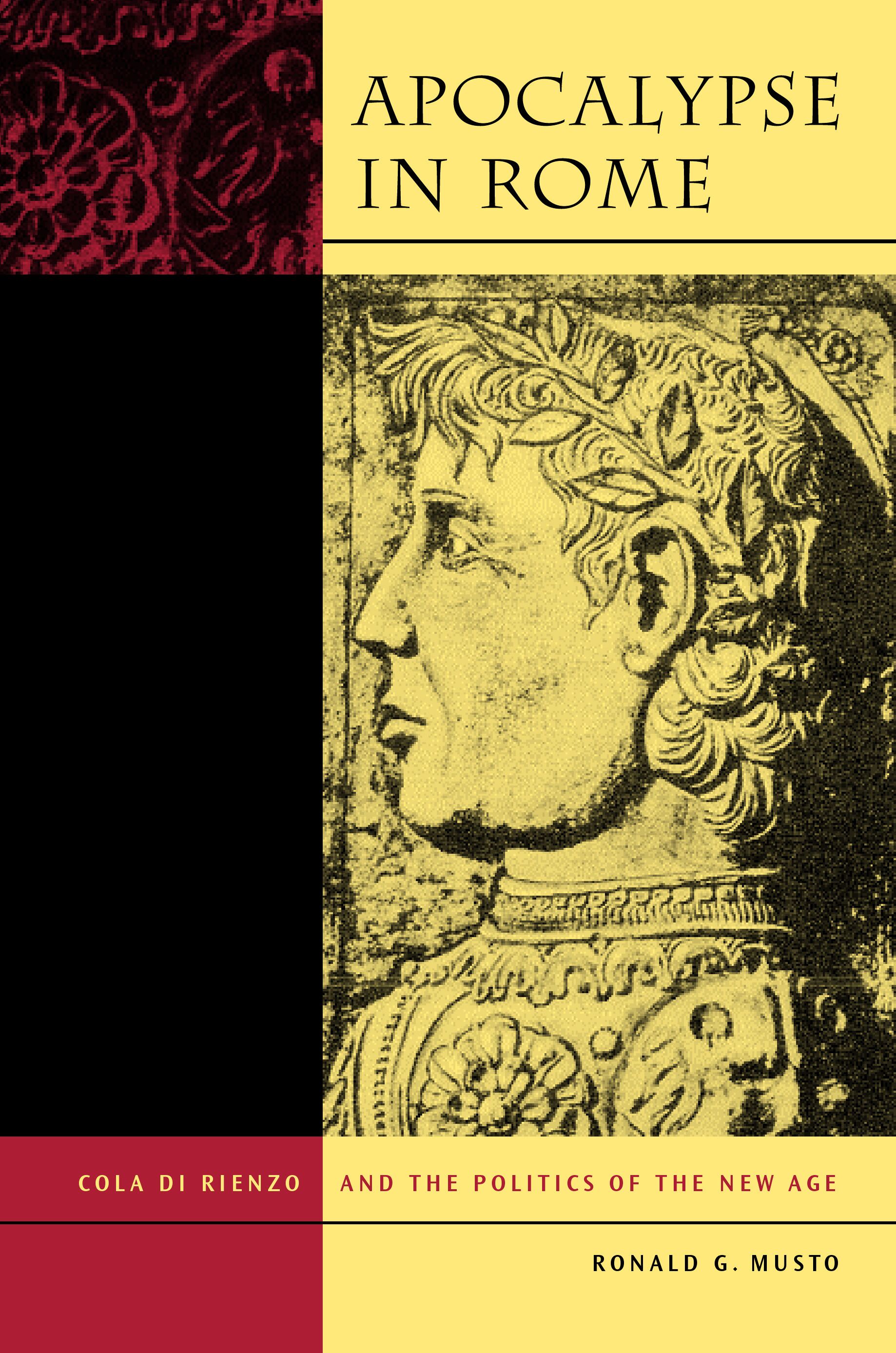
Apocalypse in Rome
On May 20, 1347, Cola di Rienzo overthrew without violence the turbulent rule of Rome’s barons and the absentee popes. A young visionary and the best political speaker of his time, Cola promised Rome a return to its former greatness. Ronald G. Musto’s vivid biography of this charismatic leader—whose exploits have enlivened the work of poets, composers, and dramatists, as well as historians—peels away centuries of interpretation to reveal the realities of fourteenth-century Italy and to offer a comprehensive account of Cola’s rise and fall.
eBook

Historiography and space in late antiquity
The Roman Empire traditionally presented itself as the centre of the world, a view sustained by ancient education and conveyed in imperial literature. Historiography in particular tended to be written from an empire-centred perspective. In Late Antiquity, however, that attitude was challenged by the fragmentation of the empire. This book explores how a post-imperial representation of space emerges in the historiography of that period. Minds adapted slowly, long ignoring Constantinople as the new capital and still finding counter-worlds at the edges of the world. Even in Christian literature, often thought of as introducing a new conception of space, the empire continued to influence geographies. Political changes and theological ideas, however, helped to imagine a transferral of empire away from Rome and to substitute ecclesiastical for imperial space. By the end of Late Antiquity, Rome was just one of many centres of the world.
Book

The Chronicle of an Anonymous Roman
The Chronicle of an Anonymous Roman is a treasure of history writing and of medieval Italian literature. It was written by an unknown fourteenth-century Roman, probably a physician and a first-hand witness to many of the events he records. It offers the most important narrative of late medieval Rome during the Avignon papacy, situating the city in a broadly Mediterranean and European context. Most famously, it provides our most detailed account of late medieval Rome's most famous son, Cola di Rienzo. The author deserves our gratitude for his vivid depiction of Cola, a charismatic man of humble birth but astonishing talent who rose to dominate Rome not once but twice. Yet this marvelous work, which provides insights and information we can find nowhere else, very nearly did not survive. From the time it was written, it has all too often tended to be read in a piecemeal, selective manner. Until recently it was neglected by modern specialists unsure of how to categorize it or the fourteenth-century Rome it describes. Scholars have now come to cherish this chronicle both as a brilliant literary product and as a rich source of historical data about late medieval Italy. Written in Romanesco, the chronicle leads us through the streets, rioni, and palaces of Rienzo's Rome. But it also offers keen observations on Milan, Florence, Naples, and the Romagna; on Iberia, the eastern Mediterranean, France, and Hungary. James A. Palmer presents the first complete English translation of the Anonimo Romano. He captures the style, spirit, and wry irony of this master historian. Palmer's introduction examines the text, its mysterious author, and the world in which he wrote. He brings us a primer on fourteenth-century Italy and explores the moral and political examples and lessons that the Anonimo Romano offered his contemporary audience.
eBook
Urban Developments in Late Antique and Medieval Rome
A narrative of decline punctuated by periods of renewal has long structured perceptions of Rome’s late antique and medieval history. In their probing contributions to this volume, a multi-disciplinary group of scholars provides alternative approaches to understanding the period. Addressing developments in governance, ceremony, literature, art, music, clerical education and the construction of the city’s identity, the essays examine how a variety of actors, from poets to popes, productively addressed the intermittent crises and shifting dynamics of these centuries in ways that bolstered the city’s resilience. Without denying that the past (both pre-Christian and Christian) consistently remained a powerful touchstone, the studies in this volume offer rich new insights into the myriad ways that Romans, between the fifth and the eleventh centuries, creatively assimilated the past as they shaped their future.
eBook
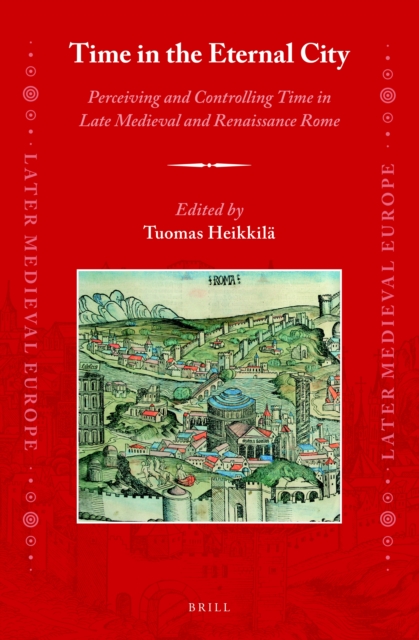
Time in the Eternal City
Time in the Eternal City: Perceiving and Controlling Time in Late Medieval and Renaissance Rome is a major contribution to the study of time and its numerous aspects in late medieval and Renaissance Rome. The authors offer a versatile view on the variety of ways time could be perceived. Individual chapters concentrate on the grass-root levels of everyday life, on various uses of the past in the present, as well as on the control of time by the ecclesiastical authorities. These studies reveal a wealth of new information that demonstrates the almost endlessly fluid manner in which time could be perceived, as well as the innovative ways in which time could be used by individuals and authorities alike. Contributors are members of Tuomas Heikkilä's research group at the Finnish Institute in Rome: Holger Kaasik, Urpo Kantola, Marko Halonen, Jasmin Lukkari and Saku Pihko.
eBook
The Chronicle of an Anonymous Roman
The Chronicle of an Anonymous Roman\" offers the first complete English translation of the Anonimo Romano's \"Cronica.\" Includes an introduction to the text and its author, as well as an introduction to its fourteenth-century world.
eBook
Rome re-imagined : twelfth-century Jews, Christians and Muslims encounter the Eternal City
This collection examines the image of Rome through Arabic, Greek, Hebrew, Latin, and Persian descriptions of the eternal city. Placing the twelfth-century renaissance into a Mediterranean context. The city of Rome is revealed as a multi-vocal object of desire and a contested ideal.
eBook