
Catalogue Search | MBRL


Are you sure you want to remove the book from the shelf?

{{itemTitle}}
1,066
result(s) for
"Rome Civilization"
Sort by:

Ancient Rome
The amazing accomplishments of Ancient Rome can still feel like a mystery to many. From the modern day calendar to the earliest incarnation of the book, it is stunning to learn how many innovations came from this advanced civilization. Along with learning about the culture, readers get the chance to study amazing Roman artifacts. They're asked to put their thinking caps on, and using questions and prompts, draw their own conclusions about Ancient Rome. This book is sure to wow readers with Rome's impressive civilization and excite them enough to discover some facts on their own.
Book

Staging the world : spoils, captives, and representations in the Roman triumphal procession
This book is about the Roman triumphal procession in its capacity as spectacle and performance. It analyses the triumphs as visually emphatic events that both conveyed and constructed Roman views of the world. Aiming at approaching issues of identity, the book analyses how Rome presented and perceived the defeated on triumphal display. Spoils, captives, and representations are the objects, and the basic questions strive to establish both contents and context: What was displayed? How was it paraded? What was the response? Arms, ships and rams, coins and bullion, sculptures and paintings, art and valuables, golden crowns, prisoners, hostages, animals, and trees are all examined in separate chapters, as are the representations that were made specifically for the occasion: models and personifications of cities, peoples, rivers, and vivid tableaux staging scenes from the war. To be able to engage in issues of processional contents and sequence, acted roles, visual interplay, spectator participation, and emotional effect, the study embraces the complete corpus of ancient sources of the historical triumph, literary and pictorial. The approach includes discussions of the triumph as a religious rite and as a political act. But performance is the key word, and attention is in the first place paid to the visual expressions and schemes of the parade, and the interplay between these and the spectators.
eBook


Greece and the Augustan Cultural Revolution
This book examines the impact of the Roman cultural revolution under Augustus on the Roman province of Greece. It argues that the transformation of Roman Greece into a classicizing 'museum' was a specific response of the provincial Greek elites to the cultural politics of the Roman imperial monarchy. Against a background of Roman debates about Greek culture and Roman decadence, Augustus promoted the ideal of a Roman debt to a 'classical' Greece rooted in Europe and morally opposed to a stereotyped Asia. In Greece the regime signalled its admiration for Athens, Sparta, Olympia and Plataea as symbols of these past Greek glories. Cued by the Augustan monarchy, provincial Greek notables expressed their Roman orientation by competitive cultural work (revival of ritual; restoration of buildings) aimed at further emphasising Greece's 'classical' legacy. Reprised by Hadrian, the Augustan construction of 'classical' Greece helped to promote the archaism typifying Greek culture under the principate.
eBook

Life in Roman times
\"Find out about everyday life in ancient Rome in this fact-packed book that combines photographs of actual objects with full-color illustrations and fascinating text.\"--Page 4 of cover.
Book

Globalizing Roman Culture
Richard Hingley here asks the questions: What is Romanization? Was Rome the first global culture? Romanization has been represented as a simple progression from barbarism to civilization. Roman forms in architecture, coinage, language and literature came to dominate the world from Britain to Syria. Hingley argues for a more complex and nuanced view in which Roman models provided the means for provincial elites to articulate their own concerns. Inhabitants of the Roman provinces were able to develop identities they never knew they had until Rome gave them the language to express them. Hingley draws together the threads of diverse and separate study, in one sophisticated theoretical framework that spans the whole Roman Empire. Students of Rome and those with an interest in classical cultural studies will find this an invaluable mine of information.
'A valuable addition to the scholarly literature.' - BMCR
'The explicit recognition of the complex relationship between past and present is one of the book's many strengths... a sophisticated and nuanced picture of 'Roman' identities... this book will do much to set the tone for a new generation of studies of the Roman World.' - Britannia
Specialist in Roman studies, with a particular focus upon Roman imperialism and the context of Roman research. Lecturer in Roman archaeology at the University of Durham. Author of Roman Officers and English Gentleman (Routledge 2000) and Images of Rome (Journal of Roman Archaeology, 2001).
eBook

Ancient Rome inside out
\"Explores the culture and achievements of ancient Rome through the examination of artifacts that have survived through the centuries. Each primary-source artifact offers the reader significant clues to the civilization's technologies, cultural traditions, foods, and conflicts.\"--Provided by publisher.
Book
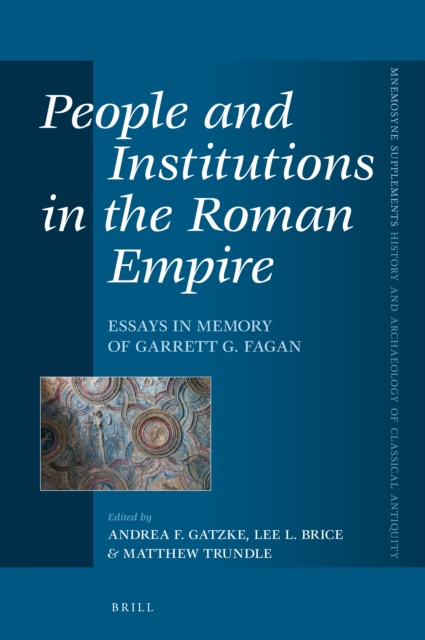
People and Institutions in the Roman Empire
People and Institutions in the Roman Empire examines the lived experience of individuals within Roman state and social institutions including army, law, religion, arena, and baths. In so doing it contextualizes Garrett Fagan's contributions to our understanding of Roman history.
eBook

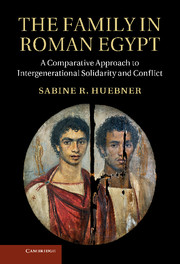
The Family in Roman Egypt
This study captures the dynamics of the everyday family life of the common people in Roman Egypt, a social strata that constituted the vast majority of any pre-modern society but rarely figures in ancient sources or in modern scholarship. The documentary papyri and, above all, the private letters and the census returns provide us with a wealth of information on these people not available for any other region of the ancient Mediterranean. The book discusses such things as family composition and household size and the differences between urban and rural families, exploring what can be ascribed to cultural patterns, economic considerations and/or individual preferences by setting the family in Roman Egypt into context with other pre-modern societies where families adopted such strategies to deal with similar exigencies of their daily lives.
eBook