
Catalogue Search | MBRL


Are you sure you want to remove the book from the shelf?

{{itemTitle}}
63
result(s) for
"Rome Region (Italy)"
Sort by:


Rome and environs
This superb guide brings the work of Filippo Coarelli, one of the most widely published and well-known scholars of Roman topography, archeology and art, to a broad English-language audience. Conveniently organized by walking tours and illustrated throughout with clear maps, drawings, and plans, Rome and Environs: An Archaeological Guide covers all of the major, and an unparalleled number of minor, ancient sites in the city, and, unlike most other guides of Rome, includes major and many minor sites within easy reach of the city, such as Ostia Antica, Palestrina, Tivoli, and the many areas of interest along the ancient Roman roads. An essential resource for tourists interested in a deeper understanding of Rome's classical remains, it is also the ideal book for students and scholars approaching the ancient history of one of the world's most fascinating cities. • Covers all the major sites including the Capitoline, the Roman Forum, the Imperial Fora, the Palatine Hill, the Valley of the Colosseum, the Esquiline, the Caelian, the Quirinal, and the Campus Martius. • Discusses important clusters of sites-one on the area surrounding Circus Maximus and the other in the vicinity of the Trastevere, including the Aventine and the Vatican. • Covers the history and development of the city walls and aqueducts. • Follows major highways leading outside of the city to important and fascinating sites in the periphery of Rome. • Features 189 maps, drawings, and diagrams, and an appendix on building materials and techniques. • Includes an updated and expanded bibliography for students and scholars of Ancient Rome.
eBook

Rome and environs : an archaeological guide
This superb guide brings the work of Filippo Coarelli, one of the most widely published and well-known scholars of Roman topography, archeology and art, to a broad English-language audience. Conveniently organized by walking tours and illustrated throughout with clear maps, drawings, and plans,'Rome and environs: an archaeological guide' covers all of the major, and an unparalleled number of minor, ancient sites in the city, and, unlike most other guides of Rome, includes major and many minor sites within easy reach of the city, such as Ostia Antica, Palestrina, Tivoli, and the many areas of interest along the ancient Roman roads.
Book

Roman Seas
This book offers an archaeological analysis of maritime economy and connectivity in the Roman east. That seafaring was fundamental to prosperity under Rome is beyond doubt, but a tendency to view the grandest long-distance movements among major cities against a background noise of small-scale, short-haul activity has tended to flatten the finer and varied contours of maritime interaction and coastal life into a featureless blue Mediterranean. Drawing together maritime landscape studies and network analysis, this work takes a bottom-up view of the diverse socioeconomic conditions and seafaring logistics that generated multiple structures and scales of interaction. The material record of shipwrecks and ports along a vital corridor from the southeast Aegean across the northeast Mediterranean provides a case study of regional exchange and communication based on routine sails between simple coastal facilities. Rather than a single well-integrated and persistent Mediterranean network, multiple discrete and evolving regional and interregional systems emerge. This analysis sheds light on the cadence of economic life along the coast, the development of market institutions, and the regional continuities that underpinned integration—despite certain interregional disintegration—into Late Antiquity. Through this model of seaborne interaction, the study advances a new approach to the synthesis of shipwreck and other maritime archaeological and historical economic data, as well as a path through the stark dichotomies that inform most paradigms of Roman connectivity and trade.
eBook

Barbarian Migrations and the Roman West, 376–568
This is a major survey of the barbarian migrations and their role in the fall of the Roman Empire and the creation of early medieval Europe, one of the key events in European history. Unlike previous studies it integrates historical and archaeological evidence and discusses Britain, Ireland, mainland Europe and North Africa, demonstrating that the Roman Empire and its neighbours were inextricably linked. A narrative account of the turbulent fifth and early sixth centuries is followed by a description of society and politics during the migration period and an analysis of the mechanisms of settlement and the changes of identity. Guy Halsall reveals that the creation and maintenance of kingdoms and empires was impossible without the active involvement of people in the communities of Europe and North Africa. He concludes that, contrary to most opinions, the fall of the Roman Empire produced the barbarian migrations, not vice versa.
eBook

The Chora of Metaponto 7
The seventh volume in the Institute of Classical Archaeology’s series on the rural countryside (chora) of Metaponto is a study of the Greek sanctuary at Pantanello. The site is the first Greek rural sanctuary in southern Italy that has been fully excavated and exhaustively documented. Its evidence—a massive array of distinctive structural remains and 30,000-plus artifacts and ecofacts—offers unparalleled insights into the development of extra-urban cults in Magna Graecia from the seventh to the fourth centuries BC and the initiation rites that took place within the cults. Of particular interest are the analyses of the well-preserved botanical and faunal material, which present the fullest record yet of Greek rural sacrificial offerings, crops, and the natural environment of southern Italy and the Greek world. Excavations from 1974 to 2008 revealed three major phases of the sanctuary, ranging from the Archaic to Early Hellenistic periods. The structures include a natural spring as the earliest locus of the cult, an artificial stream (collecting basin) for the spring’s outflow, Archaic and fourth-century BC structures for ritual dining and other cult activities, tantalizing evidence of a Late Archaic Doric temple atop the hill, and a farmhouse and tile factory that postdate the sanctuary’s destruction. The extensive catalogs of material and special studies provide an invaluable opportunity to study the development of Greek material culture between the seventh and third centuries BC, with particular emphasis on votive pottery and figurative terracotta plaques.
eBook
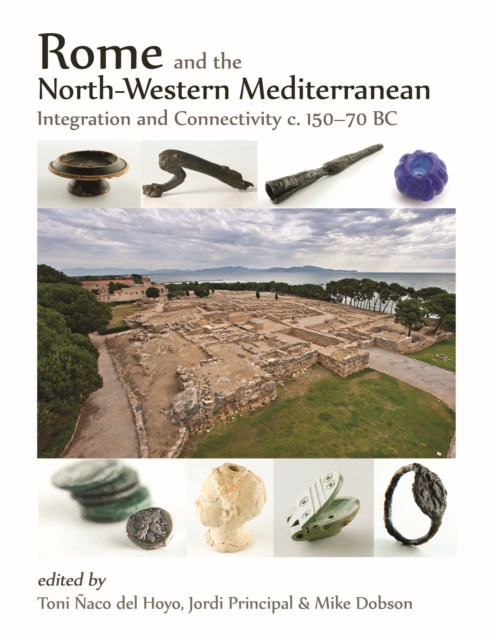
Rome and the north-western Mediterranean
To date, Rome’s intervention to the West from the mid-second century BC has not really been looked at with any sense of overview. Instead, there has been an unconnected series of micro-regional studies looking at particular areas, from the river Ebro in Spain round to Italy on the land front, and from the Balearic Islands to Corsica, Sardinia and even Sicily as regards the seaborne aspect. In contrast, the aim of this volume is to push the historical and archaeological debates about Rome’s expansion beyond these traditional geographical boundaries and the discipline-based previous research. The entire north-western Mediterranean is treated as a micro-region and is addressed using various interdisciplinary approaches. The result is to provide an innovative and comprehensive overview of the north-western Mediterranean in a period of historical crossroads, aided particularly by focusing on the connectivity and integration within this region as two interrelated issues. While Republican Rome enforced itself as an expansive power towards the West, all sorts of polities, military operations and individuals also played a significant role in creating interconnectivity and integration of the north-western Mediterranean into a new hybrid reality. In order to uncover such processes of hybridisation, contributors to this volume were encouraged to focus on the historical, archaeological and numismatic material from several areas within the region, and to incorporate aspects of interdisciplinary methodologies in order to address the region’s military, political, social and economic interconnections with Italy, Rome and each other within the overall period.
eBook

The Chora of Metaponto 4
This volume in the Institute of Classical Archaeology's series on rural settlements in the countryside (chora) of Metaponto presents the excavation of the Late Roman farmhouse at San Biagio. Located near the site of an earlier Greek sanctuary, this modest but well-appointed structure was an unexpected find from a period generally marked by large landholdings and monumental villas. Description of earlier periods of occupation (Neolithic and Greek) is followed by a detailed discussion of the farmhouse itself and its historical and socioeconomic context. The catalogs and analyses of finds include impressive deposits of coins from the late third and early fourth centuries AD. Use of virtual reality CAD software has yielded a deeper understanding of the architectural structure and its reconstruction. A remarkable feature is the small bath complex, with its examples of window glass. This study reveals the existence of a small but viable rural social and economic entity and alternative to the traditional image of crisis and decline during the Late Imperial period.
eBook

Southern Gaul and the Mediterranean
The interactions of the Celtic-speaking communities of Southern Gaul with the Mediterranean world have intrigued commentators since antiquity. This book combines sociolinguistics and archaeology to bring to life the multilingualism and multiple identities of the region from the foundation of the Greek colony of Massalia in 600 BC to the final phases of Roman Imperial power. It builds on the interest generated by the application of modern bilingualism theory to ancient evidence by modelling language contact and community dynamics and adopting an innovative interdisciplinary approach. This produces insights into the entanglements and evolving configurations of a dynamic zone of cultural contact. Key foci of contact-induced change are exposed and new interpretations of cultural phenomena highlight complex origins and influences from the entire Mediterranean koine. Southern Gaul reveals itself to be fertile ground for considering the major themes of multilingualism, ethnolinguistic vitality, multiple identities, colonialism and Mediterraneanization.
eBook

Rome and the Near Eastern kingdoms and principalities, 44-31 BC : a study of political relations during civil war
The study presents a critical examination of the political relations between Rome and Near Eastern kingdoms and principalities during the age of civil war from Caesar's death in 44 until the Battle of Actium in 31 BC.
eBook