
Catalogue Search | MBRL


Are you sure you want to remove the book from the shelf?

{{itemTitle}}
21
result(s) for
"Rome Statute of the International Criminal Court (...1998...)"
Sort by:


The Rome statute as evidence of customary international law
In The Rome Statute as Evidence of Customary International Law, Yudan Tan offers a detailed analysis of topical issues concerning the Rome Statute of the International Criminal Court as evidence of customary international law.
eBook

Making aggression a crime under domestic law : on the legislative implementation of article 8bis of the ICC statute
This book offers a comprehensive analysis of the legal questions that arise for the legislative branch when implementing the crime of aggression into domestic law. Despite being the supreme international crime that gave birth to international criminal law in Nuremberg, its ICC Statute definition has been incorporated into domestic law by fewer than 20 States. The crime of aggression was also omitted in the rich debate held among German scholars in the early 2000s regarding the legislative implementation of other ICC Statute crimes. The current inability of the International Criminal Court to respond to the Russian aggression towards Ukraine invites the continuation of these academic debates without neglecting the particularities of the crime of aggression. The fundamental issues discussed in this volume include the obligation to criminalize aggression, the core wrong of the crime, the normative gaps under domestic law and the jurisdictional gaps under the ICC Statute. To facilitate the operationalization of domestic implementation, the book explores the technical options for incorporating the definition into domestic law, the geographical ambit of domestic jurisdictionmost notably universal jurisdictionas well as legal challenges such as immunities. The book is aimed primarily at researchers and States with an interest in the domestic implementation of international criminal law but those already working in the field should also find much of interest contained within it. Dr. Annegret Hartig is Program Director of the Global Institute for the Prevention of Aggression and worked as a researcher at the University of Hamburg where she obtained her doctoral degree in international criminal law.
BOOK

Negotiating the International Criminal Court
This book is for those who want to know and understand the reasons and the story behind these historic negotiations or for those who may wonder how apparently conventional United Nations negotiations became so unusual and successful. This book is both for those who seek detailed legislative history, scholars or practitioners in international law and relations and those simply curious about how the Court came about.
eBook

The Reparation System of the International Criminal Court
Dedicated to one of the great innovations in the proceedings before the International Criminal Court, this book offers a comprehensive analysis of the Court's power to order a convicted person to make reparations to victims, possibilities for its implementation and its potential to bring justice to victims.
eBook

War crimes and crimes against humanity in the Rome Statute of the International Criminal Court
This book provides a critical analysis of the definitions of war crimes and crimes against humanity as construed in the Rome Statute of the International Criminal Court. Each crime is discussed from its origins in treaty or customary international law, through developments as a result of the jurisprudence of modern ad hoc or internationalised tribunals, to modifications introduced by the Rome Statute and the Elements of Crimes. The influence of human rights law upon the definition of crimes is discussed, as is the possible impact of State reservations to the underlying treaties which form the basis for the conduct covered by the offences in the Rome Statute. Examples are also given from recent conflicts to aid a 'real life' discussion of the type of conduct over which the International Criminal Court may take jurisdiction. This will be relevant to postgraduates, academics and professionals with an interest in the International Criminal Court and the normative basis for the crimes over which the Court may take jurisdiction.
eBook

UN Security Council Referrals to the International Criminal Court
Galand critically spells out a comprehensive conception of the nature and effects of Security Council referrals that responds to the various limits to the International Criminal Court’s exercise of jurisdiction over situations that concern nationals and territories of non-party States.
eBook
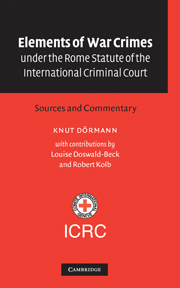
Elements of War Crimes under the Rome Statute of the International Criminal Court
The Elements of War Crimes will assist the International Criminal Court (ICC) in the interpretation and application of the articles of the ICC Statute defining the crimes under its jurisdiction. These will not only be necessary for the future work of the ICC in interpreting the crimes provisions, but also for national courts, which have primary responsibility in the prosecution of international crimes under the Rome Statute. This commentary provides a critical insight into the travaux préparatoires of the Preparatory Commission leading to the adoption of the elements of war crimes. It contains an analysis of existing case law related to each war crime in the Statute. It will provide States, judges, prosecutors and international and national lawyers with key background information to implement international humanitarian law in future cases dealing with war crimes under the ICC. A unique, indispensable tool for prosecuting and defense lawyers working in international criminal law.
eBook

Criminalizing reprisals against the natural environment
Throughout history, armed conflicts have frequently seen serious harm committed against the natural environment. From the early 1960s to 1971, the United States used Agent Orange to defoliate large tracts of Vietnamese forests. In the 1990s, Saddam Hussein vengefully ordered the burning of Kuwaiti oil wells, resulting in massive pollution to the air, land and surrounding seas. More recently, ecocentric harm has been documented in the Colombian civil war, by the so-called Islamic State group, and in the Ukraine conflict, among others. Whilst international humanitarian law (IHL) contains several prohibitions against environmental harm, the most striking is Article 55(2) of Additional Protocol I, whereby “[a]ttacks against the natural environment by way of reprisals are prohibited”. Although this provision appears absolute and unconditional, critical questions persist regarding its status under customary international law and its applicability in non-international armed conflicts. Moreover, its criminalization has not been explored in the jurisprudence of international courts or in the relevant scholarly literature, despite the fact that penal sanctions against individuals are an important factor for enforcement of environmental protections. To fill the lacuna, the following analysis examines the prohibition and criminalization of reprisals against the natural environment. It reviews conventional and customary international law to determine the current status of a putative criminal prohibition and its potential as lex ferenda. Importantly, it also assesses the relevance of reprisals against the natural environment for prosecutions under existing war crimes, such as attacks on civilian objects and destruction of enemy property. It generates novel insights for the application of international law to ecocentric harm, including that (1) reprisals against the natural environment are not criminal per se, but (2) conceptualizing the environment as a civilian object opens up clear paths for prosecuting attacks, including reprisals, against it; (3) the inherently intentional nature of reprisals has far-reaching implications for their prosecution; (4) reprisals can significantly impact the pivotal test of military necessity which arises in criminal prohibitions such as that found in Article 8(2)(b)(iv) of the Rome Statute; and (5) situations of reprisals could impact the application of the proposed definition of ecocide. Traversing IHL and international criminal law (ICL), the article identifies ways in which these traditionally anthropocentric bodies of law can be reoriented to accommodate ecocentric values. This reconceptualization is significant, as the prospect of criminal sanctions is critical for deterring potential perpetrators and potentially adds a basis for reparations designed to remediate damage to the environment. The assessment redresses the fact that the natural environment has been seen as a peripheral matter under both IHL and ICL and has remained under-explored despite the ongoing destruction wrought on nature including during armed conflict. It seeks to elevate the environment to a core protected value under these legal regimes, as a reflection of our increasing awareness that the natural environment is critical for the well-being of current and future generations and our growing appreciation of the intrinsic importance of protecting nature.
Journal Article
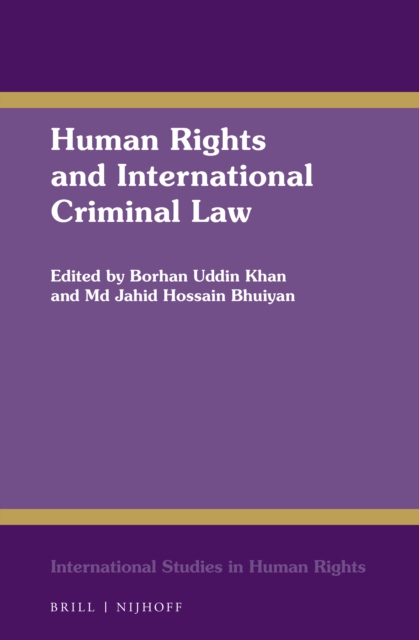
Human rights and international criminal law
The book considers human rights approaches to crimes from a theoretical and practical perspective, analyses various crimes under international law, and examines the application, implementation and enforcement of international criminal law.
eBook