Catalogue Search | MBRL


Are you sure you want to remove the book from the shelf?

{{itemTitle}}
18
result(s) for
"Rote Armee Fraktion"
Sort by:

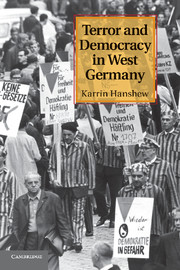
Terror and Democracy in West Germany
In 1970, the Red Army Faction declared war on West Germany. The militants failed to bring down the state, but this book argues that the decade-long debate they inspired helped shape a new era. After 1945, West Germans answered long-standing doubts about democracy's viability and fears of authoritarian state power with a 'militant democracy' empowered against its enemies and a popular commitment to anti-fascist resistance. In the 1970s, these postwar solutions brought Germans into open conflict, fighting to protect democracy from both terrorism and state overreaction. Drawing on diverse sources, Karrin Hanshew shows how Germans, faced with a state of emergency and haunted by their own history, managed to learn from the past and defuse this adversarial dynamic. This negotiation of terror helped them to accept the Federal Republic of Germany as a stable, reformable polity and to reconceive of democracy's defence as part of everyday politics.
eBook


After the Red Army faction
Masterminded by women, the Red Army Faction (RAF) terrorized West Germany from the 1970s to the 1990s. Afterimages of its leaders persist in the works of pivotal artists and writers, including Gerhard Richter, Elfriede Jelinek, and Slavoj iek. Why were women so prominent in the RAF? What does the continuing cultural response to the German armed struggle tell us about the representation of violence, power, and gender today? Engaging critical theory, Charity Scribner addresses these questions and analyzes signal works that point beyond militancy and terrorism. This literature and art discloses the failures of the Far Left and registers the radical potential that RAF women actually forfeited. After the Red Army Faction maps out a cultural history of militancy and introduces \"postmilitancy\" as a new critical term. As Scribner demonstrates, the most compelling examples of postmilitant culture don't just repudiate militancy: these works investigate its horizons of possibility, particularly on the front of sexual politics. Objects of analysis include as-yet untranslated essays by Theodor Adorno and Jürgen Habermas, as well as novels by Friedrich Dürrenmatt and Judith Kuckart, Johann Kresnik's Tanztheaterstück Ulrike Meinhof, and the blockbuster exhibition Regarding Terror at the Berlin Kunst-Werke. Scribner focuses on German cinema, offering incisive interpretations of films by Margarethe von Trotta, Volker Schlöndorff, and Fatih Akin, as well as the international box-office success The Baader-Meinhof Complex. These readings disclose dynamic junctures among several fields of inquiry: national and sexual identity, the disciplining of the militant body, and the relationship between mass media and the arts.
eBook

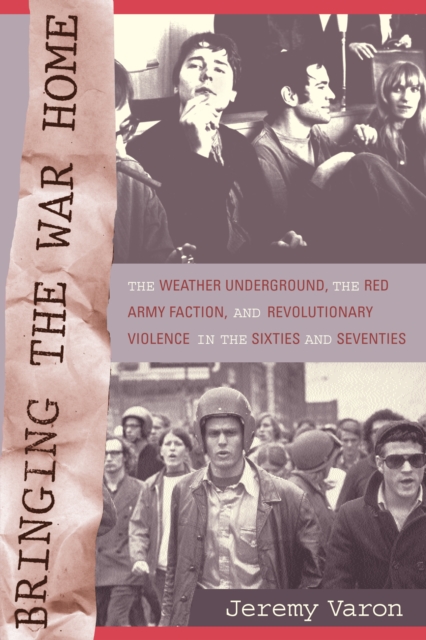
Bringing the War Home
In this first comprehensive comparison of left-wing violence in the United States and West Germany, Jeremy Varon focuses on America's Weather Underground and Germany's Red Army Faction to consider how and why young, middle-class radicals in prosperous democratic societies turned to armed struggle in efforts to overthrow their states. Based on a wealth of primary material, ranging from interviews to FBI reports, this book reconstructs the motivation and ideology of violent organizations active during the 1960s and 1970s. Varon conveys the intense passions of the era--the heat of moral purpose, the depth of Utopian longing, the sense of danger and despair, and the exhilaration over temporary triumphs. Varon's compelling interpretation of the logic and limits of dissent in democratic societies provides striking insights into the role of militancy in contemporary protest movements and has wide implications for the United States' current \"war on terrorism.\" Varon explores Weatherman and RAF's strong similarities and the reasons why radicals in different settings developed a shared set of values, languages, and strategies. Addressing the relationship of historical memory to political action, Varon demonstrates how Germany's fascist past influenced the brutal and escalating nature of the West German conflict in the 60s and 70s, as well as the reasons why left-wing violence dropped sharply in the United States during the 1970s. Bringing the War Home is a fascinating account of why violence develops within social movements, how states can respond to radical dissent and forms of terror, how the rational and irrational can combine in political movements, and finally how moral outrage and militancy can play both constructive and destructive roles in efforts at social change.
eBook

Terror and democracy in West Germany
\"In 1970, the Red Army Faction declared war on West Germany. The militants failed to bring down the state, but this book argues that the decade-long debate they inspired helped shape a new era. After 1945, West Germans answered long-standing doubts about democracy's viability and fears of authoritarian state power with a 'militant democracy' empowered against its enemies and a popular commitment to anti-fascist resistance. In the 1970s, these postwar solutions brought Germans into open conflict, fighting to protect democracy from both terrorism and state overreaction. Drawing on diverse sources, Karrin Hanshew shows how Germans, faced with a state of emergency and haunted by their own history, managed to learn from the past and defuse this adversarial dynamic. This negotiation of terror helped them to accept the Federal Republic of Germany as a stable, reformable polity and to reconceive of democracy's defence as part of everyday politics\"-- Provided by publisher.
Book

Ulrike Meinhof and West German Terrorism
In 1970 Ulrike Meinhof abandoned a career as a political journalist to join the Red Army Faction; captured as a terrorist along with other members of the group in 1972, she died an unexplained death in a high-security prison in 1976. A charismatic spokesperson for the RAF, she has often come near to being idealized as a freedom fighter, despite her use of extreme violence. In an effort to understand how terrorism takes root, Sarah Colvin seeks a dispassionate view of Meinhof and a period when West Germany was declaring its own \"war on terror.\" Ulrike Meinhof always remained a writer, and this book focuses on the role of language in her development and that of the RAF: how Meinhof came to justify violence to the point of murder, creating an identity for the RAF as resistance fighters in an imagined state of war that was reinforced by the state's adoption of what Andreas Musolff has called 'war terminology.' But its all-powerful identity as a fighting group eroded the RAF's empathy with other human beings - even those it once claimed to be 'fighting for.' It became a closed unit, self-justifying and immobilized by its own conviction that everything it did must be right. This is the first specialized study of Meinhof and the RAF in English - which is remarkable given the current interest in the topic in both Europe and the U.S. Sarah Colvin is Professor and Eudo C. Mason Chair of the German Department at the University of Edinburgh, UK.
eBook