
Catalogue Search | MBRL


Are you sure you want to remove the book from the shelf?

{{itemTitle}}
125
result(s) for
"Royal African Company"
Sort by:

Freedom's Debt
In the years following the Glorious Revolution, independent slave traders challenged the charter of the Royal African Company by asserting their natural rights as Britons to trade freely in enslaved Africans. In this comprehensive history of the rise and fall of the RAC, William A. Pettigrew grounds the transatlantic slave trade in politics, not economic forces, analyzing the ideological arguments of the RAC and its opponents in Parliament and in public debate. Ultimately, Pettigrew powerfully reasons that freedom became the rallying cry for those who wished to participate in the slave trade and therefore bolstered the expansion of the largest intercontinental forced migration in history.Unlike previous histories of the RAC, Pettigrew's study pursues the Company's story beyond the trade's complete deregulation in 1712 to its demise in 1752. Opening the trade led to its escalation, which provided a reliable supply of enslaved Africans to the mainland American colonies, thus playing a critical part in entrenching African slavery as the colonies' preferred solution to the American problem of labor supply.
eBook

Mercantilism, Enslavement, and Form: The Royal African Company's Rawlinson Archive
This article analyzes formal and substantive aspects of correspondence produced by Royal African Company factors stationed on the West African littoral. While the RAC factors' letters have been marshaled to illuminate critical historical aspects of mercantile exchange and the traffic in captive African persons, they have not been examined as formal artifacts in relation to canonical features of the Enlightenment literary epistle. This essay traces a mercantile genealogy of the letter form that mobilizes epistolary devices like writing to the moment to represent the highly contingent determinants of exchange value in West Africa's mercantile contact zone. By contrast with the bookkeeper's ledger, the form of the RAC correspondence makes manifest the factor's ethical disinterest in the practice of enslavement. Ultimately, this essay argues that the RAC correspondence must be considered a part of English literary history.
Journal Article
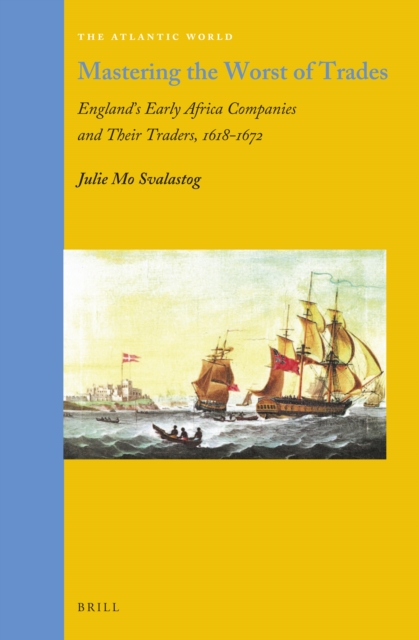
Mastering the worst of trades : England's early Africa companies and their traders, 1618-1672
An account of the emergence of England's earliest chartered Africa companies and their traders. It questions the interaction between company and private interests and their mutual impact on the emerging Atlantic of the seventeenth century and beyond.
eBook

‘To get a cargo of flesh, bone, and blood’: Animals in the slave trade in West Africa
This article examines how English and West African agents involved in the slave trade in Atlantic Africa used animals to establish trust, forge political bonds, connect distant spaces through a shared medium of exchange, and create regular trading networks from the late seventeenth century until the early eighteenth century. Slave traders from the Royal African Company and diverse West African polities offered each other livestock for sacrifice or as diplomatic gifts to formalise political or commercial alliances. Traders used the shells of cowry sea snails as abstract currency to purchase captives. These exchanges gradually produced and constituted an ecocultural network of human and animal social relationships and cross-cultural negotiations that enabled the expansion of England's involvement in the slave trade from the Gambia River to the Gold Coast and the Bight of Benin. However, vermin animals impeded these connections by destroying valuable commodities, including trade goods and human captives. This article aims to deepen our understanding of how animals bound European and African slave traders together into new networks of exchange, and how some animals threatened the stability of their partnerships.
Journal Article

“Legitimate commerce” in the Eighteenth Century: The Royal African Company of England Under the Duke of Chandos, 1720–1726
Following the loss in 1712 of its previous monopoly over British trade with West Africa, the Royal African Company found itself unable to compete with smaller, lower-cost British slave traders and nearly collapsed entirely. Salvation seemed to arrive in 1720 in the person of James Brydges, the Duke of Chandos, who led a massive re-capitalization of the company and made the strategic decision to move its focus to the commodity trade between Europe and Africa and on the search for new botanical and mineral resources in Africa itself. While Chandos directed the RAC’s employees in implementing this radical new scheme, he kept it secret from his fellow shareholders, leading them to believe that his plans were aimed at revitalizing the company’s mature but declining line of business in the transatlantic slave trade. The Duke’s strategy, however, proved overly ambitious and failed to reverse the company’s decline.
Journal Article
Principal Agent Relations and the Decline of the Royal African Company
Abstract
Several explanations for the Royal African Company’s failure around the turn of the eighteenth century have been suggested. The paper argues that these reasons can be integrated into a more comprehensive account of the company’s failure through the introduction of a modified version of principal-agent theory. Instead of focusing on abstract, dyadic relationships, the paper proposes a model that accounts for the meaningful character of principal agent interactions and for the complex networks and multiple role identities of actors within those networks that comprised principal-agent relations within the company. On the basis of this model the failure of the company can be seen as a result of contradictions between its dual role as both agent and principal. The symbolic importance of inefficient trading practices helps to explain why the company was unable to pursue alternative strategies or otherwise benefit from its monopoly.
Book Chapter
The British Atlantic Empire before the American Revolution
First Published in 1980. The dynamism within the American colonies in the fifty years or so before the outbreak of the crisis of the 1760s that was to lead to the Revolution has never been in doubt. The articles written included in this text suggest a number of ways in which the ‘imperial factor’ was of real importance in colonial life and show that there was dynamism on the British side as well as in the colonies.
eBook

“Giants of an Earlier Capitalism”: The Chartered Trading Companies as Modern Multinationals
Much has been written about late-nineteenth-century multinationals and their relationship to the transnational firms of the present, but both historians and economists have largely discounted the relevance of the earlier chartered trading companies to this discussion. In an article emphasizing transaction cost analysis and the theory of the firm, Professors Carlos and Nicholas argue that the trading companies did meet the criteria of the modern MNE—the growth of a managerial hierarchy necessitated by a large volume of transactions and of systems to control those managers over space and time.
Journal Article


The Legacies
This chapter assesses how the political disputes between the African Company and the separate traders helped produce from the 1680s to the 1760s the ideological and policy underpinnings for the antislavery movement that developed in the final third of the eighteenth century into full-blown abolitionism. The public, parliamentary setting for the debates between the separate traders and the African Company broadened the discussion beyond the narrow consideration of the management of the trade to the treatment of Africans. The dialogic impetus between company and traders also saw the refinement of their respective positions on regulation so that monopoly came to be seen as a potential means to rein in the slave trade’s unique brutality.
Book Chapter