
Catalogue Search | MBRL


Are you sure you want to remove the book from the shelf?

{{itemTitle}}
682
result(s) for
"Ruby, Jack"
Sort by:

Frederic Andrews Gibbs and the assassination of John Fitzgerald Kennedy
Frederic Gibbs, the peerless expert on electroencephalogrphy was summoned to provide opinion on the EEG tracing of Jack Ruby, who murdered Lee Harvey Oswald, the assassin of John Fitzgerald Kennedy, the American President, in 1963. Gibbs pleaded that the tracing suggested features indicative of psychomotor epilepsy and Ruby killed Oswald in a state of fugue. His view was not agreed upon but Gibbs stood his ground unflinchingly. Subsequent appeals to the higher court spared Ruby from imminent execution and finally he died a natural death from metastatic complications of carcinoma of the lung in 1967.
Journal Article

\You Are the Man who Killed My Brother\: Krieger v. Mittelman, New York, 1950
In June 1950, American newspapers reported a heated skirmish between two Holocaust survivors in New York. The altercation stemmed from one survivor accusing the other of murdering his brother in the Muhldorf labor camp in Germany. As the news spread, concerns rippled through the leadership of the American Jewish Congress (AJC), fearing that the ensuing negative publicity could jeopardize the willingness of authorities to allow survivors to immigrate to the United States. Drawing upon extensive archival material, including a comprehensive transcript of the legal proceedings meticulously assembled by the AJC, I delve into the intricate motivations and multifaceted reactions surrounding this trial. By excavating the historical layers, I shed light on underlying tensions within the survivors ' community and underscore gaps between survivors and American Jews in their perceptions of the Holocaust.
Journal Article

Who Killed Kennedy?
Because most of the conspiracy theories surrounding the Kennedy assassination involve questions about whether there was a second shooter firing at the president from behind a picket fence behind a \"grassy knoll,\" the term \"grassy knoll\" is almost synonymous with \"conspiracy theory.\") Any review of the various theories as to who killed President Kennedy must necessarily begin with a summary of Oswald's rather unusual life in his 24 years on this Earth, which provide fertile soil for a variety of theories cither that he did not act alone, or that he had nothing to do with the assassination but was, in his words, \"a patsy.\" Interestingly, the Warren Commission withheld information about Oswald's possible knowledge of the U-2 planes in their report. There is little known about Oswald's time in Russia, but it is known that he had excellent living conditions in Minsk, Belarus, which, according to FBI Director J. Edgar Hoover, was the site of an espionage training school.
Journal Article

The Commission Has Investigated Rumors That Jack Ruby and Lee Harvey Oswald Were Both Homosexuals
In the wake of the assassination, President Lyndon B. Johnson appointed a commission to look into the facts surrounding the murders of President Kennedy and Lee Harvey Oswald. The report took its name from Chief Justice Earl Warren, who chaired the commission. The report concluded that Oswald was the lone gunman in the president’s murder. This chapter focuses on the report’s emphasis on the potential homosexuality of both Oswald and his killer, Jack Ruby. It also considers the impact of a case DA Jim Garrison argued before the Supreme Court in 1964. The finding in that case further empowered the prominent DA, leading to his reelection in 1965. It was during this second term that Garrison began an investigation into the possibility of a New Orleans-based conspiracy in the president’s murder.
Book Chapter

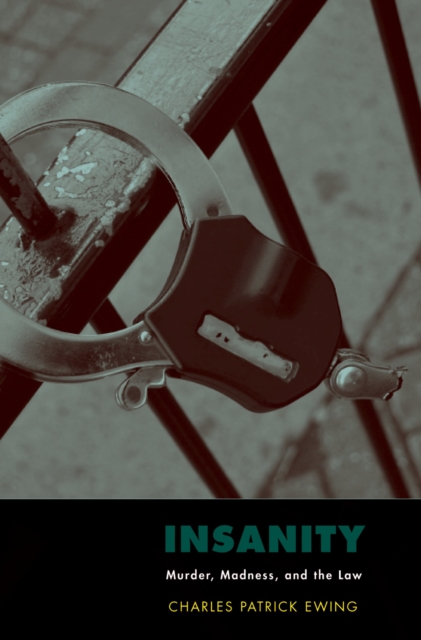
Insanity : murder, madness, and the law
The insanity defense is one of the oldest fixtures of the Anglo-American legal tradition. Though it is available to people charged with virtually any crime, and is often employed without controversy, homicide defendants who raise the insanity defense are often viewed by the public and even the legal system as trying to get away with murder. Often it seems that the legal result of an insanity defense is unpredictable, and is determined not by the defendant's mental state, but by their lawyers' and psychologists' influence. From the thousands of murder cases in which defendants have claimed insanity, Doctor Ewing has chosen ten of the most influential and widely varied. Some were successful in their insanity plea, while others were rejected. Some of the defendants remain household names years after the fact, like Jack Ruby, while others were never nationally publicized. Regardless of the circumstances, each case considered here was extremely controversial, hotly contested, and relied heavily on lengthy testimony by expert psychologists and psychiatrists. Several of them played a major role in shaping the criminal justice system as we know it today.
eBook