
Catalogue Search | MBRL


Are you sure you want to remove the book from the shelf?

{{itemTitle}}
1,658,679
result(s) for
"Rugby"
Sort by:


Roy Paxton Anderson
A vet with a no-nonsense, good-humoured approach to practice, he had a loyal following of clients. He was very active in the local community and was proud to serve as Deputy Lieutenant for Stirling and Falkirk.
Journal Article

44 Implementing an early detection strategy to detect early signs of groin problems and to monitor hip strength throughout a season
IntroductionThe aim of this study was to implement and evaluate an early groin problem detection strategy and to monitor hip adduction and abduction strength of rugby union players during a full season.Materials and Methods49 male, senior, rugby union players performed isometric hip adduction and abduction strength assessments in the 0° hip-flexion long-lever testing position using the ForceFrame, weekly for 28-weeks. Alerts were recorded weekly and were defined as performance-limiting hip/groin pain, adduction strength decrease >10%, or adduction:abduction strength ratio <0.90.Results371 alerts were registered over the study period, by a total of 39 players, with one player sustaining a time-loss groin injury. 34 alerts were pain-related, while 337 were strength-related. Players who triggered a pain-related alert had significantly lower (p=0.049) baseline hip adduction strength (1.86 ± 0.58 Nm/kg) compared to players who did not (2.27 ± 0.48 Nm/kg). Similarly, players who triggered a strength-related alert had lower baseline hip adduction strength (2.03 ± 0.56Nm/kg) and significantly lower baseline hip adduction:abduction strength ratio (0.97 ± 0.22), compared to players who did not trigger a strength-related alert (2.30 ± 0.41Nm/kg, and 1.12 ± 0.12 respectively). At group-level, time did not demonstrate a significant main effect on hip adduction, abduction or adduction:abduction strength ratio throughout the season.ConclusionAn early detection strategy can identify players with groin problems and can be implemented throughout a full season. Players who triggered alerts for groin problems during the season had lower baseline hip adduction and hip adduction:abduction strength ratios than players who did not trigger these alerts.
Journal Article

My life and rugby : the autobiography
Eddie Jones is one of the most experienced and decorated coaches in world rugby. He career has spanned four World Cups; from losing to England in the 100th minute in 2003, working with South Africa when they won in 2007, and causing the greatest upset in 2015 when he masterminded the Japanese defeat of South Africa. Since taking over as head coach of England in 2015 Eddie Jones has masterminded a complete revival of the national team. He has won the Six Nations Championship back-to-back, including England's first grand slam in a generation, their first ever whitewash of Australia, as well as taking them on their longest ever winning streak. In his explosive autobiography Jones shows how his fiercely competitive attitude, his love of coaching and his philosophy of the game were formed while growing up in a tough working-class suburb of Sydney as a small half-Japanese kid, playing schoolboy rugby alongside the legendary Ella brothers.
Book
74 (8A) Quantifying full-season head acceleration exposure in professional men’s rugby league players: exploring imputation methods with instrumented mouthguards
PurposeHead acceleration events (HAEs) are a concern in sports due to potential long-term neurological effects. Instrumented mouthguards (iMG) quantify HAEs, however missing data limits their ability to provide full-season exposure. This study utilises imputation methods to estimate HAE exposure in professional men’s rugby league.MethodsVideo analysis was conducted across 167 rugby league matches of the 2024 Super League season, 254 male players recorded iMG data in at least one match. These players participated in 4,600 player matches and iMG data were collected in 68.8% (n=3,163), meaning imputation was necessary in the remaining 31.2%. Player matches with iMG data were split into training (n=1,704) and testing (n=424) datasets to train XGBoost, random forest, and generalised linear mixed models (GLMM). Estimated HAE count was compared against the actual via root mean square error (RMSE), mean absolute error (MAE), and R2 values.ResultsThe median (interquartile range [IQR]) HAE count per player match was 24 (16–33). The GLMM had the highest predictive performance with RMSE, MAE and R2 of 6.47, 4.86, and 0.70, respectively. XGBoost and Random Forest models performed worse with RMSE of 7.98 and 8.09, MAE of 6.06 and 6.13, and R2 of 0.57 and 0.54. The median (IQR) full-season HAE count was 390 (218–601) using GLMM imputation, the highest was 1,606 (figure 1).Abstract 74 (8A) Figure 1Full season HAE (>10 g) counts for each player (n = 254) with iMG data across the super league 2024 season based on recorded and imputed (via GLMM) player match HAE counts[Figure omitted. See PDF]ConclusionImputation is necessary for estimating full HAE exposures given missing iMG data. GLMMs may be beneficial for imputation due to their ability to account for individuals. Predicted HAE exposures revealed considerable variation in full-season HAE exposure across players.
Journal Article

Unholy union : when rugby collided with the modern world
No sport has undergone so traumatic a transformation as rugby since the turn of the century. The last of the major sports to be granted a license to make or dispense money, rugby was propelled on a trajectory that has twisted its cumbersome frame to the very limits of integrity and continues to do so. The pressures exerted throughout, on infrastructure, economics, administrators and, most poignantly of all, the players themselves, have conjured the perpetual impression of a sport on the brink of explosion or implosion, a drama compelling and appalling to behold. Unholy Union is a snapshot of the sport in the early 21st century, pulling apart how we have come to be where we are, while brazenly prescribing what needs to be done next. It is ambitious in its scope, drawing on rugby's long history from the same cradle as its bigger sister, association football, while tapping into the edgy, prescriptive zeitgeist of this raging age of social media. This book will be irreverent and provocative, asking uncomfortable questions of rugby, sport and life, but it will be imbued throughout with love for a game whose ancient spirit is that of the foot soldier, that of the cavalier. The task at hand is to preserve it in the face of the professional onslaught.
Book

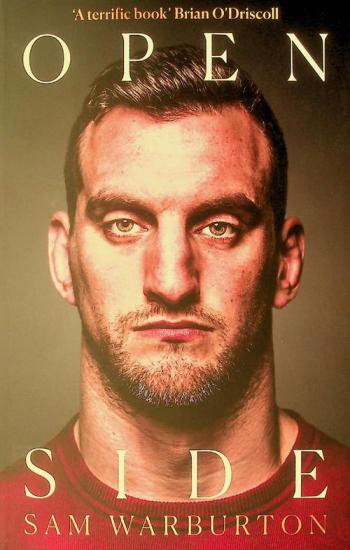
Open side
Sam Warburton OBE was not only a titan of Welsh rugby, but an icon of the game. Having represented his country as a player and team captain at all junior levels, he propelled himself to international attention in 2011 when named as the youngest ever captain of Wales for the Rugby World Cup. Despite his tender age, Sam's immense displays for club and country were recognised still further in April 2013, when, at just 24, he was named the Lions' captain for the extraordinary 2013 tour to Australia. Four years later, after a year 'in the wilderness', Sam was named Lions' captain yet again for the historic tour to New Zealand, thereby becoming the first ever Lions Captain never to lose a series in the professional era. Intelligent, calm, thoughtful - in many ways seemingly the exact opposite of the smash and crash of modern rugby - Warburton's edge never came with his size, but with his depth of thought, his reading of movement, and his understanding that, to be a uniquely successful leader, one needs to set goals that far exceed the ambitions of even the most ferocious of opponents. In leading other men, and in pitting himself against the world's best, Warburton was forced repeatedly to push himself to the very edge of his physiological and mental limits, the 21 significant injuries over that period a painful testament to his sacrifice. Open Side is therefore not simply a chronology of events or a celebration of statistics. Written in a compelling but soul searching style, this is an astoundingly personal book exploring the nature of leadership, the value of self-control, the precision of mindset and of course the future of the game. It is also a deeply personal meditation on the sacrifice of body, the torment of injury and the pain of retirement, a decision Sam was forced to make in July 2018, at just 29 years old. Never before has a rugby autobiography given such intimate access not only to the realities of the dressing room and the heroes and villains of the modern game, but to the unique mindset required to make someone a genuinely great leader of men.
