
Catalogue Search | MBRL


Are you sure you want to remove the book from the shelf?

{{itemTitle}}
51,564
result(s) for
"Rural Planning"
Sort by:

Role of regional development agencies in entrepreneurial and rural development : emerging research and opportunities
\"\"This book provides an analysis on the role of regional development agencies in entrepreneurial and rural development\"--Provided by publisher\"-- Provided by publisher.
Book
role of the state and individual in sustainable land management
Bringing together case studies from Europe, Africa and North and South America, this book makes a fresh assessment of the role of the individual and the state in land development. It discusses a range of issues related to land reform, land development and land management, providing a unique reflection of the current state of research. Particular emphasis is laid on the implementation of sustainable processes of land development as an integrated principle of land management. The book examines the rights of the land users and addresses a number of issues relating to sustainability and land development, ranging from emerging land markets and environmental issues, through to natural resource development. The case studies provide practical examples of the application of land reform and land development to land management.
Contents: Introduction, Robert Dixon-Gough; Land ownership and personal empowerment: a review of some aspects of current land reforms in the light of the lessons of modern social history, Chris Arnison; Changes in land use and their implications upon coastal regions: the case of Grange-over-Sands, Northwest England, Robert Dixon-Gough ; Land management, cadastral reform and biodiversity: a New Zealand study Munir Morad; The contested territories of Costa Rica: sustainable land management challenges in the Neotropics, Simon Evans; Flood defence and estuary management: a case study of the Blackwater estuary, Essex, England, Peter Wynn; Characteristics of land-related administrative institutions: what is needed to support equitable and productive land development?, David Bledsoe; Managing informal settlements in Botswana, Robert Dixon-Gough and Otladisane Molobeng; The contribution of foreign assistance to the development of land markets and the strengthening of property rights: the case of USAID, Peter C Bloch, Susana Lastarria-Cornhiel and J. David Stanfield; Comparative evaluation of purchase and subdivision processes in Denmark, England and Wales, and Belarus, Marina Vaskovitch, Robert Dixon-Gough and Erik Stubkjœr; The role of land consolidation and land readjustment in modern society,Robert Dixon-Gough; Land tenure reform in Scotland, Anthony Andrew; Index.
eBook

Green Revolution research saved an estimated 18 to 27 million hectares from being brought into agricultural production
New estimates of the impacts of germplasm improvement in the major staple crops between 1965 and 2004 on global land-cover change are presented, based on simulations carried out using a global economic model (Global Trade Analysis Project Agro-Ecological Zone), a multicommodity, multiregional computable general equilibrium model linked to a global spatially explicit database on land use. We estimate the impact of removing the gains in cereal productivity attributed to the widespread adoption of improved varieties in developing countries. Here, several different effects—higher yields, lower prices, higher land rents, and trade effects—have been incorporated in a single model of the impact of Green Revolution research (and subsequent advances in yields from crop germplasm improvement) on land-cover change. Our results generally support the Borlaug hypothesis that increases in cereal yields as a result of widespread adoption of improved crop germplasm have saved natural ecosystems from being converted to agriculture. However, this relationship is complex, and the net effect is of a much smaller magnitude than Borlaug proposed. We estimate that the total crop area in 2004 would have been between 17.9 and 26.7 million hectares larger in a world that had not benefited from crop germplasm improvement since 1965. Of these hectares, 12.0-17.7 million would have been in developing countries, displacing pastures and resulting in an estimated 2 million hectares of additional deforestation. However, the negative impacts of higher food prices on poverty and hunger under this scenario would likely have dwarfed the welfare effects of agricultural expansion.
Journal Article

Rural development planning in Africa
This book applies a range of theories that focus on current concerns in rural Africa. The contributors lay out the conceptualization, analysis, methods, assumptions, perceptions, and ideas considered in each individual case. Specifically, this project inspires research in the field of rural development in Africa through multi-faceted endeavors that promote the ability of planning to uplift people's well-being and quality of life.
Book

Participatory Rural Spatial Planning Based on a Virtual Globe-Based 3D PGIS
With the current spatial planning reform in China, public participation is becoming increasingly important in the success of rural spatial planning. However, engaging various stakeholders in spatial planning projects is difficult, mainly due to the lack of planning knowledge and computer skills. Therefore, this paper discusses the development of a virtual globe-based 3D participatory geographic information system (PGIS) aiming to support public participation in the spatial planning process. The 3D PGIS-based rural planning approach was applied in the village of XiaFan, Ningbo, China. The results demonstrate that locals’ participation capacity was highly promoted, with their interest in 3D PGIS visualization being highly activated. The interactive landscape design tools allow stakeholders to present their own suggestions and designs, just like playing a computer game, thus improving their interactive planning abilities on-site. The scientific analysis tools allow planners to analyze and evaluate planning scenarios in different disciplines in real-time to quickly respond to suggestions from participants on-site. Functions and tools such as data management, marking, and highlighting were found to be useful for smoothing the interactions among planners and participants. In conclusion, virtual globe-based 3D PGIS highly supports the participatory rural landscape planning process and is potentially applicable to other regions.
Journal Article
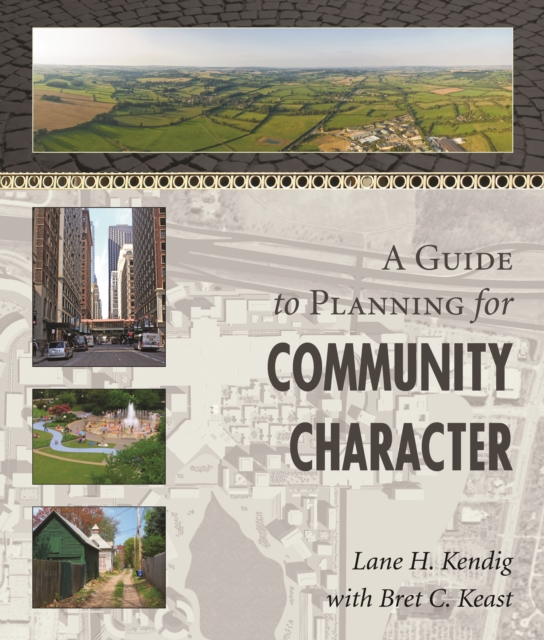
guide to planning for community character
A Guide to Planning for Community Character adds a wealth of practical applications to the framework that Lane Kendig describes in his previous book, Community Character. The purpose of the earlier book is to give citizens and planners a systematic way of thinking about the attributes of their communities and a common language to use for planning and zoning in a consistent and reliable way. This follow-up volume addresses actual design in the three general classes of communities in Kendig's framework-urban, suburban, and rural.
The author's practical approaches enable designers to create communities \"with the character that citizens actually want.\" Kendig also provides a guide for incorporating community character into a comprehensive plan. In addition, this book shows how to use community character in planning and zoning as a way of making communities more sustainable. All examples in the volume are designed to meet real-world challenges. They show how to design a community so that the desired character is actually achieved in the built result. The book also provides useful tools for analyzing or measuring relevant design features.
Together, the books provide a comprehensive treatment of community character, offering both a tested theory of planning based on visual and physical character and practical ways to plan and measure communities. The strength of this comprehensive approach is that it is ultimately less rigid and more adaptable than many recent \"flexible\" zoning codes.
eBook

Wealth creation : a new framework for rural economic and community development
\"A new approach to rural development is emerging. Instead of being about attracting companies that might create jobs over which communities have no control, the emerging paradigm is about connecting the unique underutilized assets of place with market opportunity to grow assets that are owned and controlled by and for the benefit of low-wealth people and places. But asset development is about more than bricks and mortar or narrowly defined financial assets. There are many kinds of assets that communities require to thrive - such as social capital, natural capital, political capital, and intellectual capital. The emerging new approach to rural development is, then about broadening the definition of \"wealth,\" engaging underutilized assets, and a key third element: harnessing the power of the market - rather than relying solely on philanthropy and government. Wealth Creation provides a conceptual guide with practical examples for policymakers, practitioners of economic and community development, community organizers, environmentalists, funders, investors, and corporations seeking a values-based framework for identifying self-interests across sectors that can lead to opportunities to transform existing systems for the collective good\"-- Provided by publisher.
Book
Changing Land Management
There is a rich and extensive history of research into factors that encourage farmers to change their land management practices, or inhibit them from doing so. Yet this research is often under-utilised in practice. Changing Land Management provides key insights from past and cutting-edge research to support decision-makers as they attempt to influence or assist rural communities adapting to changed circumstances, such as new technologies, new environmental imperatives, new market opportunities or changed climate. Understanding the process of practice change by rural landholders is crucial for policy makers, agricultural researchers, extension agents, natural resource management bodies, non-government organisations and agricultural consultants. For example, such understanding can assist with the design and implementation of environmental programs, with the prioritisation of agricultural research and with commercial ventures. Common themes are the need for an appreciation of the diversity of land managers and their contexts, of the diversity of factors that influence land-management decisions, and of the challenges that face government programs that are intended to change land management.
eBook