
Catalogue Search | MBRL


Are you sure you want to remove the book from the shelf?

{{itemTitle}}
40,836
result(s) for
"Russia, Ukraine"
Sort by:

Ukraine and the art of strategy
\"In Ukraine and the Art of Strategy, Sir Lawrence Freedman provides an account of the origins and course of the Russia-Ukraine conflict through the lens of the theory and practice of strategy. That is, he explores Putin's near, medium, and long-term strategies when he decided to initiate the conflict. How successful has he been? In contrast to many who see Putin as a master operator who has resuscitated a supine Russia against all odds, Freedman is less impressed with his strategic acumen in terms of the long-term fallout. By exploring concepts such as coercive diplomacy, limited war, escalation and information operations, Freedman brings the story up to the present, where a low-level conflict between Ukrainian and breakaway rebel forces in the east grinds on, and illuminates the external challenges faced by the governments' involved\"-- Provided by publisher.
BOOK

Everyday War
Everyday War provides an
accessible lens through which to understand what noncombatant
civilians go through in a country at war. What goes
through the mind of a mother who must send her child to school
across a minefield or the men who belong to groups of volunteer
body collectors? In Ukraine, such questions have been part of the
daily calculus of life. Greta Uehling engages with the lives of
ordinary people living in and around the armed conflict over Donbas
that began in 2014 and shows how conventional understandings of war
are incomplete.
In Ukraine, landscapes filled with death and destruction
prompted attentiveness to human vulnerabilities and the cultivation
of everyday, interpersonal peace. Uehling explores a constellation
of social practices where ethics of care were in operation. People
were also drawn into the conflict in an everyday form of war that
included provisioning fighters with military equipment they
purchased themselves, smuggling insulin, and cutting ties to former
friends. Each chapter considers a different site where care can
produce interpersonal peace or its antipode, everyday war.
Bridging the fields of political geography, international
relations, peace and conflict studies, and anthropology,
Everyday War considers where peace can be cultivated at an
everyday level.
eBook

Ukraine crisis : what it means for the West
The Ukraine issue has rapidly escalated into a major geopolitical crisis, the most severe test of the relationship between Russia and the West since the Cold War. And it is far from resolved. Andrew Wilson's account situates the crisis within Russia's covert ambition since 2004 to expand its influence within the former Soviet periphery, and over countries that have since joined the EU and NATO, such as the Baltic States. He shows how Russia has spent billions developing its soft power within central Europe, aided by US diplomatic inattention in the area, and how Putin's conservative values project is widely misunderstood in he West. The book examines Yanukovych's corrupt 'coup d'etat' of 2010 and provides the most intimate day-by-day account we have of the protests in Kiev from November 2013 to February 2014 (at which Wilson was present). It explores the military coup in Crimea, the role of Russia and long-term tensions with the Muslim Crimean Tatars. It covers the election of 25 May 2014 and the prospects for new president Petro Poroshenko. And it analyses other states under pressure from Russia - Georgia, Moldova, Belarus. 'Russia will clearly not stop at Ukraine'. Andrew Wilson has been covering the Ukrainian crisis in newspapers, broadcasts and digital media (see link http://www.ucl.ac.uk/ssees/ssees-news-publication/andrew_wilson), was in the Maidan, Kiev, for the crucial demonstrations in February, and briefed Number 10 on his return.
Book
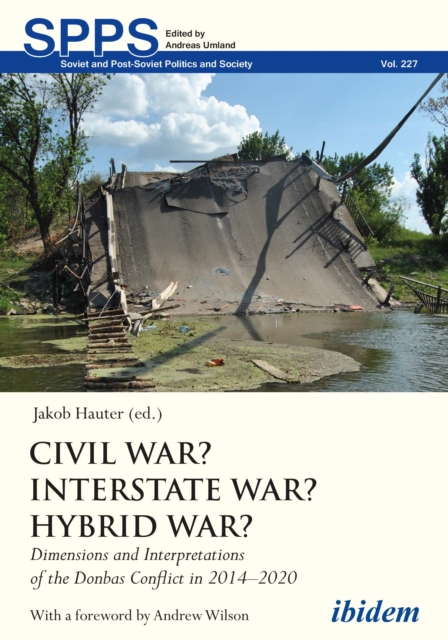
Civil War? Interstate War? Hybrid War?
This volume of collected papers takes stock of what has become known about the war in eastern Ukraines Donets Basin (Donbas) between April 2014 and mid-2020.It provides an introduction to the conflict and illustrates the key point of contention in the academic debate surrounding itthe question whether this war is primarily an internal Ukrainian.
eBook
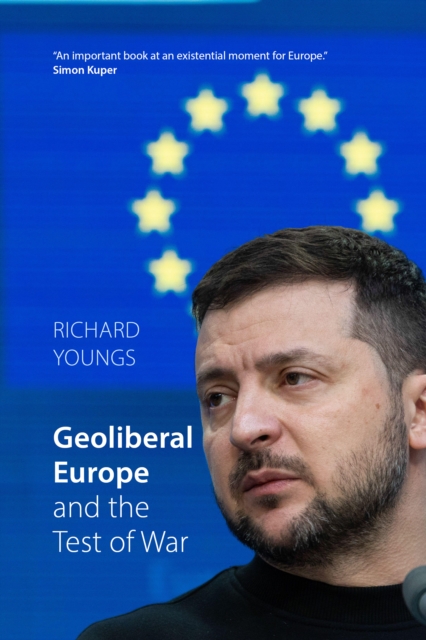
Geoliberal Europe and the Test of War
Russia's invasion of Ukraine has pushed Europe into a new strategic era. The knock-on effects of the war have combined to open a period of reordering across the European continent. European governments and the European Union collectively have begun to fashion policies for this shift, recognizing this to be a pivotal historical moment.
Richard Youngs unpacks the different dynamics that have come to characterize European policies in the wake of the war: the nature of EU integration, geopolitical power, defence priorities, European borders, liberal values, the green transition and economic sovereignty. The book looks to the future and outlines the issues and choices with which European governments still need to grapple. Youngs develops the notion of geoliberalism as a way of addressing these challenges and guiding European governments and the EU into the fragile order taking shape in the shadow of Ukraine's war.
eBook

The Russo-Ukrainian war : the return of history
\"Despite repeated warnings from the White House, Russia's invasion of Ukraine in February 2022 shocked the world. Why did Putin start the war--and why has it unfolded in previously unimaginable ways? Ukrainians have resisted a superior military; the West has united, while Russia grows increasingly isolated. Serhii Plokhy, a leading historian of Ukraine and the Cold War, offers a definitive account of this conflict, its origins, course, and the already apparent and possible future consequences\"-- Provided by publisher.
Book

Staging Democracy
Focusing on the experiences of people in Russia and Ukraine,
Staging Democracy shows how some national leaders' seeming
popularity rests on local economic compacts. Jessica Pisano draws
on long-term research in rural communities and company towns,
analyzing how local political and business leaders, seeking favor
from incumbent politicians, used salaries, benefits, and public
infrastructure to pressure citizens to participate in command
performances.
Pisano looks at elections whose outcome was known in advance,
protests for hire, and smaller mises en scène to explain why people
participate, what differs from spectacle in totalitarian societies,
how political theater exists in both authoritarian and democratic
systems, and how such performances reshape understandings of the
role of politics.
Staging Democracy moves beyond Russia and Ukraine to
offer a novel economic argument for why some people support Putin
and similar politicians. Pisano suggests we can analyze politics in
both democracies and authoritarian regimes using the same
analytical lens of political theater.
eBook

The Crimean nexus : Putin's war and the clash of civilizations
Provides an account of the major international crisis in Crimea and explains the missteps made on all sides.
BOOK

Children of Rus
InChildren of Rus', Faith Hillis recovers an all but forgotten chapter in the history of the tsarist empire and its southwestern borderlands. The right bank, or west side, of the Dnieper River-which today is located at the heart of the independent state of Ukraine-was one of the Russian empire's last territorial acquisitions, annexed only in the late eighteenth century. Yet over the course of the long nineteenth century, this newly acquired region nearly a thousand miles from Moscow and St. Petersburg generated a powerful Russian nationalist movement. Claiming to restore the ancient customs of the East Slavs, the southwest's Russian nationalists sought to empower the ordinary Orthodox residents of the borderlands and to diminish the influence of their non-Orthodox minorities.
Right-bank Ukraine would seem unlikely terrain to nourish a Russian nationalist imagination. It was among the empire's most diverse corners, with few of its residents speaking Russian as their native language or identifying with the culture of the Great Russian interior. Nevertheless, as Hillis shows, by the late nineteenth century, Russian nationalists had established a strong foothold in the southwest's culture and educated society; in the first decade of the twentieth, they secured a leading role in local mass politics. By 1910, with help from sympathetic officials in St. Petersburg, right-bank activists expanded their sights beyond the borderlands, hoping to spread their nationalizing agenda across the empire.
Exploring why and how the empire's southwestern borderlands produced its most organized and politically successful Russian nationalist movement, Hillis puts forth a bold new interpretation of state-society relations under tsarism as she reconstructs the role that a peripheral region played in attempting to define the essential characteristics of the Russian people and their state.
eBook