
Catalogue Search | MBRL


Are you sure you want to remove the book from the shelf?

{{itemTitle}}
319
result(s) for
"Russia (Federation) -- Languages"
Sort by:

Words like birds : Sakha language discourses and practices in the city
\"An analysis of Sakha linguistic sensibilities and practices in the urban space of Yakutsk, capital of the Sakha Republic, based on research conducted in the early twenty-first century\"-- Provided by publisher.
Book

Religion and Language in Post-Soviet Russia
Church Slavonic, one of the world's historic sacred languages, has experienced a revival in post-Soviet Russia. Blending religious studies and sociolinguistics, this is the first book devoted to Church Slavonic in the contemporary period. It is not a narrow study in linguistics, but uses Slavonic as a passkey into various wider topics, including the renewal and factionalism of the Orthodox Church; the transformation of the Russian language; and the debates about protecting the nation from Western cults and culture. It considers both official and popular forms of Orthodox Christianity, as well as Russia's esoteric and neo-pagan traditions. Ranging over such diverse areas as liturgy, pedagogy, typography, mythology, and conspiracy theory, the book illuminates the complex interrelationship between language and faith in post-communist society, and shows how Slavonic has performed important symbolic work during a momentous chapter in Russian history. It is of great interest to scholars of sociolinguistics and of religion, as well as to Russian studies specialists.
eBook

After Newspeak
In After Newspeak, Michael S. Gorham presents a cultural history of the politics of Russian language from Gorbachev and glasnost to Putin and the emergence of new generations of Web technologies. Gorham begins from the premise that periods of rapid and radical change both shape and are shaped by language. He documents the role and fate of the Russian language in the collapse of the USSR and the decades of reform and national reconstruction that have followed. Gorham demonstrates the inextricable linkage of language and politics in everything from dictionaries of profanity to the flood of publications on linguistic self-help, the speech patterns of the country's leaders, the blogs of its bureaucrats, and the official programs promoting the use of Russian in the so-called \"near abroad.\"
Gorham explains why glasnost figured as such a critical rhetorical battleground in the political strife that led to the Soviet Union's collapse and shows why Russians came to deride the newfound freedom of speech of the 1990s as little more than the right to swear in public. He assesses the impact of Medvedev's role as Blogger-in-Chief and the role Putin's vulgar speech practices played in the restoration of national pride. And he investigates whether Internet communication and new media technologies have helped to consolidate a more vibrant democracy and civil society or if they serve as an additional resource for the political technologies manipulated by the Kremlin.
eBook

Legacies of totalitarian language in the discourse culture of the post-totalitarian era
This book is unique in its kind. It is the first scholarly work to attempt a comprehensive and fairly detailed look into the lingering legacies of the communist totalitarian modes of thought and expression in the new discourse forms of the post-totalitarian era. The book gives also new and interesting insights into the ways the new, presumably democratically-minded political elites in post-totalitarian Eastern Europe, Russia, and China manipulate language to serve their own political and economic agendas. The book consists of ten discrete discussions, nine case-studies or 'chapters' and an 'introduction.' Chapter 1 discusses patterns of continuity and change in the conceptual apparatus and linguistic habits of political science and sociology practiced in the Czech Republic before and after 1989. Chapter 2 analyzes lingering effects of communist propaganda language in the political discourse and behavior in post-communist Poland. Chapter 3 analyzes the legacy of Soviet semantics in post-Soviet Moldovan politics through the prism of such politically contested words as 'democracy,' 'democratization,' and 'people.' Chapters 4 and 5 discuss the way in which communist patterns of thought and expression manifest themselves in the new political discourse in Romania and Bulgaria, respectively. Chapter 6 examines phenomena of change and continuity in the socio-linguistic and socio-political scene of post-Soviet Latvia. Chapter 7 analyzes the extent to which the language of the post-communist Romanian media differs from the official language of the communist era. Chapter 8 examines the evolution of Russian official discourse since the late eighties with a view of showing 'whether or not new phenomena in the evolution of post-Soviet discourse represent new development or just a mutation of the value-orientations of the old Soviet ideological apparatus.' Chapter 9 gives a detailed and lucid account of the evolution of both official and non-official discourse in China since the end of the Mao era.
eBook
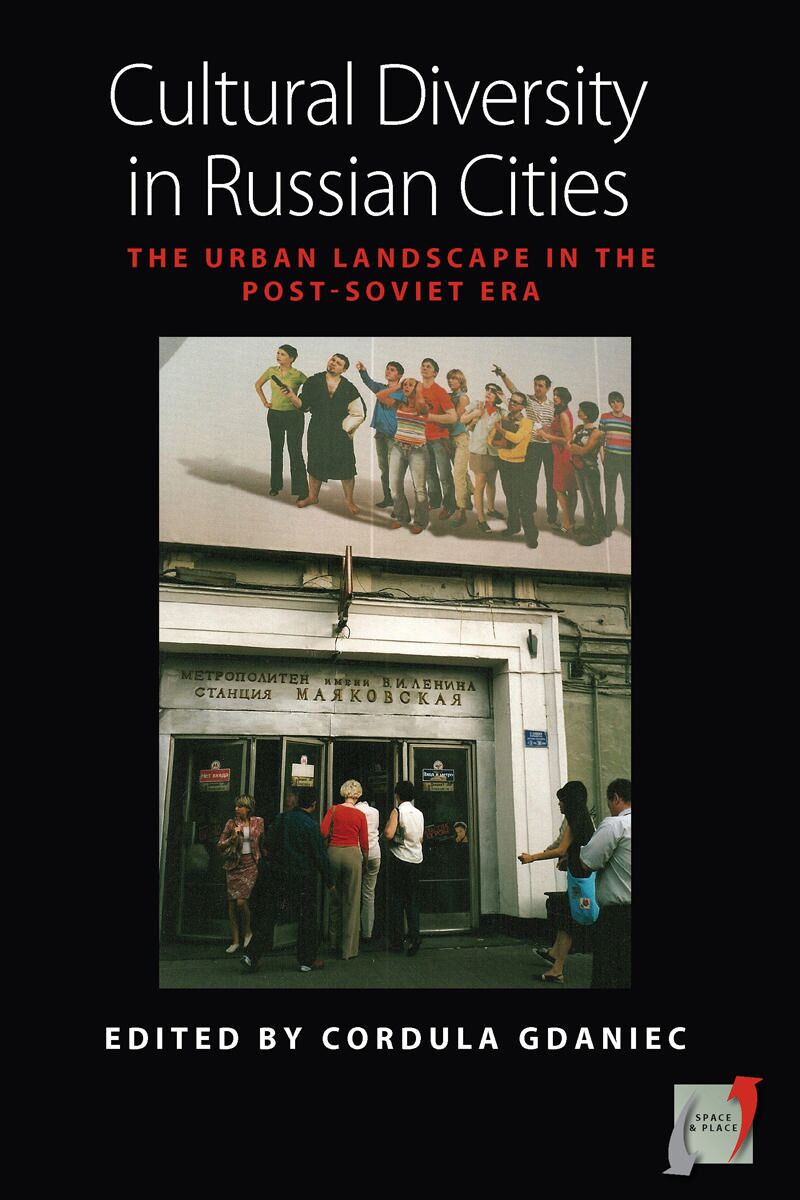
Cultural Diversity in Russian Cities
Cultural diversity — the multitude of different lifestyles that are not necessarily based on ethnic culture — is a catchphrase increasingly used in place of multiculturalism and in conjunction with globalization. Even though it is often used as a slogan it does capture a widespread phenomenon that cities must contend with in dealing with their increasingly diverse populations. The contributors examine how Russian cities are responding and through case studies from Moscow, St. Petersburg, Novosibirsk, and Sochi explore the ways in which different cultures are inscribed into urban spaces, when and where they are present in public space, and where and how they carve out their private spaces. Through its unique exploration of the Russian example, this volume addresses the implications of the fragmented urban landscape on cultural practices and discourses, ethnicity, lifestyles and subcultures, and economic practices, and in doing so provides important insights applicable to a global context.
eBook
Reconstructing non-standard languages : a socially-anchored approach
Focusing on language contact involving Russian, and the linguistic varieties that emerged from that contact in different social settings, this book analyzes issues and methodologies in reconstructing both the linguistic effects of language contact and the social contexts of usage.
eBook
Language relations across Bering Strait : reappraising the archaeological and linguistic evidence
In building up a scenario for the arrival on the shores of Alaska of speakers of languages related to Eskimo-Aleut with genetic roots deep within Sineria, this book touches upon a number of issues in contemporary historical linguistics and archaeology. The Arctic \"gateway\" to the New World, by acting as a bottleneck, has allowed only small groups of mobile hunter-gatherers through during specific propitious periods, and thus provides a unique testing ground for theories about population and language movements in pre-agricultural times. Owing to the historically attested prevalence of language shifts and other contact phenomena in the region, it is arguable that the spread of genes and the spread of language have been out of step since the earliest reconstructable times, contrary to certain views of their linkage. Proposals that have been put forward in the past concerning the affiliations of Eskimo-Aleut languages are followed up in the light of recent progress in reconstructing the proto-languages concerned. Those linking Eskimo-Aleut with the Uralic languages and Yukagir are particularly promising, and reconstructions for many common elements are presented. The entire region \"Great Beringia\" is scoured for typological evidence in the form of anomalies and constellations of uncommon traits diagnostic of affiliation or contact. The various threads lead back to mesolithic times in south central Siberia, when speakers of a \"Uralo-Siberian\" mesh of related languages appears to have moved along the major waterways of Siberia. Such a scenario would acount for the present distribution of these languages and the results of their meeting with remnants of earlier linguistic waves from the Old World to the New.
eBook


Russia's postcolonial identity : a subaltern empire in a Eurocentric world
01
02
This book applies postcolonial theory to Russia by looking at it as a subaltern empire. It pushes postcolonial studies and constructivist International Relations towards an uneasy dialogue, which produces tensions and reveals multiple blind spots in both approaches. A critical re-evaluation of the existing literature enables the author to produce a comprehensive account of how Russia's position in the international system has conditioned its domestic development, and how this in turn generated specific foreign policy outcomes. Having internalised the Eurocentric worldview, Russia is nevertheless different from the core European countries. This difference is not determined by 'culture', but rather by uneven and combined development of global capitalism, in which Russia is integrated as a semi-peripheral nation. The Russian state has colonised its own periphery on behalf of the Western core, but has never been able to overcome economic and normative dependency on the West. The peculiar dialectic of the subaltern and the imperial during the post-Soviet period has given rise to a regime which claims to defend 'genuine Russian values', while in fact there is nothing behind this new traditionalism but the negation of Western hegemony. Trying to 'defend' the nation from the postulated threat of Western interventionism, the regime engages in a disavowal of politics and thus suppresses popular subjectivity. The only political subject that remains on the horizon of Russian politics is the West, while the Russian people, as any other subaltern, are being spoken for, and thus silenced, by the country's Eurocentric elites and the Western intellectuals.
02
02
Pushing postcolonial studies and constructivist International Relations towards an uneasy dialogue, this book looks at Russia as a subaltern empire. It demonstrates how the dialectic of the subaltern and the imperial has produced a radically anti-Western regime, which nevertheless remains locked in a Eurocentric outlook.
04
02
1. The Postcolonial and the Imperial in the Space and Time of World Politics
2. Russia in/and Europe: Sources of Ambiguity
3. Material Dependency: Postcolonialism, Development and Russia's 'Backwardness'
4. Normative Dependency: Putinite Paleoconservatism and the Missing Peasant
5 The People are Speechless: Russia, the West and the Voice of the Subaltern
6. Conclusion
13
02
Viatcheslav Morozov is Professor of EU-Russia Studies at the University of Tartu. Before moving to Estonia in 2010, he taught for thirteen years at the St Petersburg State University, Russia. He is the author of Russia and the Others: Identity and Boundaries of a Political Communit y and the editor of Decentring the West: The Idea of Democracy and the Struggle for Hegemony .
eBook