
Catalogue Search | MBRL


Are you sure you want to remove the book from the shelf?

{{itemTitle}}
14
result(s) for
"Russia History February Revolution, 1917."
Sort by:


Shattering Empires
The break-up of the Ottoman empire and the disintegration of the Russian empire were watershed events in modern history. The unravelling of these empires was both cause and consequence of World War I and resulted in the deaths of millions. It irrevocably changed the landscape of the Middle East and Eurasia and reverberates to this day in conflicts throughout the Caucasus and Middle East. Shattering Empires draws on extensive research in the Ottoman and Russian archives to tell the story of the rivalry and collapse of two great empires. Overturning accounts that portray their clash as one of conflicting nationalisms, this pioneering study argues that geopolitical competition and the emergence of a new global interstate order provide the key to understanding the course of history in the Ottoman-Russian borderlands in the twentieth century. It will appeal to those interested in Middle Eastern, Russian, and Eurasian history, international relations, ethnic conflict, and World War I.
eBook

Eyewitness 1917 : the Russian Revolution as it happened
A dramatic account of a year of two revolutions in Russia, told through extracts from contemporary diaries, letters and memoirs and illustrated with many previously unpublished photographs.
Book
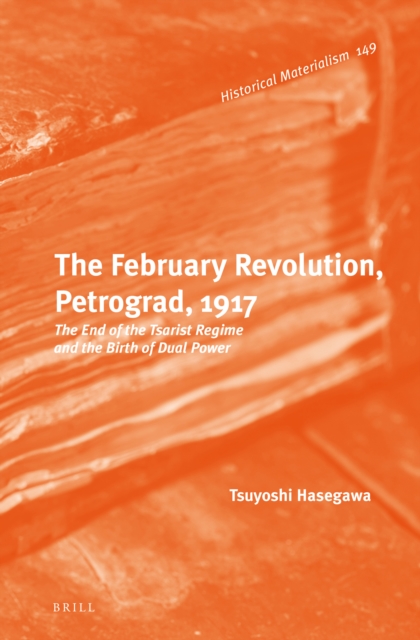
The February Revolution, Petrograd, 1917
The February Revolution, Petrograd, 1917 is the most comprehensive book on the epic uprising that toppled the tsarist monarchy and ushered in the next stage of the Russian Revolution. Hasegawa presents in detail the intense drama of the nine days of the revolution, including the workers' strike, soldiers' revolt, the scrambling of revolutionary party activists to control the revolution, and the liberals' conspiracy to force Tsar Nicholas II to abdicate. Based on his previous work, published in 1981, the author has revised, enlarged, and reinterpreted the complexity of the February Revolution, resulting in a major and timely reassessment on the occasion of its centennial.
eBook

The Russian Revolution
In this work, the author incorporates data from archives that were previously inaccessible not only to Western but also to Soviet historians, as well as drawing on important recent Russian publications.
Book

March 1917
To commemorate the 100th anniversary of the Russian Revolution,
the University of Notre Dame Press is proud to publish Nobel
Prize-winner Aleksandr Solzhenitsyn's epic work March
1917 , Node III, Book 1, of The Red Wheel .
The Red Wheel is Solzhenitsyn's magnum opus about the
Russian Revolution. Solzhenitsyn tells this story in the form of a
meticulously researched historical novel, supplemented by newspaper
headlines of the day, fragments of street action, cinematic
screenplay, and historical overview. The first two nodes- August
1914 and November 1916 -focus on Russia's crises and
recovery, on revolutionary terrorism and its suppression, on the
missed opportunity of Pyotr Stolypin's reforms, and how the surge
of patriotism in August 1914 soured as Russia bled in World War
I.
March 1917 -the third node-tells the story of the
Russian Revolution itself, during which not only does the Imperial
government melt in the face of the mob, but the leaders of the
opposition prove utterly incapable of controlling the course of
events. The action of book 1 (of four) of March 1917 is
set during March 8-12. The absorbing narrative tells the stories of
more than fifty characters during the days when the Russian Empire
begins to crumble. Bread riots in the capital, Petrograd, go
unchecked at first, and the police are beaten and killed by mobs.
Efforts to put down the violence using the army trigger a mutiny in
the numerous reserve regiments housed in the city, who kill their
officers and rampage. The anti-Tsarist bourgeois opposition,
horrified by the violence, scrambles to declare that it is
provisionally taking power, while socialists immediately create a
Soviet alternative to undermine it. Meanwhile, Emperor Nikolai II
is away at military headquarters and his wife Aleksandra is
isolated outside Petrograd, caring for their sick children.
Suddenly, the viability of the Russian state itself is called into
question.
The Red Wheel has been compared to Tolstoy's War
and Peace , for each work aims to narrate the story of an era
in a way that elevates its universal significance. In much the same
way as Homer's Iliad became the representative account of
the Greek world and therefore the basis for Greek civilization,
these historical epics perform a parallel role for our modern
world.
eBook


The Russian Revolution
This updated new edition of Sheila Fitzpatrick's classic short history of the Russian Revolution takes into account the centenary of the Revolution in 2017 and what it means today.
eBook

Shattering empires : the clash and collapse of the Ottoman and Russian empires, 1908-1918
\"The fall of the Ottoman and Russian empires were watershed events in modern history. The unraveling of these empires was both cause and consequence of World War I and resulted in the deaths of millions. It irrevocably changed the landscape of the Middle East and Eurasia and reverberates to this day in conflicts throughout the Caucasus and Middle East. Shattering Empires draws on extensive research in the Ottoman and Russian archives to tell the story of the rivalry and collapse of two great empires. Overturning accounts that portray their clash as one of conflicting nationalisms, this pioneering study argues that geopolitical competition and the emergence of a new global interstate order provide the key to understanding the course of history in the Ottoman-Russian borderlands in the twentieth century. It will appeal to those interested in Middle Eastern, Russian, and Eurasian history, international relations, ethnic conflict, and World War I\"-- Provided by publisher.
Book

March 1917
The Red Wheel is Nobel Prize-winner Aleksandr
Solzhenitsyn's multivolume epic work about the Russian Revolution.
He spent decades writing about just four of the most important
periods, or \"nodes.\" This is the first time that the monumental
March 1917-the third node-has been translated into English. It
tells the story of the Russian Revolution itself, during which the
Imperial government melts in the face of the mob, and the giants of
the opposition also prove incapable of controlling the course of
events.
The action of Book 2 (of four) of March 1917 is set
during March 13-15, 1917, the Russian Revolution's turbulent second
week. The revolution has already won inside the capital, Petrograd.
News of the revolution flashes across all Russia through the
telegraph system of the Ministry of Roads and Railways. But this is
wartime, and the real power is with the army. At Emperor Nikolai
II's order, the Supreme Command sends troops to suppress the
revolution in Petrograd. Meanwhile, victory speeches ring out at
Petrograd's Tauride Palace. Inside, two parallel power structures
emerge: the Provisional Government and the Executive Committee of
the Petrograd Soviet of Workers' and Soldiers' Deputies, which
sends out its famous \"Order No. 1,\" presaging the destruction of
the army. The troops sent to suppress the Petrograd revolution are
halted by the army's own top commanders. The Emperor is detained
and abdicates, and his ministers are jailed and sent to the Peter
and Paul Fortress. This sweeping, historical novel is a must-read
for Solzhenitsyn's many fans, as well as those interested in
twentieth-century history, Russian history and literature, and
military history.
eBook