
Catalogue Search | MBRL


Are you sure you want to remove the book from the shelf?

{{itemTitle}}
4
result(s) for
"Russia. Armii͡a Biography."
Sort by:


Bitter Choices
Russia's attempt to consolidate its authority in the North
Caucasus has exerted a terrible price on both sides since the
mid-nineteenth century. Michael Khodarkovsky tells a concise and
compelling history of the mountainous region between the Black and
Caspian seas during the centuries of Russia's long conquest
(1500-1850s). The history of the region unfolds against the
background of one man's life story, Semën Atarshchikov (1807-1845).
Torn between his Chechen identity and his duties as a lieutenant
and translator in the Russian army, Atarshchikov defected, not once
but twice, to join the mountaineers against the invading Russian
troops. His was the experience more typical of Russia's
empire-building in the borderlands than the better known stories of
the audacious kidnappers and valiant battles. It is a history of
the North Caucasus as seen from both sides of the conflict, which
continues to make this region Russia's most violent and vulnerable
frontier.
Russia's attempt to consolidate its authority in the North
Caucasus has exerted a terrible price on both sides since the
mid-nineteenth century. Michael Khodarkovsky's book tells the story
of a single man with multiple allegiances and provides a concise
and compelling history of the mountainous region between the Black
and Caspian seas. After forays beginning in the late 1500s, Russia
tenuously conquered the peoples of the region in the 1850s; the
campaign was defined by a cruelty on both sides that established a
pattern repeated in our own time, particularly in Chechnya.
At the center of Khodarkovsky's sweeping account is Semen
Atarshchikov (1807-1845). His father was a Chechen translator in
the Russian army, and Atarshchikov grew up with roots in both
Russian and Chechen cultures. His facility with local languages
earned him quick promotion in the Russian army. Atarshchikov
enjoyed the confidence of his superiors, yet he saw the violence
that the Russians inflicted on the native population and was torn
between his duties as a Russian officer and his affinity with the
highlanders. Twice he deserted the army to join the highlanders in
raids against his former colleagues. In the end he was betrayed by
a compatriot who sought to gain favor with the Russians by killing
the infamous Atarshchikov.
Khodarkovsky places Atarshchikov's life in a rich context: we
learn a great deal about the region's geography, its peoples, their
history, and their conflicts with both the Russians and one
another. Khodarkovsky reveals disputes among the Russian commanders
and the policies they advocated; some argued for humane approaches
but always lost out to those who preferred more violent means. Like
Hadji Murat-the hero of Tolstoy's last great work-Atarshchikov
moved back and forth between Russian and local allegiances; his
biography is the story of the North Caucasus, one as relevant today
as in the nineteenth century.
eBook
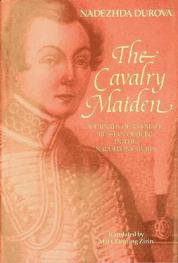
The cavalry maiden : journals of a female Russian officer in the Napoleonic Wars
The story of Nadezhda Andreevna Durova who, disguised as a man, served nearly ten years in the Russian light cavalry during the Napoleonic wars.
BOOK

The Damned and the Dead
The confrontation between the Wehrmacht and the Red Army on the Eastern Front of World War II was defined by incalculable suffering, destruction, casualties, and heroism. While many historians have chronicled the epic nature of that arena of war, it has largely been left to Russian novelists to fully express the intense human dimensions of that conflict. Frank Ellis's groundbreaking study provides the first comprehensive survey of that impressive body of literature. Canvassing a wide spectrum of works by Soviet and post-Soviet writers, many of whom were war veterans themselves, Ellis uncovers themes both common to war literature in general and distinctive to the Soviet experience. He recalls the earliest works in this genre by Emmanuil Kazakevich, Grigorii Baklanov, and IUrii Bondarev; presents a long overdue assessment of Vasil' Bykov's work, which focuses on the partisan war in Bykov's native Belorussia; and brings into sharp focus the powerful Stalingrad novels of Vasilii Grossman, Konstantin Simonov, Viktor Nekrasov, and Bondarev. He also provides keen insights into the heroic portraits of Stalin in the fiction of Ivan Stadniuk and Vladimir Bogomolov and examines three important war novels published during the 1990s: Viktor Astaf'ev's The Damned and the Dead, Georgii Vladimov's The General and His Army, and Vladimir But's Heads-Tails. One of the many threads running throughout Ellis's study is the dilemma of the Red Army soldier condemned to serve a regime that was utterly paranoid regarding the allegiances of its own armies, so much so that Soviet soldiers often felt as threatened by the Soviet government as they did by the German armies. Many of these novels reinforce the now well-known fact that Stalin devoted considerable resources to ferreting out soldiers whose actions (or inactions) suggested disloyalty to his repressive regime. A few of them-such as Grossman's Life and Fate-became battlegrounds in their own right, pitting Soviet writers against Soviet censors in a struggle over the public memory of the war. Russia's memories of World War II are forever tied to the suffering of its people. Ellis's rich and revealing work shows us why.
eBook