
Catalogue Search | MBRL


Are you sure you want to remove the book from the shelf?

{{itemTitle}}
11,544
result(s) for
"Russian politics"
Sort by:


Russian Minority Politics in Post-Soviet Latvia and Kyrgyzstan
The collapse of the Soviet Union suddenly rendered ethnic Russians living in non-Russian successor states like Latvia and Kyrgyzstan new minorities subject to dramatic political, economic, and social upheaval. As elites in these new states implemented formal policies and condoned informal practices that privileged non-Russians, ethnic Russians had to react. In Russian Minority Politics in Post-Soviet Latvia and Kyrgyzstan, Michele E. Commercio draws on extensive field research, including hundreds of personal interviews, to analyze the responses of minority Russians to such policies and practices. In particular, she focuses on the role played by formal and informal institutions in the crystallization of Russian attitudes, preferences, and behaviors in these states.Commercio asks why there is more out-migration and less political mobilization among Russians in Kyrgyzstan, a state that adopts policies that placate both Kyrgyz and Russians, and less out-migration and more political mobilization among Russians in Latvia, a state that adopts policies that favor Latvians at the expense of Russians. Challenging current thinking, she suggests that the answer to this question lies in the power of informal networks.After the fall of the Soviet Union, the Communist party, Komsomol youth organization, and KGB networks were transformed into informal networks. Russians in Kyrgyzstan were for various reasons isolated from such networks, and this isolation restricted their access to the country's private sector, making it difficult for them to create effective associations capable of representing their interests. This resulted in a high level of Russian exit and the silencing of Russian voices. In contrast, Russians in Latvia were well connected to such networks, which provided them with access to the country's private sector and facilitated the establishment of political parties and nongovernmental organizations that represented their interests. This led to a low level of Russian exit and high level of Russian voice. Commercio concludes that informal networks have a stronger influence on minority politics than formal institutions.
eBook


Charting Putin’s Shifting Populism in the Russian Media from 2000 to 2020
This article analyses the changing themes of Vladimir Putin’s populist messaging during his almost 20 years at the apex of Russian politics. To reveal shifts in Putin’s populist rhetoric, the article examines Russian media framing of his four presidential-election campaigns and of Russia’s relations with China and the United States (U.S.). Public opinion data is used to assess the impact of Putin’s populist propaganda. The article begins by assessing to what degree Putin can be considered a populist politician, concluding that while his rhetoric is populist his rule is largely not. The article further finds that Putin has maintained his populist appeal by turning his ire from domestic economic elites to international political enemies, specifically by positioning himself as the main challenger to U.S. hegemony in the global system. Putin’s control of the Russian media, co-opting of opposition populist causes and geopolitical victories in Syria and Crimea have helped him maintain his populist connection with Russian voters. But, the article concludes, growing access to anti-Kremlin online media, the pain of economic sanctions, botched social welfare reforms, and the presence of effective opposition movements are causing Putin’s populism to lose its lustre.
Journal Article


The long telegram 2.0 : a Neo-Kennanite approach to Russia
\"Inspired by the telegram that the legendary American diplomat and historian George F. Kennan sent from Moscow to Washington in February 1946, The Long Telegram 2.0 provides an original explanation of contemporary Russia, exploring its resurgent imperial character and predicting its forthcoming disintegration.\"-- Provided by publisher.
Book

Russia's postcolonial identity : a subaltern empire in a Eurocentric world
01
02
This book applies postcolonial theory to Russia by looking at it as a subaltern empire. It pushes postcolonial studies and constructivist International Relations towards an uneasy dialogue, which produces tensions and reveals multiple blind spots in both approaches. A critical re-evaluation of the existing literature enables the author to produce a comprehensive account of how Russia's position in the international system has conditioned its domestic development, and how this in turn generated specific foreign policy outcomes. Having internalised the Eurocentric worldview, Russia is nevertheless different from the core European countries. This difference is not determined by 'culture', but rather by uneven and combined development of global capitalism, in which Russia is integrated as a semi-peripheral nation. The Russian state has colonised its own periphery on behalf of the Western core, but has never been able to overcome economic and normative dependency on the West. The peculiar dialectic of the subaltern and the imperial during the post-Soviet period has given rise to a regime which claims to defend 'genuine Russian values', while in fact there is nothing behind this new traditionalism but the negation of Western hegemony. Trying to 'defend' the nation from the postulated threat of Western interventionism, the regime engages in a disavowal of politics and thus suppresses popular subjectivity. The only political subject that remains on the horizon of Russian politics is the West, while the Russian people, as any other subaltern, are being spoken for, and thus silenced, by the country's Eurocentric elites and the Western intellectuals.
02
02
Pushing postcolonial studies and constructivist International Relations towards an uneasy dialogue, this book looks at Russia as a subaltern empire. It demonstrates how the dialectic of the subaltern and the imperial has produced a radically anti-Western regime, which nevertheless remains locked in a Eurocentric outlook.
04
02
1. The Postcolonial and the Imperial in the Space and Time of World Politics
2. Russia in/and Europe: Sources of Ambiguity
3. Material Dependency: Postcolonialism, Development and Russia's 'Backwardness'
4. Normative Dependency: Putinite Paleoconservatism and the Missing Peasant
5 The People are Speechless: Russia, the West and the Voice of the Subaltern
6. Conclusion
13
02
Viatcheslav Morozov is Professor of EU-Russia Studies at the University of Tartu. Before moving to Estonia in 2010, he taught for thirteen years at the St Petersburg State University, Russia. He is the author of Russia and the Others: Identity and Boundaries of a Political Communit y and the editor of Decentring the West: The Idea of Democracy and the Struggle for Hegemony .
eBook

Graphic satire in the Soviet Union : Krokodil's political cartoons
\"After the death of Joseph Stalin, Soviet-era Russia experienced a flourishing artistic movement due to relaxed censorship and new economic growth. In this new atmosphere of freedom, Russia's satirical magazine Krokodil (The Crocodile) became rejuvenated. John Etty explores Soviet graphic satire through Krokodil and its political cartoons. He investigates the forms, production, consumption, and functions of Krokodil, focusing on the period from 1954 to 1964. Krokodil remained the longest-serving and most important satirical journal in the Soviet Union, unique in producing state-sanctioned graphic satirical comment on Soviet and international affairs for over seventy years. Etty's analysis of Krokodil extends and enhances our understanding of Soviet graphic satire beyond state-sponsored propaganda. For most of its life, Krokodil consisted of a sixteen-page satirical magazine comprising a range of cartoons, photographs, and verbal texts. Authored by professional and nonprofessional contributors and published by Pravda in Moscow, it produced state-sanctioned satirical comment on Soviet and international affairs from 1922 onward. Soviet citizens and scholars of the USSR recognized Krokodil as the most significant, influential source of Soviet graphic satire. Indeed, the magazine enjoyed an international reputation, and many Americans and Western Europeans, regardless of political affiliation, found the images pointed and witty. Astoundingly, the magazine outlived the USSR but until now has received little scholarly attention.\" -- Provided by publisher.
Book
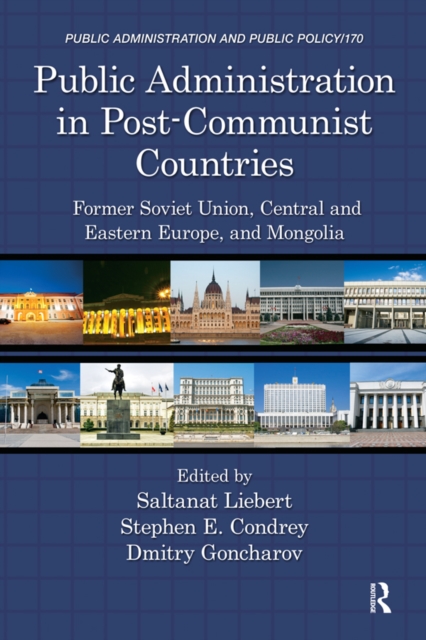
Public Administration in Post-Communist Countries
Although it has been more than 20 years since Communism crumbled in Central and Eastern Europe and the Soviet Union, many scholars and politicians still wonder what the lifting of the Iron Curtain has really meant for these former Communist countries. And, because these countries were largely closed off to the world for so long, there has yet to be an all-inclusive study on their administrative systems—until now. In Public Administration in Post-Communist Countries: Former Soviet Union, Central and Eastern Europe, and Mongolia, expert contributors supply a comprehensive overview and analysis of public administration in their respective post-Communist countries. They illustrate each country’s transformation from an authoritarian system of governance into a modern, market-based, and in some cases, democratic government. The book covers the countries that were officially part of the Soviet Union (Russia, Ukraine, Moldova, Estonia, Lithuania, Georgia, Kazakhstan, and Kyrgyzstan); those that were theoretically independent but were subject to Soviet-dominated Communist rule (Bulgaria, Hungary, Romania, and Poland); as well as a satellite republic that was under significant Soviet influence (Mongolia). Each chapter includes a brief introduction to the specific country, an overview of politics and administration, and discussions on key aspects of public management and administration—including human resource management, public budgeting, financial management, corruption, accountability, political and economic reform, civil society, and prospects for future development in the region. The book concludes by identifying common themes and trends and pinpointing similarities and differences to supply you with a broad comparative perspective.
Introduction: Public Administration in Central and Eastern Europe and the Former Soviet States—Common Legacy and Challenge of the Post-Communist Era; Saltanat Liebert, Stephen E. Condrey, and Dmitry Goncharov Ukrainian Public Management: Top-Down or Bottom-Up Reform?; Stephen E. Condrey, Svitlana Slava, R. Paul Battaglio, and Mykola Palinchak Public Administration in Russia; Dmitry Goncharov and Anton Shirikov Public Sector Reforms in Kazakhstan; Aigerim R. Ibrayeva and Tamara Nezhina Public Administration in Kyrgyzstan; Saltanat Liebert and Medet Tiulegenov Public Administration in Georgia; Nino Dolidze, Ilia Jobava, Elizabeth Sopromadze, Nino Loladze, Tea Lola dze, Lana Ovsia nnikova, Zhana Antia, George Mzhavanadze, and Tea Sonishvili Post-Communist Public Administration in Lithuania; Saulius Pivoras Public Administration Developments and Practices in Estonia; Georg Sootla and Sulev Lääne Republic of Moldova: Toward a European Administration; Lucica Matei Public Administration in Romania: Historical Milestones and Daily Realities; Ani Matei Public Administration in Bulgaria; Margarita Shivergueva Hungarian Public Administration: From Transition to Consolidation; István Ványolós and György Hajnal Public Administration in Poland; Jacek Czaputowicz and Marcin Sakowicz Public Administration in Mongolia; Tsedev Damiran and Richard Pratt Conclusion: Public Administration in Former Soviet States—Two Decades of Different Ways; Saltanat Liebert, Stephen E. Condrey, and Dmitry Goncharov Index
Saltanat Liebert is an Assistant professor at the L. Douglas Wilder School of Government and Public Affairs at Virginia Commonwealth University. Her publications have appeared in journals such as Public Administration Review, Journal of Central Asian Studies , and Central Eurasian Studies Review , as well as in edited volumes including Migration and Remittances: Eastern Europe and the Former Soviet Union (World Bank), Trafficking and the Global Sex Industry (Lexington Books), and In the Tracks of Tamerlane: Central Asia’s Path to the 21st Century (National Defense University Press). Her first book, Irregular Migration from the Former Soviet Union to the United States , was published by Routledge in 2009. Saltanat’s current research interests include civil service reforms in post-Communist countries, corruption, labor migration, and immigration policy. She earned a PhD in Public Administration at American University in Washington, DC.
Stephen E. Condrey is the president of Condrey and Associates, Inc., president-elect of the American Society for Public Administration, and editor-in-chief of the Review of Public Personnel Administration . His publications have appeared in Public Administration Review, Journal of Public Administration Research and Theory, The American Review of Public Administration , and elsewhere. He is the editor of the Handbook of Human Resource Management in Government (third edition). His research interests include public human resource management and public management. He holds a PhD from the University of Georgia.
Dmitry Goncharov is a professor in the department of political science, National Research University Higher School of Economics, Russia. His publications have appeared in Russian journals such as Polis and Poleteia . His current research interests include post-Communist civil society, post-Communist public administration, elections in hybrid regimes, and Russian sub-national politics. He holds a doctor of sciences degree (in political science) from St. Petersburg State University.
eBook