
Catalogue Search | MBRL


Are you sure you want to remove the book from the shelf?

{{itemTitle}}
201
result(s) for
"Russian security strategy"
Sort by:

Russian and European Union's Quest for the formation of a European security system after the cold war
The need for an understanding of the problem of creating a modern system for resolving European security problems and developing new reliable mechanisms for intraregional security with the participation of the EU and Russia has become an important issue in Europe. The current European security system is no longer based on traditional great power balancing. This article firstly examines how the transformation of the European security system has taken place in the post-confrontational period and secondly analyses how this process has influenced the role and place of Russia in the post-cold war European security architecture. This article shows that the place of Russia within the system of pan-European security since 1991 fits into the logic of keeping Russia outside of Europe. The new strategic nuances of Western policy are only modernized tools that regulate the degree of distance between the US, NATO and the EU from Russia.
Journal Article
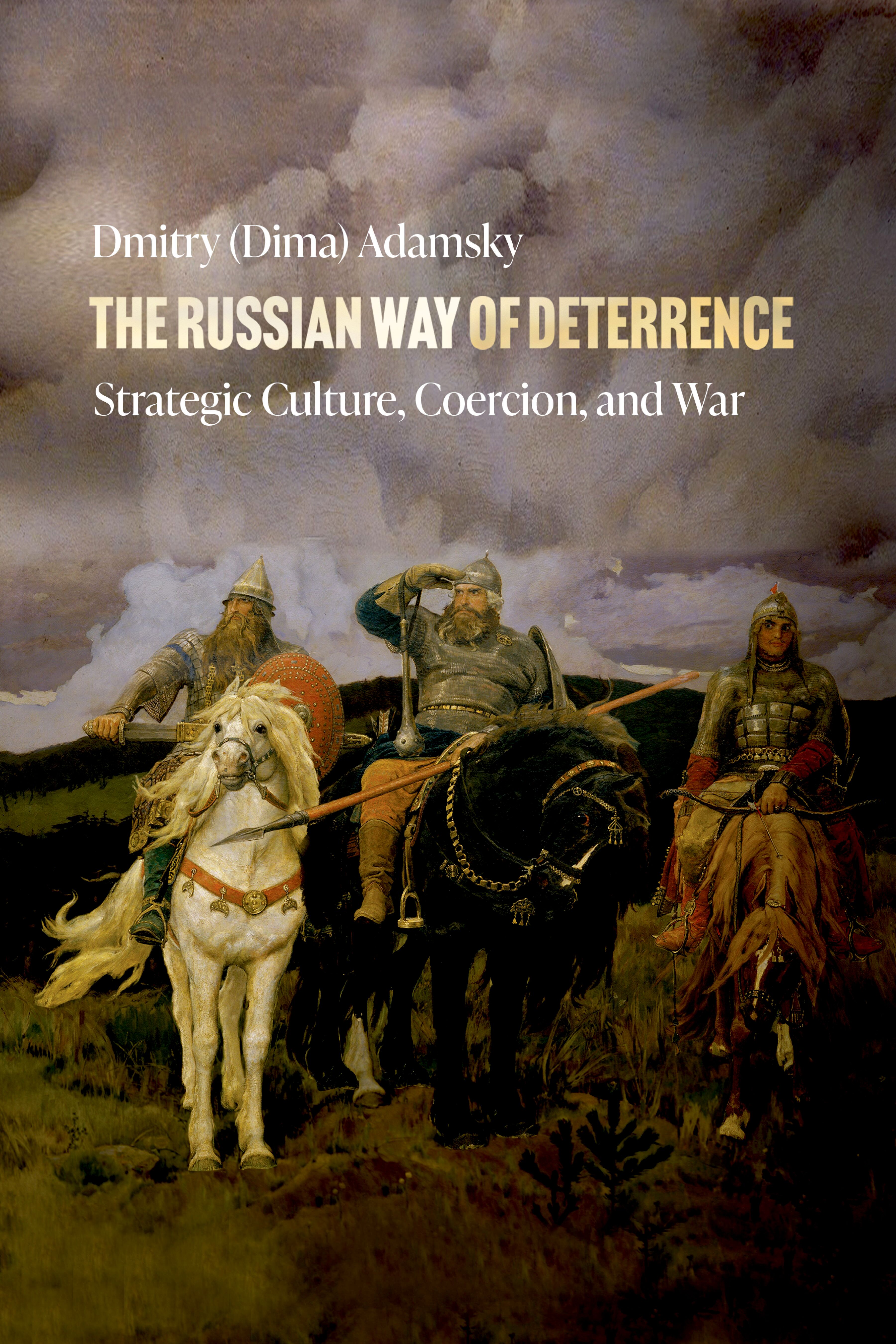
The Russian Way of Deterrence
Selected among Foreign Affairs's \"Best of Books 2024\"
From a globally renowned expert on Russian military strategy and national security, The Russian Way of Deterrence investigates Russia's approach to coercion (both deterrence and compellence), comparing and contrasting it with the Western conceptualization of this strategy. Strategic deterrence, or what Dmitry (Dima) Adamsky calls deterrence à la Russe, is one of the main tools of Russian statecraft. Adamsky deftly describes the genealogy of the Russian approach to coercion and highlights the cultural, ideational, and historical factors that have shaped it in the nuclear, conventional, and informational domains. Drawing on extensive research on Russian strategic culture, Adamsky highlights several empirical and theoretical peculiarities of the Russian coercion strategy, including how this strategy relates to the war in Ukraine. Exploring the evolution of strategic deterrence, along with its sources and prospective avenues of development, Adamsky provides a comprehensive intellectual history that makes it possible to understand the deep mechanics of this Russian stratagem, the current and prospective patterns of the Kremlin's coercive conduct, and the implications for policymakers on both sides of the Atlantic.
eBook

Russian Novel Nuclear Weapons and War-Fighting Capabilities
This article argues that Russia's novel nuclear-capable weapons will have a minor but real impact on Russian war-fighting capabilities in Eastern Europe. Using publicly available assessments, it evaluates the weapons' characteristics individually and when taken together to determine their possible impact on war fighting, deterrence, and arms control. Additionally, it analyzes Russian war-fighting concepts to project how Russian strategists think about their use and how they might integrate them into Russian war-fighting concepts. The study's conclusions will assist military strategists and policy practitioners as they plan for a potential regional war on NATO's eastern flank.
Journal Article

Evolution of the U.S. Arctic Strategy’s Conceptual Basis
Introduction. The article examines the features of the main stages in the evolution of the U.S. Arctic strategy in the period after the end of the Cold War that helps to understand the future of American regional policy. The United States is one of the main participants in the Arctic policy, on which the state of security and cooperation in the region largely depends. Methods and materials. The empirical basis for the study was the documents of various institutions and departments involved in the planning, implementation and control of the U.S. Arctic policy. These documents include the directives and public papers of the president, documents of the Department of Defense, the Arctic strategies of ministries and departments, reports of the Congressional Research Service, documents of “think tanks”. Analysis. The article concludes that the Arctic became a priority of U.S. policy only in the early 2000s after the revival of Russia’s activity in the Far North. The U.S. strategy was finalized only under President Barack Obama. It directed to achieving American dominance in all spheres by combining political, diplomatic, economic, military instruments. If B. Obama considered international cooperation in the Arctic productive, then the next President D. Trump shifted the American strategy towards nationalism and isolationism, curtailing many cooperation projects. Results. The development of the American strategy was inconsistent, and so far it does not represent a coherent, consistent vision of American policy in the Arctic. Relations between the United States and Russia in the Arctic decreased in the aftermath of the Ukrainian crisis, but objective conditions for cooperation remain. The scenario for the further evolution of bilateral relations remains uncertain under J. Biden. Authors’ contribution. Valery Konyshev: introduction, contours of the Arctic policy after the end of the Cold War: strategic interests, development of the U.S. Arctic Doctrine: limited cooperation. Alexander Sergunin: methods and materials, revision of the Arctic doctrine: from cooperation to rivalry, results.
Journal Article
EU PROJECTS IN THE FIELD OF SECURITY AND DEFENSE: CHALLENGES AND PROSPECTS OF IMPLEMENTATION
The article dwells upon the problems of implementing the EU defense strategy, taking into account the leading European concept, strategic documents and the current initiatives in the EU security and defense sector. It was proved that due to the divergent views of the EU member states, there exist the following interpretations of the leading defense concept, namely: 1) “strategic autonomy / sovereignty” (France, Germany, Spain, Italy) considers independence in decision-making, increased integration and generating of finances and resources; 2) “strategic responsibility” (Netherlands, Finland, Estonia) is about greater collective contribution to the regional security system, which provides for a balance of interests in the EU-NATO-USA partnership; 3) “open strategic autonomy” (Poland, Slovakia, Hungary, Lithuania, Latvia) deals with preservation of power only in priority areas of EU activity. The peculiarities of the transformations of the EU defense strategy were identified, and the following three EU strategic documents were analyzed, i. e., the European Security Strategy of 2003, the EU Global Strategy of 2016, and the EU Strategic Compass of 2022. It was determined that the Strategic Compass should introduce consistency in the rules, the management structure of the defense initiatives, clarify the boundaries between ambition and pragmatism, and integrate the defense sector. The strengths and weaknesses of the defense initiatives both within the framework of EU treaties (PESCO, CARD, EDF) and outside them (EI2) were pinpointed. The set of shortcomings detected in the abovementioned defense initiatives were outlined. The priority scenarios are represented. It has been predicted that by 2030, under the conditions of preserving the ambition of “strategic autonomy”, it is necessary to take a set of the following measures: 1) to define a single vision of their cooperation; 2) to find out the structure of the defense cooperation within the framework of EU treaties (PESCO) or outside the EU (EI2); 3) to clarify the rules of the defense sector management and a special body for decision-making.
Journal Article

The tragedy of US–Russian relations: NATO centrality and the revisionists’ spiral
We contribute to the debate on NATO expansion in two ways that depart from standard practice: we make explicit the theoretical models that this debate demands; and we carefully trace Russian discourse and behavior through time. We show that NATO centrality rather than simply NATO expansion is the root issue. It best captures the historical origins of the problem and is most consistent with the Russian evidence. We demonstrate that Russia’s cooperative moves vis-à-vis NATO were premised upon Moscow’s strongly revisionist preferences regarding the European security architecture. We argue that the US–NATO–Russia spiral is best understood as an offensive-realist tragedy as opposed to a security dilemma or a standoff between one pure security-seeking state and one greedy expansionist. The key protagonists were both revisionists whose preferences and grand strategies brought them into conflict. Central to the whole story is not classical territorial security threats, but much broader conceptions of security.
Journal Article

The Strategic Implications of the Protracted Russian-Ukrainian War
Long-standing disputes between Ukraine and Russia escalated into a heated conflict in February 2022, resulting in significant repercussions across international politics, European security, the NATO alliance, regional dynamics, and military strategy. This article aims to explore these effects in detail. Primarily, the article concludes that the Russia-Ukraine war has disrupted the post-1990s rules-based global order that had ensured peace among major global powers for over three decades. Furthermore, the forcible violation of an independent states borders by Russia, irrespective of international law, poses a grave threat to Europes security. In response to the visible threat posed by Russia, the NATO alliance rallied and strengthened under the leadership of the United States. European states began prioritizing defense capabilities to deter potential threats from Russia. Moreover, the conflict underscored the increased importance of artillery, unmanned aerial vehicles (UAVs), air defense systems, and electronic target detection in military strategy.
Journal Article


The Russian Arctic World as a “cultural circle” and an object of development
The geospatial image of the Russian Arctic in the cultural and civilizational context is considered, taking into account the current policy and development strategy of the Arctic zone of the Russian Federation for the period up to 2035. Russian Arctic world as a domestic phenomenon, which embodies the specifics of Russian civilization, national culture, history and geography, is in the center of attention. It is emphasized that the “space factor” played and continues to play a huge role in the formation of Russian civilization. It left a vivid imprint on all aspects of public life. Overcoming the space in Russia still remains one of the most urgent state tasks. First of all, this applies to the Arctic zone of the Russian Federation, the strategic importance of which is becoming more and more significant. It is pointed out that the implementation of the unique geospatial capabilities of the Russian Arctic lies not only in the implementation of the strategic tasks of socio-economic development and technological advancement, but also in the spiritual, moral, cultural and professional growth of people living and working there. As the methodological basis of the study, the authors chose the concept of “spatial rotation”, which covers modern social theory and practice. Its main content boils down to the fact that space is recognized as an active participant in the interactions taking place on Earth. At the same time, the space is represented as a “characteristic” human work, saturated with the meanings of social dialectics and strategy. This statement was an argument to consider the fact of “spatialization” of the Russian Arctic into the category of a special life world. In this regard, the idea is expressed about the need for an intensive “humanization” of the Russian Arctic world.
Journal Article
Strategies of the Sides in the Russia-Ukraine War
The research into the strategies of the sides in the Russia-Ukraine war is of great relevance, as it is one of the most intense conflicts on the territory of Europe since World War II. Further, the violent actions committed by the Russian Federation on the territory of Ukraine have had an unprecedented impact on the international peace architecture and international relations; they have caused a humanitarian, economic, and social crisis on a regional and global scale. The present research may, most notably, help understand the causes and consequences of the conflict. For this reason, this paper aims to analyze and cover the peculiarities of the main military and political strategies of Ukraine and the Russian Federation in the context of the 2022 war, as well as evaluate specific actions the enemies took against each other as international actors. The updating of the states’ strategies should be noted, as previously Ukraine was regarded only in the context of European integration and reforms, while the full-scale war increases Ukraine’s subjectivity, particularly in terms of planning and implementation of military decisions and more proactive diplomatic efforts. Russia’s strategies were considered in the context of Western theoretical models aimed at establishing it as a regional leader with extensive military potential. Moreover, the beginning of the full-scale war proved that in the situation of the military conflict against Ukraine and its allies Russia’s strategic resources are limited, which calls for further research. The results of this investigation provide a theoretical basis for further research in the field and are of importance for the understanding of security issues, and safeguarding of peace and stability not only in Ukraine and Europe but all around the world.
Journal Article