
Catalogue Search | MBRL


Are you sure you want to remove the book from the shelf?

{{itemTitle}}
114,137
result(s) for
"Russians."
Sort by:


Russian Minority Politics in Post-Soviet Latvia and Kyrgyzstan
The collapse of the Soviet Union suddenly rendered ethnic Russians living in non-Russian successor states like Latvia and Kyrgyzstan new minorities subject to dramatic political, economic, and social upheaval. As elites in these new states implemented formal policies and condoned informal practices that privileged non-Russians, ethnic Russians had to react. In Russian Minority Politics in Post-Soviet Latvia and Kyrgyzstan, Michele E. Commercio draws on extensive field research, including hundreds of personal interviews, to analyze the responses of minority Russians to such policies and practices. In particular, she focuses on the role played by formal and informal institutions in the crystallization of Russian attitudes, preferences, and behaviors in these states.Commercio asks why there is more out-migration and less political mobilization among Russians in Kyrgyzstan, a state that adopts policies that placate both Kyrgyz and Russians, and less out-migration and more political mobilization among Russians in Latvia, a state that adopts policies that favor Latvians at the expense of Russians. Challenging current thinking, she suggests that the answer to this question lies in the power of informal networks.After the fall of the Soviet Union, the Communist party, Komsomol youth organization, and KGB networks were transformed into informal networks. Russians in Kyrgyzstan were for various reasons isolated from such networks, and this isolation restricted their access to the country's private sector, making it difficult for them to create effective associations capable of representing their interests. This resulted in a high level of Russian exit and the silencing of Russian voices. In contrast, Russians in Latvia were well connected to such networks, which provided them with access to the country's private sector and facilitated the establishment of political parties and nongovernmental organizations that represented their interests. This led to a low level of Russian exit and high level of Russian voice. Commercio concludes that informal networks have a stronger influence on minority politics than formal institutions.
eBook

The White Russian
A novel of love, art, music and family secrets set amongst the Russian émigré community of Paris in 1937.
Book

The constructivist moment : from material text to cultural poetics
Winner of the American Comparative Literature Association's Rene Wellek Prize (2004)
As one of the founding poets and editors of the Language School of poetry and one of its central theorists, Barrett Watten has consistently challenged the boundaries of literature and art. In The Constructivist Moment, he offers a series of theoretically informed and textually sensitive readings that advance a revisionist account of the avant-garde through the methodologies of cultural studies. His major topics include American modernist and postmodern poetics, Soviet constructivist and post-Soviet literature and art, Fordism and Detroit techno—each proposed as exemplary of the social construction of aesthetic and cultural forms. His book is a full-scale attempt to place the linguistic turn of critical theory and the self-reflexive foregrounding of language by the avant-garde since the Russian Formalists in relation to the cultural politics of postcolonial studies, feminism, and race theory. As such, it will provide a crucial revisionist perspective within modernist and avant-garde studies.
eBook

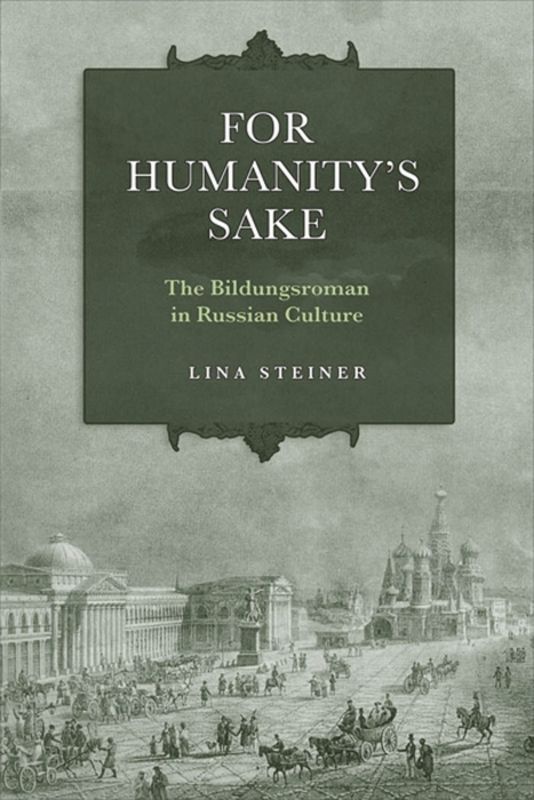
For Humanity's Sake
Positing the classic Russian novel as an inheritor of the Enlightenment's key values — including humanity, self-perfection, and cross-cultural communication —For Humanity's Sakeoffers a unique view of Russian intellectual history and literature.
eBook

Russian immigrants : in their shoes
Offers readers a compelling look into the lives, challenges, and successes of Russian immigrants.
Book

Transnational Russian-American Travel Writing
In this study, Marinova examines the diverse practices of crossing boundaries, tactics of translation, and experiences of double and multiple political and national attachments evident in texts about Russo-American encounters from the end of the American Civil War to the Russian Revolution of 1905. Marinova brings together published writings, archival materials, and personal correspondence of well or less known travelers of diverse ethnic backgrounds and artistic predilections: from the quintessential American Mark Twain to the Russian-Jewish ethnographer and revolutionary Vladimir Bogoraz; from masters of realist prose such as the Ukrainian-born Vladimir Korolenko and the Jewish-Russian-American Abraham Cahan, to romantic wanderers like Edna Proctor, Isabel Hapgood or Grigorii Machtet. By highlighting the reification of problematic stereotypes of ethnic and racial difference in these texts, Marinova illuminates the astonishing success of the Cold War period’s rhetoric of mutual hatred and exclusion, and its continuing legacy today.
Margarita Marinova is Assistant Professor of English at Christopher Newport University.
\"Marinova's research brings together a variety of Russian and American voices from this period and provides a thoughtful analysis of their convergences, similarities, differences, and 'mimetic capital'... Her work is an important step in understanding both historical and contemporary Russian and American attitudes towards each other.\" - Slavic and East European Journal
Contents List of Figures Acknowledgments Introduction 1: Russian Tourists View Postbellum America 2: \"Innocent\" Encounters with Russia, or Americans at Play 3: Russian \"Marvels\" and American \"Originals.\" The View of Russia and America During the Last Two Decades of the Nineteenth Century 4: The Gifts of Travel: Tales of Passing of the Ethnic Russian in America: Vladimir Korolenko’s Bez Iazyka and Abraham Cahan’s \"Theodore and Martha\" and The White Terror and the Red Conclusion Notes Bibliography Index
eBook


The Vortex That Unites Us
The Vortex That Unites Us is a study of totality in Russian literature, from the foundation of the modern Russian state to the present day. Considering a diversity of texts that have in common chiefly their prominence in the Russian literary canon, Jacob Emery examines the persistent ambition in Russian literature to gather the whole world into an artwork. Emery reveals how the diversity of totalizing figures in the Russian canon—often in alliance with ideologies like the totalitarian state or enlightenment reason—strive for the frontiers of space and time in order to guarantee the coherence of the globe and the continuity of history. He expores subjects like romantic metaphors of supernatural possession; Tolstoy's conception of art as a vector of emotional contagion; the panoramic ambitions of the avant-garde to grasp the globe in a new poetic medium; efforts of Soviet utopians to harmonize the whole of social life along aesthetic lines; Mandelstam's evocation of writing as a transcendental authority that guarantees a grandiose historical rhythm even when manifested as authoritarian repression; and the mass market of cultural commodities in which the exiled Vladimir Nabokov found success with his novel Lolita. The Vortex That Unites Us reveals a common thread in the disparate works it explores, bringing into a single horizon a variety of typically siloed texts and aesthetic approaches. In all these cases, the medium of totality is the body, inspired by artistic vision and compelled by aesthetic response.
eBook