
Catalogue Search | MBRL


Are you sure you want to remove the book from the shelf?

{{itemTitle}}
39
result(s) for
"Russkai︠a︡ pravoslavnai︠a︡ t︠s︡erkovʹ"
Sort by:

Religion and Enlightenment in Catherinian Russia
This valuable study explores the Russian Enlightenment with reference to the religious Enlightenment of the mid to late eighteenth century. Grounded in close reading of the sermons and devotional writings of Platon (Levshin), Court preacher and Metropolitan of Moscow, the book examines the blending of European ideas into the teachings of Russian Orthodoxy. Highlighting the interplay between Enlightenment thought and Orthodox enlightenment, Elise Wirtschafter addresses key questions of concern to religious Enlighteners across Europe: humanity's relationship to God and creation, the distinction between learning and enlightenment, the role of Christian love in authority relationships, the meaning of free will in a universe governed by Divine Providence, and the unity of church, monarchy, and civil society. Countering scholarship that depicts an Orthodox religious culture under assault from European modernity and Petrine absolutism, Wirtschafter emphasizes the ability of Russia's educated churchmen to assimilate and transform Enlightenment ideas. The intellectual and spiritual vitality of eighteenth-century Orthodoxy helps to explain how Russian policymakers and intellectuals met the challenge of European power while simultaneously coming to terms with the broad cultural appeal of the Enlightenment's universalistic human rights agenda. Religion and Enlightenment in Catherinian Russia defines the Russian Enlightenment as a response to the allure of European modernity, as an instrument of social control, and as the moral voice of an emergent independent society. Because Russia's enlightened intellectuals focused on the moral perfectibility of the individual human being, rather than social and political change, the originality of the Russian Enlightenment has gone unrecognized. This study corrects images of a superficial Enlightenment and crisis-ridden religious culture, arguing that in order to understand the humanistic sensibility and emphasis on individual dignity that permeate Russian intellectual history, and the history of the educated classes more broadly, it is necessary to bring Orthodox teachings into the discussion of Enlightenment thought. The result is a book that explains the distinctive origins of modern Russian culture while also allowing scholars to situate the Russian Enlightenment in European and global history.
eBook

The Orthodox Church and civil society in Russia
In the void left by the fall of Communism in Russia during the late twentieth century, can that country establish a true civil society? Many scholars have analyzed the political landscape to answer this question, but in The Orthodox Church and Civil Society in Russia, Wallace L. Daniel offers a unique perspective: within the church are individuals who hold the values and institutional models that can be vital in determining the direction of Russia in the twenty-first century.
Daniel tells the stories of a teacher and controversial parish priest, the leader of Russia’s most famous women’s monastery, a newspaper editor, and a parish priest at Moscow University to explore thoroughly and with a human voice the transformation from Communist country to a new social order. Daniel explores specific religious communities and the way they operate, their efforts to rebuild parish life, and the individuals who have devoted themselves to such goals. This is the level, Daniel shows, at which the reconstruction of Russia and the revitalization of Russian society is taking place.
This book is written for general readers interested in the intersection between politics, religion, and society, as well as for scholars.
eBook
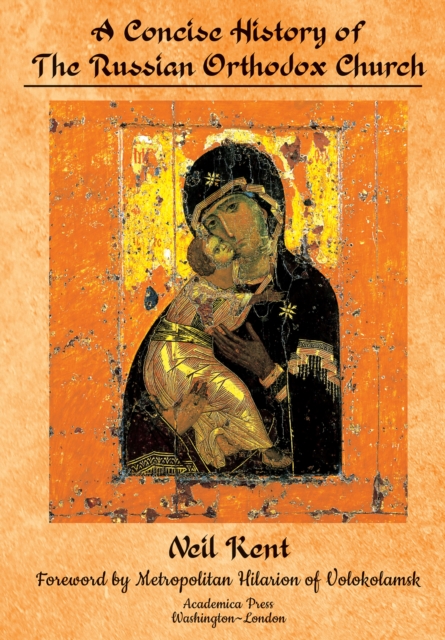
A Concise History of the Russian Orthodox Church
Orthodox Christianity is one of the world's major religions, and the Russian Orthodox Church is by far its largest denomination. Few know its history and spiritual richness, however. Neil Kent's comprehensive new book fills that gap. The Russian Orthodox Church's Eastern roots, including its dogma, canons, and practices, are explored, along with the political and military contexts in which it carried out its mission over the centuries. Hemmed in between the Catholic powers of pre-Reformation Europe in the West, the Mongol steppe empires to the East, and the Islamic civilizations to the South, Russia and its Church found themselves in a difficult position during the Middle Ages. The Russian Orthodox Church's greatest strength was in the spiritual power of its liturgy, prayerfulness, icons, and monastic life. But even as the Church consolidated its authority under its own metropolitan, and later patriarch, it came into conflict with political rulers who sought to undermine it. After defeating foreign challenges, the Church underwent a painful reformation and schism, finally coming under government control. The Church survived this \"Babylonian Captivity,\" and, in philosophical and spiritual terms, flourished under tsarist rule while still facing rising opposition. The fall of the monarchy in 1917 led to the Church's brief rejuvenation, but communist rule spelled relentless persecution with little respite at home and a lively émigré church carrying Russian traditions abroad. In post-Soviet times, however, the Church enjoyed an extraordinary resurrection and, benefiting from the spiritual richness and reunion with the Russian Orthodox Church abroad, once again became a spiritual pillar of the Russian people and a beacon of hope and Christian values, not only in Russia but anywhere it is currently practiced.
eBook

The bride of the Lamb
Sergius Bulgakov is thought by many to be the twentieth century's foremost Russian Orthodox theologian.The Bride of the Lamb is widely regarded as Bulgakov's magnum opus and, even more, as one of the greatest works ever produced in the modern Orthodox church.
eBook

Orthodox Christianity in Imperial Russia
From sermons and clerical reports to personal stories of faith, this book of translated primary documents reveals the lived experience of Orthodox Christianity in 19th- and early 20th-century Russia. These documents allow us to hear the voices of educated and uneducated writers, of clergy and laity, nobles and merchants, workers and peasants, men and women, Russians and Ukrainians. Orthodoxy emerges here as a multidimensional and dynamic faith. Beyond enhancing our understanding of Orthodox Christianity as practiced in Imperial Russia, this thoughtfully edited volume offers broad insights into the relationship between religious narrative and social experience and reveals religion's central place in the formation of world views and narrative traditions.
eBook

The Russian-Orthodox tradition and modernity
The book attempts to identify the uniqueness of the Russian-Orthodox religious tradition from a historical and comparative perspective and to contrast it with two of modern Western society's characteristics: its particular economic ethics and individualism.
eBook

Women of the Catacombs
The memoirs presented in Women of
the Catacombs offer a rare close-up account
of the underground Orthodox community and its priests during some
of the most difficult years in Russian history. The
catacomb church in the Soviet Union came into existence in the
1920s and played a significant part in Russian national life for
nearly fifty years. Adherents to the Orthodox faith often referred
to the catacomb church as the \"light shining in the dark.\"
Women of the Catacombs provides a first-hand portrait of
lived religion in its social, familial, and cultural setting during
this tragic period.
Until now, scholars have had only brief, scattered fragments of
information about Russia's illegal church organization that claimed
to protect the purity of the Orthodox tradition. Vera Iakovlevna
Vasilevskaia and Elena Semenovna Men, who joined the church as
young women, offer evidence on how Russian Orthodoxy remained a
viable, alternative presence in Soviet society, when all political,
educational, and cultural institutions attempted to indoctrinate
Soviet citizens with an atheistic perspective. Wallace L. Daniel's
translation not only sheds light on Russia's religious and
political history, but also shows how two educated women maintained
their personal integrity in times when prevailing political and
social headwinds moved in an opposite direction.
eBook
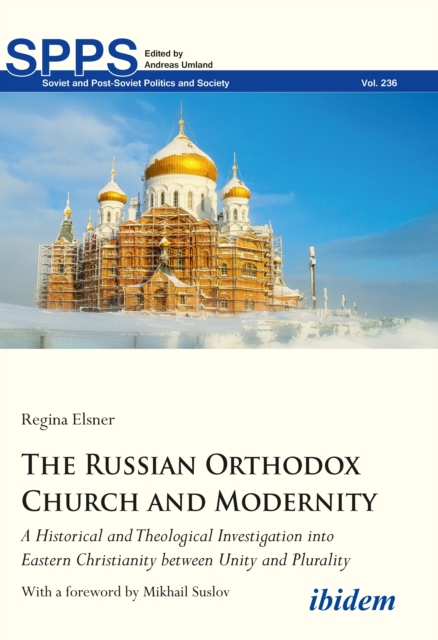
The Russian Orthodox Church and Modernity
The Russian Orthodox Church (ROC) faced various iterations of modernization throughout its history.This conflicted encounter continues in the ROCs current resistance againstwhat it perceives asWestern modernity including liberal and secular values.
eBook
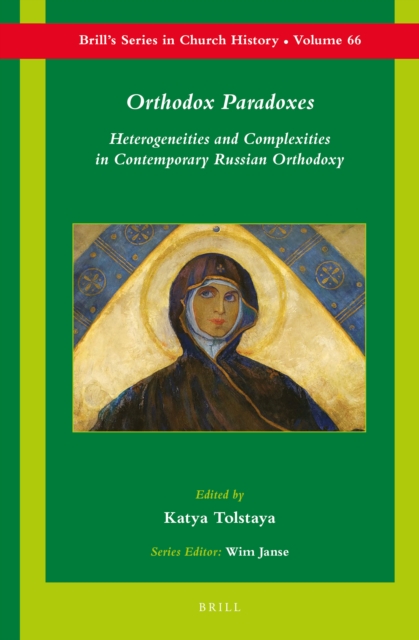
Orthodox Paradoxes
This book focuses on \"Orthodox paradoxes\" created by the dynamic between tradition and innovation within the Russian Orthodox Church. Nineteen contributions from renowned specialists tackle societal and theological aspects and implications of these paradoxes.
eBook

Thinking Orthodox in Modern Russia
Thinking Orthodox in Modern Russia illuminates the significant role of Russian Orthodox thought in shaping the discourse of educated society during the imperial and early Soviet periods. Bringing together an array of scholars, this book demonstrates that Orthodox reflections on spiritual, philosophical, and aesthetic issues of the day informed much of Russia’s intellectual and cultural climate. Volume editors Patrick Lally Michelson and Judith Deutsch Kornblatt provide a historical overview of Russian Orthodox thought and a critical essay on the current state of scholarship about religious thought in modern Russia. The contributors explore a wide range of topics, including Orthodox claims to a unique religious Enlightenment, contests over authority within the Russian Church, tensions between faith and reason in academic Orthodoxy, the relationship between sacraments and the self, the religious foundations of philosophical and legal categories, and the effect of Orthodox categories in the formation of Russian literature.
eBook