
Catalogue Search | MBRL


Are you sure you want to remove the book from the shelf?

{{itemTitle}}
11,899
result(s) for
"Russland."
Sort by:

The Russian Empire 1450-1801
Modern Russian identity and historical experience has been largely shaped by Russia's imperial past: an empire that was founded in the early modern era and endures in large part today. The Russian Empire 1450-1801 surveys how the areas that made up the empire were conquered and how they were governed. It considers the Russian empire a 'Eurasian empire', characterized by a 'politics of difference': the rulers and their elites at the center defined the state's needs minimally - with control over defense, criminal law, taxation, and mobilization of resources - and otherwise tolerated local religions, languages, cultures, elites, and institutions. The center related to communities and religions vertically, according each a modicum of rights and autonomies, but didn't allow horizontal connections across nobilities, townsmen, or other groups potentially with common interests to coalesce. Thus, the Russian empire was multi-ethnic and multi-religious; Nancy Kollmann gives detailed attention to the major ethnic and religious groups, and surveys the government's strategies of governance - centralized bureaucracy, military reform, and a changed judicial system.
Book

Study of russian households income differentiation with various inequality measures
The article reviews modern income inequality measure such that Gini index and its modification, Zenga index and Davydov, their advantages and disadvantages. The reviewed indices are applied to the household's income data for different regions in the Russian Federation from 2014 to 2018. The indices studied showed different level of income inequality in regions compared, thus the tendency is the same - income inequality decreases for all type of inequality studied. Russian regions become more similar in terms of income inequality, while income inequality itself tends to decrease in most regions.
Journal Article

Authoritarian Russia : analyzing post-Soviet regime changes
Presents theoretical and comparative perspectives on the factors affecting Russian regime changes since the collapse of the Soviet Union and the country's drift to \"electoral authoritarianism\", essentially authoritarian rule with the trappings of democratic institutions.
Book

Can Russia Complete?
Russian economy has been growing at an average nominal rate of 6 percent annually for the past decade. Among the most important factors contributing to its expansion has been the skyrocketing cost of oil and gas. In 2000, when Vladimir Putin took office, the cost of oil was approximately $20 a barrel; at the end of his term, it was five times higher. Meanwhile, the competitiveness of Russian enterprises has become increasingly fragile because of the appreciating ruble, climbing resource prices, and rising wages as well as the exhaustion of Russia's excess industrial capacity. Observers have called for Russian authorities to take measures to counterbalance the nation's increasing economic dependence on natural resources. Economic diversification can cover a wide number of issues and involve many challenges, including entrepreneurship, foreign investment, regional development, and physical infrastructure. In Russia's case, it comes down to one thing: ensuring that the manufacturing sector can compete in the global economy. Russian competitiveness will not depend on centralized, top-down efforts to pick winners but on broader policy measures designed both to improve the investment climate-which affects firms' incentives to invest productively and create jobs-and to develop a more competitive, knowledge-based economy. Russian authorities are seeking to address many of the country's most important developmental challenges. Economic diversification will require reducing investment risks induced by national and regional policies and lowering barriers to entry for newer, more dynamic, and innovative firms, specifically by facilitating transfer of land from municipalities and from older, loss-making firms. It also will require greater inclusiveness in government decision making, more transparency regarding government decision making, and stable legislation at all levels of government. This book quantifies and benchmarks the relative strengths of Russian manufacturing and identifies opportunities to increase its productivity and competitiveness. This volume focuses on the challenges now facing enterprises in Russia, highlighting sources of productivity growth and competitiveness within enterprises, including technological progress (knowledge absorption and innovation), worker skills, and the investment climate. After the 1998 crisis, as gross domestic product rebounded, investment accelerated, and foreign direct investment increased dramatically, Russia's recovery s...
Book

A short history of the Russian Revolution
In 1917 revolutionary fervour swept through Russia, ending centuries of imperial rule and instigating political and social changes that would lead to the formation of the Soviet Union. Arising out of proletariat discontent with the Tsarist autocracy and Lenin's proclaimed version of a Marxist ideology, the revolutionary period saw a complete overhaul of Russian politics and society and led directly to the ensuing civil war. The Soviet Union eventually became the world's first communist state and the events of 1917 proved to be one of the turning-points in world history, setting in motion a chain of events which would change the entire course of the twentieth century. Geoffrey Swain provides a concise yet thorough overview of the revolution and the path to civil war.
Book

Politicising Government Engagement with Corporate Social Responsibility: \CSR\ as an Empty Signifier
Governments are widely viewed by academics and practitioners (and society more generally) as the key societal actors who are capable of compelling businesses to practice corporate social responsibility (CSR). Arguably, such government involvement could be seen as a technocratic device for encouraging ethical business behaviour. In this paper, we offer a more politicised interpretation of government engagement with CSR where \"CSR\" is not a desired form of business conduct but an element of discourse that governments can deploy in structuring their relationships with other social actors. We build our argument through a historical analysis of government CSR discourse in the Russian Federation. Laclau and Mouffe's (Hegemony and socialist strategy: Towards a radical democratic politics,Verso Books, London, 1985) social theory of hegemony underpins our research. We find that \"CSR\" in the Russian government's discourse served to legitimise its power over large businesses. Using this case, we contribute to wider academic debates by providing fresh empirical evidence that allows the development of critical evaluation tools in relation to governments' engagement with \"CSR\". We find that governments are capable of hijacking CSR for their own self-interested gain. We close the paper by reflecting on the merit of exploring the case of the Russian Federation. As a \"non-core\", non-western exemplar, it provides a useful \"mirror\" with which to reflect on the more widely used test-bed of Western industrial democracies when scrutinising CSR. Based on our findings, we invite other scholars to adopt a more critical, politicised stance when researching the role of governments in relation to CSR in other parts of the world.
Journal Article
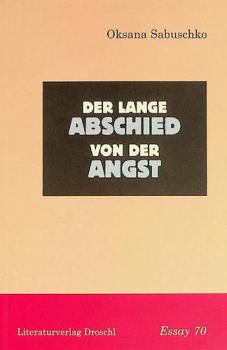
Der lange Abschied von der Angst
Etwas mehr als einen Monat nach dem Terroranschlag im Bataclan am 13.11.2015 ist Oksana Sabuschko zu Gast in Paris. Die Erfahrung in der paralysierten Metropole lässt die ukrainische Autorin über das Verarbeiten von Angst, hervorgerufen durch Krieg und Terror, reflektieren. Das historische und kulturelle Gedächtnis europäischer Staaten stehen zunächst im Fokus des Essays. Ausgehend von den Kollaborateuren mit dem Vichy-Regime und dem Versagen der Linksintellektuellen während des Zweiten Weltkriegs reist Sabuschko durch die französische Geistesgeschichte von Sartre über Derrida bis hin zu Houellebecq. Wo liegen die Parallelen zwischen dem Einmarsch der Nationalsozialisten in Frankreich und der russischen Besatzung der Krim seit 2014? Ist die Ukraine ein failed state? Welchen Einfluss haben Politik und Medien auf unser Alltagsleben? Bezugnehmend auf die Feldstudien geht sie in einem weiteren Schritt der Frage nach, inwieweit Sex eine Metapher für soziale und kulturelle Konstellationen darstellt. Dieser kluge und provokante Essay zeichnet einen langen Abschied von der Angst nach - lange mag der Weg sein, aber nicht hoffnungslos. Oksana Sabuschko wurde 1960 geboren und lebt in Kiew. Sie hat Philosophie studiert, an der Ukrainischen Akademie der Wissenschaften gearbeitet, war als Fulbright-Stipendiatin in Harvard sowie Pittsburgh und als writer-in-residence an der Penn State University. Sabuschko zählt zu den bedeutendsten Schriftstellerinnen der heutigen Ukraine. Ihr Werk wurde in zahlreiche Sprachen übersetzt und u.a. mit dem Global Commitment Foundation Poetry Prize (1997) sowie dem Angelus-Preis (2013) ausgezeichnet. Bei Droschl erschienen die beiden Romane \"Feldstudien über ukrainischen Sex\" (2006) und \"Museum der vergessenen Geheimnisse\" (2010) sowie die Essaysammlung \"Planet Wermut\" (2012).

Measures to improve the environment (example of Krasnodar, Russia)
The article discusses measures to improve the environment, presents the measures proposed by the mayor of Krasnodar, describes the advantages of building parks for residents. The project \"SOS! Air\", an interactive map with foci of pollution. The problem of pollution of the center of Krasnodar is described. The project \"General cleaning\" is considered. Conclusions are drawn about the need to preserve a clean environment.
Journal Article

The new politics of Russia : interpreting change
From the conflict in Syria to the crisis in Ukraine, Russia continues to dominate the headlines. Yet the political realities of contemporary Russia are poorly understood by Western observers and policy-makers. In this highly engaging book, Andrew Monaghan explains why we tend to misunderstand Russia - and the importance of 'getting Russia right'. Exploring in detail the relationship between the West and Russia, he charts the development of relations and investigates the causes of the increasingly obvious sense of strategic dissonance. He also considers the evolution in Russian domestic politics, introducing influential current figures and those who are forming the leadership and opposition of the future. By delving into the depths of difficult questions such as the causes of the Ukraine crisis or the political protests surrounding the 2011-12 elections, the book offers a dynamic model for understanding this most fascinating and elusive of countries. -- Publisher website.
Book

Differentiation of dependency ratio in Irkutsk oblast
The article determines the dependency ratio among municipalities of Irkutsk oblast. We designed scales with ratio gradation for mapping the results for different types of dependency burdens. We revealed that the youth population less than 400 per 1,000 people is typical for northern peripheral districts of the region and for the well-developed industrial and multifunctional central cities. The connection between the long-term mean birthrate within the main settlement zone in the region and mean indices of youth dependency burden from 400 to 600 is determined. Minimal old dependency burden (less than 400) have been revealed in the regional center Irkutsk and the Irkutsk district with higher working-age population, in most other districts the old dependency burden has mean values 400 to 500 per 1,000. Maximal value of the old dependency ratio is typical for the north of the region and they are determined by migration outflow, low birthrate and aging population. We have summarized the values of youth dependency ratio and the old dependency ratio and revealed a significant differentiation of indicators of the total dependency load in the region within the values up to 800 and more than 1,000. The northern regions with a considerate proportion of pensioners in the total population and the regions of the main settlement zone with mean values of both ratios and the regions of Ust'-Orda Buryat okrug with traditionally high birthrates experience the greatest dependency load on the workforce.
Journal Article