
Catalogue Search | MBRL


Are you sure you want to remove the book from the shelf?

{{itemTitle}}
1,072
result(s) for
"SACRED PLACES"
Sort by:

The Death of Aztec Tenochtitlan, the Life of Mexico City
The capital of the Aztec empire, Tenochtitlan, was, in its era, one of the largest cities in the world. Built on an island in the middle of a shallow lake, its population numbered perhaps 150,000, with another 350,000 people in the urban network clustered around the lake shores. In 1521, at the height of Tenochtitlan's power, which extended over much of Central Mexico, Hernando Cortés and his followers conquered the city. Cortés boasted to King Charles V of Spain that Tenochtitlan was \"destroyed and razed to the ground.\" But was it?Drawing on period representations of the city in sculptures, texts, and maps, The Death of Aztec Tenochtitlan, the Life of Mexico City builds a convincing case that this global capital remained, through the sixteenth century, very much an Amerindian city. Barbara E. Mundy foregrounds the role the city's indigenous peoples, the Nahua, played in shaping Mexico City through the construction of permanent architecture and engagement in ceremonial actions. She demonstrates that the Aztec ruling elites, who retained power even after the conquest, were instrumental in building and then rebuilding the city. Mundy shows how the Nahua entered into mutually advantageous alliances with the Franciscans to maintain the city's sacred nodes. She also focuses on the practical and symbolic role of the city's extraordinary waterworks—the product of a massive ecological manipulation begun in the fifteenth century—to reveal how the Nahua struggled to maintain control of water resources in early Mexico City.
eBook

Maya Pilgrimage to Ritual Landscapes
Pilgrimage to ritually significant places is a part of daily life in the Maya world. These journeys involve important social and practical concerns, such as the maintenance of food sources and world order. Frequent pilgrimages to ceremonial hills to pay offerings to spiritual forces for good harvests, for instance, are just as necessary for farming as planting fields. Why has Maya pilgrimage to ritual landscapes prevailed from the distant past and why are journeys to ritual landscapes important in Maya religion? How can archaeologists recognize Maya pilgrimage, and how does it compare to similar behavior at ritual landscapes around the world? The author addresses these questions and others through cross-cultural comparisons, archaeological data, and ethnographic insights.
eBook
Sacred Places, Emerging Spaces
Though long-associated with violence, the Caucasus is a region rich with religious conviviality. Based on fresh ethnographies in Georgia, Armenia, Azerbaijan, and the Russian Federation, Sacred Places, Emerging Spaces discusses vanishing and emerging sacred places in the multi-ethnic and multi-religious post-Soviet Caucasus. In exploring the effects of de-secularization, growing institutional control over hybrid sacred sites, and attempts to review social boundaries between the religious and the secular, these essays give way to an emergent Caucasus viewed from the ground up: dynamic, continually remaking itself, within shifting and indefinite frontiers.
eBook
The Performances of Sacred Places
This is the first book to explore the notion of sacred places from the perspective of performance studies and presents both practice-as-research accounts alongside theoretical analysis. It is multidisciplinary, bringing together religious studies, philosophy and anthropological approaches under the umbrella of performance studies. By focusing on practice and performance rather than theology it also expands the notion of sacred places to non-religious contexts.
This new collection offers a multi-layered and contemporary approach to the question of sacred sites, their practices, politics and ecologies. The overarching critical framework of inquiry is performance studies, a multidisciplinary methodological perspective that stresses the importance of investigating the practices and actions through which things are conducted and processes activated. This is an innovative perspective that recognizes the value, function and role that practices and their materialities have in the constitution of special places, their developments in culture, and the politics in place for the conservation of their sense of specialness.
The questions investigated are: what is a sacred place? Is a place inherently sacred or does it become sacred? Is it a paradigm, a real location, an imaginary place, a projected condition, a charged setting, an enhanced perception? What kind of practices and processes allow the emergence of a sacred place in human perception? And what is its function in contemporary societies?
The book is divided into three sections that evidence the three approaches that are generally engaged with and through which sacred places are defined, actualized and activated: Crossing, Breathing and Resisting. There is a strong field of international contributors including practitioners and academics working in the United Kingdom, the United States, Poland and Australia.
Primary interest will be students, academics and practitioners studying or working in theatre and performance studies; fine art; architecture; cultural and visual studies; geography; religious studies; and psychology.
Potential for classroom use, and very strong potential for inclusion on reading lists as a secondary text for undergraduate and postgraduate courses in fine art, live art, performance art, performance and theatre studies.
eBook
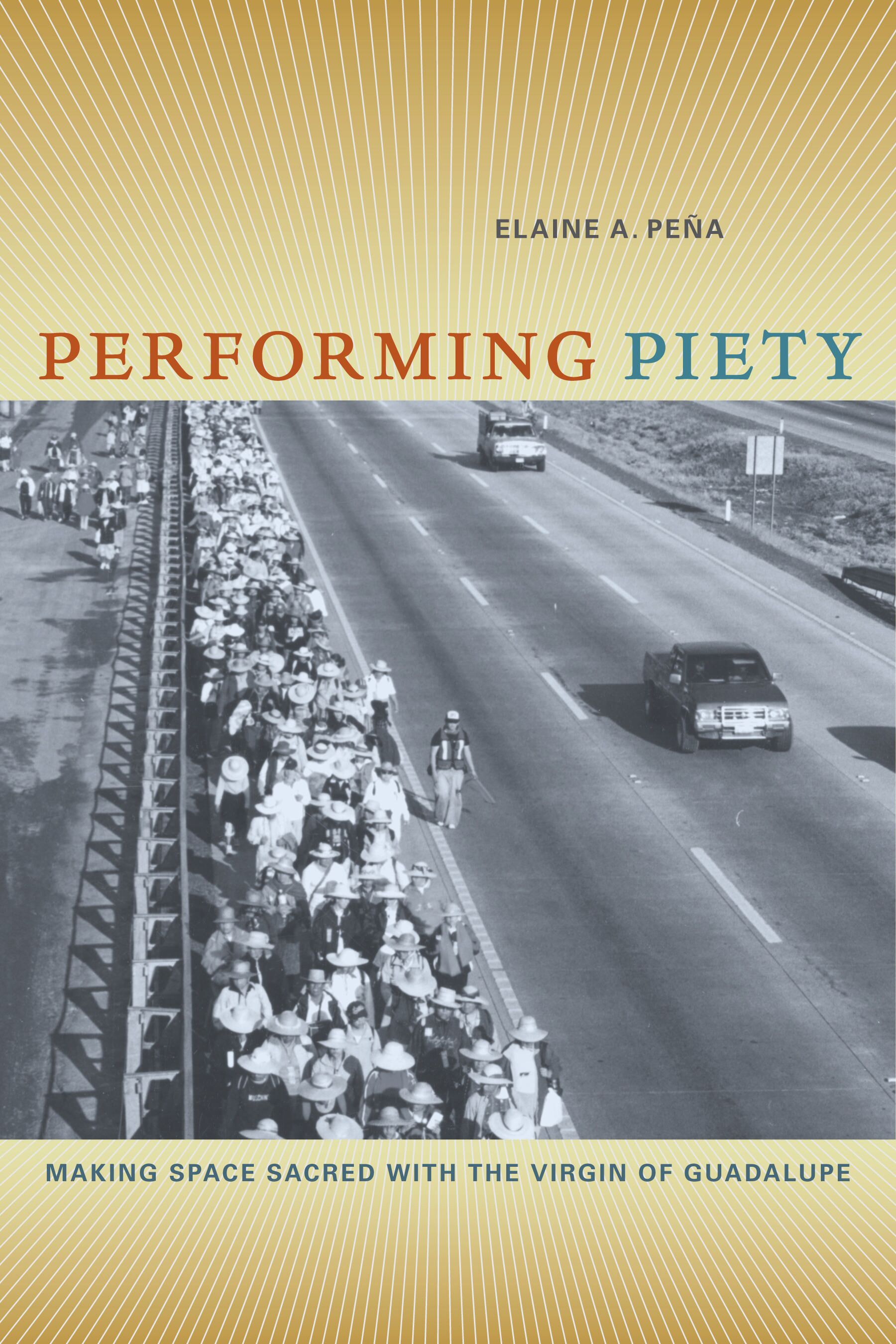
Performing piety
The Virgin of Guadalupe, though quintessentially Mexican, inspires devotion throughout the Americas and around the world. This study sheds new light on the long-standing transnational dimensions of Guadalupan worship by examining the production of sacred space in three disparate but interconnected locations--at the sacred space known as Tepeyac in Mexico City, at its replica in Des Plaines, Illinois, and at a sidewalk shrine constructed by Mexican nationals in Chicago. Weaving together rich on-the-ground observations with insights drawn from performance studies, Elaine A. Peña demonstrates how devotees' rituals--pilgrimage, prayers, and festivals--develop, sustain, and legitimize these sacred spaces. Interdisciplinary in scope, Performing Piety paints a nuanced picture of the lived experience of Guadalupan devotion in which different forms of knowing, socio-economic and political coping tactics, conceptions of history, and faith-based traditions circulate within and between sacred spaces.
eBook

Castle and Cathedral
This book takes a new approach to interwar Prague by addressing religion as an integral part of the city’s cultural history. Berglund views Prague’s cultural history in the broader context of religious change and secularization in 20th-century Europe. Based on detailed knowledge of sources, the monograph explores the interdisciplinary linkages between politics, architecture and theology in the building of symbolism and a “new mythology\" of the first Czechoslovak republic (1918-1938). Berglund´s text provides an important service for understanding both Czech history as well as current Czech political debate. The author’s method can be characterized as culture history, able to connect several disciplines, emphasizing common topic (religion, politics, symbolics). Modern Czech elites, superficially characterized as “ateistic\", appears in a new light to be deeply religious, a transition from more traditional, (mostly) Catholic religiosity, to a concept of a new, modern, ethical religion. The study incorporates biographical research, focusing on three principal characters: Tomás Garrigue Masaryk, Czechoslovakia’s first president; his daughter Alice Garrigue Masaryková, founding director of the Czechoslovak Red Cross; and Joze Plecnik, the Slovenian architect who directed the renovations of Prague Castle.
eBook

Subfloor pits and the archaeology of slavery in colonial Virginia
Enslaved Africans and their descendants comprised a significant portion of colonial Virginia populations, with most living on rural slave quarters adjacent to the agricultural fields in which they labored. Archaeological excavations into these home sites have provided unique windows into the daily lifeways and culture of these early inhabitants. A common characteristic of Virginia slave quarters is the presence of subfloor pits beneath the houses. The most common explanations of the functions of these pits are as storage places for personal belongings or root vegetables, and some contextual and ethnohistoric data suggest they may have served as West Africa-style shrines. Through excavations of 103 subfloor pits dating from the 17th through mid-19th centuries, Samford reveals a wealth of data including shape, location, surface area, and depth, as well as contents and patterns of related feature placement. Archaeology reveals the material circumstances of slaves’ lives, which in turn opens the door to illuminating other aspects of life: spirituality, symbolic meanings assigned to material goods, social life, individual and group agency, and acts of resistance and accommodation. Analysis of the artifact assemblages allows the development of hypotheses about how West African, possibly Igbo, cultural traditions were maintained and transformed in the Virginia Chesapeake.
eBook

Sacred Darkness
Caves have been used in various ways across human society, but despite the persistence within popular culture of the iconic caveman, deep caves were never used primarily as habitation sites for early humans. Rather, in both ancient and contemporary contexts, caves have served primarily as ritual spaces. In Sacred Darkness, contributors use archaeological evidence as well as ethnographic studies of modern ritual practices to envision the cave as place of spiritual and ideological power that emerges as a potent venue for ritual practice. Covering the ritual use of caves in Europe, Asia, Australia, Africa, Mesoamerica, and the US Southwest and Eastern woodlands, this book brings together case studies by prominent scholars whose research spans from the Paleolithic period to the present day. These contributions demonstrate that cave sites are as fruitful as surface contexts in promoting the understanding of both ancient and modern religious beliefs and practices. This state-of-the-art survey of ritual cave use will be one of the most valuable resources for understanding the role of caves in studies of religion, sacred landscape, or cosmology and a must-read for any archaeologist interested in caves.
eBook

Landscapes, gender, and ritual space
The division of land and consolidation of territory that created the Greek polis also divided sacred from productive space, sharpened distinctions between purity and pollution, and created a ritual system premised on gender difference. Regional sanctuaries ameliorated competition between city-states, publicized the results of competitive rituals for males, and encouraged judicial alternatives to violence. Female ritual efforts, focused on reproduction and the health of the family, are less visible, but, as this provocative study shows, no less significant. Taking a fresh look at the epigraphical evidence for Greek ritual practice in the context of recent studies of landscape and political organization, Susan Guettel Cole illuminates the profoundly gendered nature of Greek cult practice and explains the connections between female rituals and the integrity of the community. In a rich integration of ancient sources and current theory, Cole brings together the complex evidence for Greek ritual practice. She discusses relevant medical and philosophical theories about the female body; considers Greek ideas about purity, pollution, and ritual purification; and examines the cult of Artemis in detail. Her nuanced study demonstrates the social contribution of women's rituals to the sustenance of the polis and the identity of its people.
eBook
Body and Sacred Place in Medieval Europe, 1100-1389
Body and Sacred Place in Medieval Europe investigates the medieval understanding of sacred place, arguing for the centrality of bodies and bodily metaphors to the establishment, function, use, and power of medieval churches. Questioning the traditional division of sacred and profane jurisdictions, this book identifies the need to consider non-devotional uses of churches in the Middle Ages. Dawn Marie Hayes examines idealized visions of medieval sacred places in contrast with the mundane and profane uses of these buildings. She argues that by the later Middle Ages-as loyalties were torn by emerging political, economic, and social groups-the Church suffered a loss of security that was reflected in the uses of sacred spaces, which became more restricted as identities shifted and Europeans ordered the ambiguity of the medieval world.
eBook