
Catalogue Search | MBRL


Are you sure you want to remove the book from the shelf?

{{itemTitle}}
79,098
result(s) for
"SAN"
Sort by:

Fodor's 25 best. San Francisco
\"Compact and affordable, Fodor's 25 Best San Francisco is a great travel guide for those who want an easy-to-pack guidebook and map to one of the most exciting cities in Northern California,\"--Amazon.com.
Book

Cooking up a revolution
On Labor Day in 1988 two hundred hungry and homeless people went to Golden Gate Park in search of a hot meal, while fifty-four activists from Food Not Bombs, surrounded by riot police, lined up to serve them food. The riot police counted twenty-five served meals, the legal number allowed by city law before breaking permit restrictions, and then began to arrest people. The arrests proceeded like an assembly line: an activist would scoop a bowl of food and hand it to a hungry person. A police officer would then handcuff and arrest that activist. Immediately, the next activist in line would take up the ladle and be promptly arrested. By the end of the day fifty-four people had been arrested for “providing food without a permit.” These arrests were not an aberration but part of a multi-year campaign by the city of San Francisco against radical homeless activists. Why would a liberal city arrest activists helping the homeless? In exploring this question, the book uses the conflict between the city and activists as a unique opportunity to examine the contested nature of urban politics, homelessness, and public space, while developing an anarchist alternative to liberal urban politics, which is rooted in mutual aid, solidarity, and anti-capitalism.
eBook

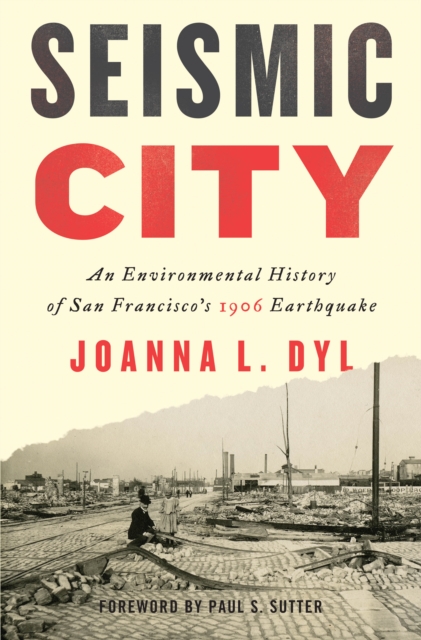
Seismic City
On April 18, 1906, a 7.8-magnitude earthquake shook the San Francisco region, igniting fires that burned half the city. The disaster in all its elements — earthquake, fires, and recovery — profoundly disrupted the urban order and challenged San Francisco’s perceived permanence.The crisis temporarily broke down spatial divisions of class and race and highlighted the contested terrain of urban nature in an era of widespread class conflict, simmering ethnic tensions, and controversial reform efforts. From a proposal to expel Chinatown from the city center to a vision of San Francisco paved with concrete in the name of sanitation, the process of reconstruction involved reenvisioning the places of both people and nature. In their zeal to restore their city, San Franciscans downplayed the role of the earthquake and persisted in choosing patterns of development that exacerbated risk.In this close study of the 1906 San Francisco earthquake, Joanna L. Dyl examines the decades leading up to the catastrophic event and the city’s recovery from it. Combining urban environmental history and disaster studies, Seismic City demonstrates how the crisis and subsequent rebuilding reflect the dynamic interplay of natural and human influences that have shaped San Francisco.
eBook


When Mexicans Could Play Ball
In 1939, a team of short, scrappy kids from a vocational school established specifically for Mexican Americans became the high school basketball champions of San Antonio, Texas. Their win, and the ensuing riot it caused, took place against a backdrop of shifting and conflicted attitudes toward Mexican Americans and American nationalism in the WWII era. \"Only when the Mexicans went from perennial runners-up to champs,\" García writes, \"did the emotions boil over.\"
The first sports book to look at Mexican American basketball specifically,When Mexicans Could Play Ballis also a revealing study of racism and cultural identity formation in Texas. Using personal interviews, newspaper articles, and game statistics to create a compelling narrative, as well as drawing on his experience as a sports writer, García takes us into the world of San Antonio's Sidney Lanier High School basketball team, the Voks, which became a two-time state championship team under head coach William Carson \"Nemo\" Herrera. An alumnus of the school himself, García investigates the school administrators' project to Americanize the students, Herrera's skillful coaching, and the team's rise to victory despite discrimination and violence from other teams and the world outside of the school. Ultimately, García argues, through their participation and success in basketball at Lanier, the Voks players not only learned how to be American but also taught their white counterparts to question long-held assumptions about Mexican Americans.
eBook

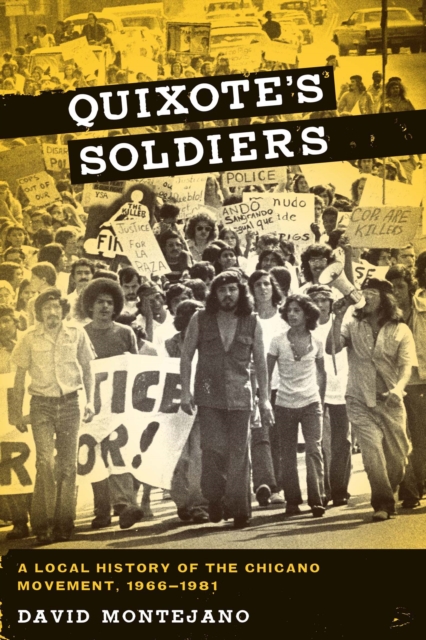
Quixote's Soldiers
In the mid-1960s, San Antonio, Texas, was a segregated city governed by an entrenched Anglo social and business elite. The Mexican American barrios of the west and south sides were characterized by substandard housing and experienced seasonal flooding. Gang warfare broke out regularly. Then the striking farmworkers of South Texas marched through the city and set off a social movement that transformed the barrios and ultimately brought down the old Anglo oligarchy. InQuixote's Soldiers, David Montejano uses a wealth of previously untapped sources, including the congressional papers of Henry B. Gonzalez, to present an intriguing and highly readable account of this turbulent period.
Montejano divides the narrative into three parts. In the first part, he recounts how college student activists and politicized social workers mobilized barrio youth and mounted an aggressive challenge to both Anglo and Mexican American political elites. In the second part, Montejano looks at the dynamic evolution of the Chicano movement and the emergence of clear gender and class distinctions as women and ex-gang youth struggled to gain recognition as serious political actors. In the final part, Montejano analyzes the failures and successes of movement politics. He describes the work of second-generation movement organizations that made possible a new and more representative political order, symbolized by the election of Mayor Henry Cisneros in 1981.
eBook


The Teotihuacan trinity : the sociopolitical structure of an ancient Mesoamerican city
Northeast of modern-day Mexico City stand the remnants of one of the world’s largest preindustrial cities, Teotihuacan. Monumental in scale, Teotihuacan is organized along a three-mile-long thoroughfare, the Avenue of the Dead, that leads up to the massive Pyramid of the Moon. Lining the avenue are numerous plazas and temples, which indicate that the city once housed a large population that engaged in complex rituals and ceremonies. Although scholars have studied Teotihuacan for over a century, the precise nature of its religious and political life has remained unclear, in part because no one has yet deciphered the glyphs that may explain much about the city’s organization and belief systems. In this groundbreaking book, Annabeth Headrick analyzes Teotihuacan’s art and architecture, in the light of archaeological data and Mesoamerican ethnography, to propose a new model for the city’s social and political organization. Challenging the view that Teotihuacan was a peaceful city in which disparate groups united in an ideology of solidarity, Headrick instead identifies three social groups that competed for political power—rulers, kin-based groups led by influential lineage heads, and military orders that each had their own animal insignia. Her findings provide the most complete evidence to date that Teotihuacan had powerful rulers who allied with the military to maintain their authority in the face of challenges by the lineage heads. Headrick’s analysis also underscores the importance of warfare in Teotihuacan society and clarifies significant aspects of its ritual life, including shamanism and an annual tree-raising ceremony that commemorated the Mesoamerican creation story.
eBook