
Catalogue Search | MBRL


Are you sure you want to remove the book from the shelf?

{{itemTitle}}
147
result(s) for
"SCIENCE / Environmental Science. bisacsh"
Sort by:


A future for Amazonia : Randy Borman and Cofán environmental politics
No detailed description available for \"A Future for Amazonia\".
eBook

The Bet
In 1980, the iconoclastic economist Julian Simon challenged celebrity biologist Paul Ehrlich to a bet. Their wager on the future prices of five metals captured the public's imagination as a test of coming prosperity or doom. Ehrlich, author of the landmark bookThe Population Bomb,predicted that rising populations would cause overconsumption, resource scarcity, and famine-with apocalyptic consequences for humanity. Simon optimistically countered that human welfare would flourish thanks to flexible markets, technological change, and our collective ingenuity.
Simon and Ehrlich's debate reflected a deepening national conflict over the future of the planet.The Betweaves the two men's lives and ideas together with the era's partisan political clashes over the environment and the role of government. In a lively narrative leading from the dawning environmentalism of the 1960s through the pivotal presidential contest between Jimmy Carter and Ronald Reagan and on into the 1990s, Paul Sabin shows how the fight between Ehrlich and Simon-between environmental fears and free-market confidence-helped create the gulf separating environmentalists and their critics today. Drawing insights from both sides, Sabin argues for using social values, rather than economic or biological absolutes, to guide society's crucial choices relating to climate change, the planet's health, and our own.
eBook

Power on the Hudson
The beauty of the Hudson River Valley was a legendary subject for artists during the nineteenth century. They portrayed its bucolic settings and humans in harmony with nature as the physical manifestation of God's work on earth. More than a hundred years later, those sentiments would be tested as never before. In the fall of 1962, Consolidated Edison of New York, the nation's largest utility company, announced plans for the construction of a pumped-storage hydroelectric power plant at Storm King Mountain on the Hudson River, forty miles north of New York City. Over the next eighteen years, their struggle against environmentalists would culminate in the abandonment of the project.Robert D. Lifset offers an original case history of this monumental event in environmental history, when a small group of concerned local residents initiated a landmark case of ecology versus energy production. He follows the progress of this struggle, as Con Ed won approvals and permits early on, but later lost ground to environmentalists who were able to raise questions about the potential damage to the habitat of Hudson River striped bass.Lifset uses the struggle over Storm King to examine how environmentalism changed during the 1960s and 1970s. He also views the financial challenges and increasingly frequent blackouts faced by Con Ed, along with the pressure to produce ever-larger quantities of energy.As Lifset demonstrates, the environmental cause was greatly empowered by the fact that through this struggle, for the first time, environmentalists were able to gain access to the federal courts. The environmental cause was also greatly advanced by adopting scientific evidence of ecological change, combined with mounting public awareness of the environmental consequences of energy production and consumption. These became major factors supporting the case against Con Ed, spawning a range of new local, regional, and national environmental organizations and bequeathing to the Hudson River Valley a vigilant and intense environmental awareness. A new balance of power emerged, and energy companies would now be held to higher standards that protected the environment.
eBook

Transport & Fate of Chemicals in Soils
During the last four decades, tremendous advances have been made towards the understanding of transport characteristics of contaminants in soils, solutes, and tracers in geological media. This book offers a comprehensive treatment of the subject complete with supporting examples of mathematical models that describe contaminants reactivity and transport in soils and aquifers. This approach makes it a practical guide for designing experiments and collecting data that focus on characterizing retention as well as release kinetic reactions in soils and contaminant transport experiments in the laboratory, greenhouse, and in the field.The book provides the basic framework of the principals governing the sorption and transport of chemicalsin soils. It focuses on physical processes such as fractured media, multiregion, multiple porosities, and heterogeneity and effect of scale as well as chemical processes such as nonlinear kinetics, release and desorption hysteresis, multisite and multireaction reactions, and competitive-type reactions.
eBook

Nanotechnology
Should you adopt nanotechnology? If you have already adopted it, what do you need to know? What are the risks? Nanomaterials and nanotechnologies are revolutionizing the ways we treat disease, produce energy, manufacture products, and attend to our daily wants and needs. To continue to capture the promise of these transformative products, however, we need to ask critical questions about the broader impacts of nanotechnology on society and the environment. Exploring these questions, the second edition of Nanotechnology: Health and Environmental Risks gives you the latest tools to understand the risks of nanotechnology and make better decisions about using it. Examining the state of the science, the book discusses what is known, and what still needs to be understood, about nanotechnology risk. It looks at the uses of nanotechnology for energy, industry, medicine, technology, and consumer applications and explains how to determine whether there is risk-even when there is little reliable evidence-and how to manage it. Contributors cover a wide range of topics, including: Current concerns, among them perceived risks and the challenges of evaluating emerging technology A historical perspective on product safety and chemicals policy The importance of being proactive about identifying and managing health and environmental risks during product development How the concepts of sustainability and life cycle assessment can guide nanotechnology product development Methods for evaluating nanotechnology risks, including screening approaches and research How to manage risk when working with nanoscale materials at the research stage and in occupational environments What international organizations are doing to address risk issues How risk assessment can inform environmental decision making Written in easy-to-understand language, without sacrificing complexity or scientific accuracy, this book offers a wide-angle view of nanotechnology and risk. Supplying cutting-edge approaches and insight, it explains what types of risks could exist and what you can do to address them. What's New in This Edition Updates throughout, reflecting advances in the field, new literature, and policy developments A new chapter on nanotechnology risk communication, including insights into risk perceptions and the mental models people use to evaluate technological risks An emphasis on developing nanotechnology products that are sustainable in the long term Advances in the understanding of nanomaterials toxicity Cutting-edge research on occupational exposure to nanoparticles Changes in the international landscape of organizations working on the environmental, health, and safety aspects of nanotechnologies
eBook

The Praeger Handbook of Environmental Health
Written by internationally acclaimed experts in the United States and abroad, this comprehensive set of environmental health articles serves to clarify our impending challenges as well as opportunities for health and wellness.
eBook
Statistical applications for environmental analysis and risk assessment
Statistical Applications for Environmental Analysis and Risk Assessment guides readers through real-world situations and the best statistical methods used to determine the nature and extent of the problem, evaluate the potential human health and ecological risks, and design and implement remedial systems as necessary.
eBook
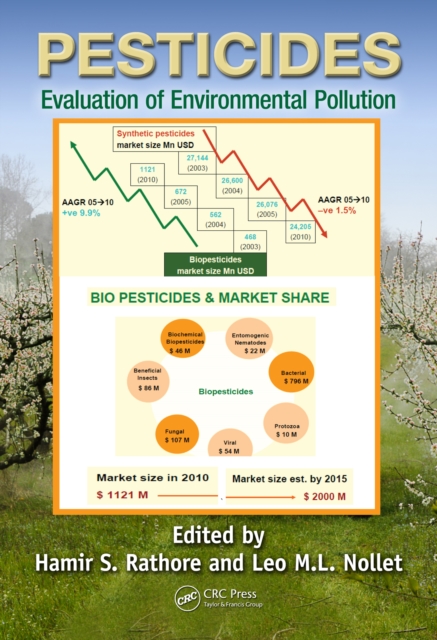
Pesticides
The extent and seriousness of the potential hazards due to pesticides still remains to be fully defined. This book compiles current knowledge on pesticide residues in a single volume. Featuring contributions by eminent scientists from around the world, it describes the fate and transport of pesticides and their degradation in the environment. The text covers the effects of pesticides on in humans, birds and mammals, fish, soil invertebrates, soil microflora, aquatic invertebrates, surface and groundwater, milk products, and more. It also addresses endocrine-disrupting pesticides and explores biopesticides as alternatives to chemical pesticides.
eBook

Arsenic
This volume represents one of the first comprehensive and interdisciplinary examinations into arsenic's behaviour in air, water, soils, sediments, plants and the human body. Based on state-of-the-art investigations into the global arsenic cycle, the related human toxicology and available remediation technologies, arsenic is assessed holistically in all the environmental compartments. Using the results of primary research, the authors offer concrete suggestions for risk reduction and management of environmental pollution that allow the reader to successfully tackle similar problems and find sustainable solutions.
eBook