
Catalogue Search | MBRL


Are you sure you want to remove the book from the shelf?

{{itemTitle}}
59,444
result(s) for
"SCIENCE / Gravity."
Sort by:

The Europa Clipper Gravity and Radio Science Investigation
The primary objective of the Europa Clipper mission is to assess the habitability of Europa, an overarching goal that rests on improving our understanding of Europa’s interior structure, composition, and geologic activity. Here we describe the Gravity and Radio Science (G/RS) investigation. The primary measurement, the gravitational tidal Love number
k
2
, will be an independent diagnostic of the presence of a global subsurface ocean, but G/RS will make a number of other key measurements related to Europa’s deep interior, silicate mantle-ocean interface, ice shell, ionosphere, and plasma environment. Although radio science is common to many missions, Europa Clipper’s orbit and spacecraft configuration during flybys present special challenges for the design of this experiment. The information obtained through G/RS will be complementary to the measurements by the other instruments onboard Europa Clipper, and their combined analysis will refine the geophysical understanding of Europa necessary to best assess its potential habitability.
Journal Article
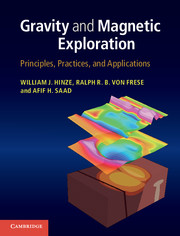
Gravity and Magnetic Exploration
This combination of textbook and reference manual provides a comprehensive account of gravity and magnetic methods for exploring the subsurface using surface, marine, airborne and satellite measurements. It describes key current topics and techniques, physical properties of rocks and other earth materials, and digital data analysis methods used to process and interpret anomalies for subsurface information. Each chapter starts with an overview and concludes by listing key concepts to consolidate new learning. An accompanying website presents problem sets and interactive computer-based exercises, providing hands-on experience of processing, modeling and interpreting data. A comprehensive online suite of full-color case histories illustrates the practical utility of modern gravity and magnetic surveys. This is an ideal text for advanced undergraduate and graduate courses and reference text for research academics and professional geophysicists. It is a valuable resource for all those interested in petroleum, engineering, mineral, environmental, geological and archeological exploration of the lithosphere.
eBook
Comparison of the Deep Atmospheric Dynamics of Jupiter and Saturn in Light of the Juno and Cassini Gravity Measurements
The nature and structure of the observed east-west flows on Jupiter and Saturn have been a long-standing mystery in planetary science. This mystery has been recently unraveled by the accurate gravity measurements provided by the Juno mission to Jupiter and the Grand Finale of the Cassini mission to Saturn. These two experiments, which coincidentally happened around the same time, allowed the determination of the overall vertical and meridional profiles of the zonal flows on both planets. This paper reviews the topic of zonal jets on the gas giants in light of the new data from these two experiments. The gravity measurements not only allow the depth of the jets to be constrained, yielding the inference that the jets extend to roughly 3000 and 9000 km below the observed clouds on Jupiter and Saturn, respectively, but also provide insights into the mechanisms controlling these zonal flows. Specifically, for both planets this depth corresponds to the depth where electrical conductivity is within an order of magnitude of 1 S m
−1
, implying that the magnetic field likely plays a key role in damping the zonal flows. An intrinsic characteristic of any gravity inversion, as discussed here, is that the solutions might not be unique. We analyze the robustness of the solutions and present several independent lines of evidence supporting the results presented here.
Journal Article

Teleparallel Gravity
This is the first book devoted to teleparallel Gravity (TG), an alternative theory for gravitation, which is equivalent to General Relativity (GR). Shows how TG attributes gravitation to torsion, which accounts for gravitation by acting as a force.
eBook

Einstein's Unfinished Symphony
An updated classic that recounts the long hunt for Einstein's predicted gravitational waves-and celebrates their recent discovery In February 2016, astronomers announced that they had verified the last remaining prediction of Einstein's general theory of relativity-vibrations in space-time, called gravitational waves. Humanity can now tune in to a cosmic orchestra. We have heard the chirp of two black holes dancing toward a violent union. We will hear the cymbal crashes from exploding stars, the periodic drumbeats from swiftly rotating pulsars, and maybe even the echoes from the Big Bang itself. Marcia Bartusiak was one of the first to report on the new generation of observatories, showing the motivations of the detectors' creators and the gamble they made to prove Einstein right when all other attempts had failed. She traces the quest of astronomers to build the Laser Interferometer Gravitational-Wave Observatory (LIGO) detectors, the most accurate measuring devices humans have created, and the discovery of gravitational waves, revealing the brilliance, personalities, and luck required to start a new age of astronomy.
eBook

Void : the strange physics of nothing
In this work, James Owen Weatherall takes on a fundamental concept of modern physics: nothing. The physics of stuff,- protons, neutrons, electrons, and even quarks and gluons, is at least somewhat familiar to most of us. But what about the physics of nothing? Isaac Newton thought of empty space as nothingness extended in all directions, a kind of theatre in which physics could unfold. But both quantum theory and relativity tell us that Newton's picture can't be right. Nothing, it turns out, is an awful lot like something, with a structure and properties every bit as complex and mysterious as matter.
eBook
The Radio Frequency Subsystem and Radio Science on the MESSENGER Mission
The MErcury Surface, Space ENvironment, GEochemistry, and Ranging (MESSENGER) Radio Frequency (RF) Telecommunications Subsystem is used to send commands to the spacecraft, transmit information on the state of the spacecraft and science-related observations, and assist in navigating the spacecraft to and in orbit about Mercury by providing precise observations of the spacecraft's Doppler velocity and range in the line of sight to Earth. The RF signal is transmitted and received at X-band frequencies (7.2 GHz uplink, 8.4 GHz downlink) by the NASA Deep Space Network. The tracking data from MESSENGER will contribute significantly to achieving the mission's geophysics objectives. The RF subsystem, as the radio science instrument, will help determine Mercury's gravitational field and, in conjunction with the Mercury Laser Altimeter instrument, help determine the topography of the planet. Further analysis of the data will improve the knowledge of the planet's orbital ephemeris and rotation state. The rotational state determination includes refined measurements of the obliquity and forced physical libration, which are necessary to characterize Mercury's core state.
Journal Article
General Relativity
Generalising Newton's law of gravitation, general relativity is one of the pillars of modern physics. While applications in the beginning were restricted to isolated effects such as a proper understanding of Mercury's orbit, the second half of the twentieth century saw a massive development of applications. These include cosmology, gravitational waves, and even very practical results for satellite based positioning systems as well as different approaches to unite general relativity with another very successful branch of physics – quantum theory. On the occassion of general relativity's centennial, leading scientists in the different branches of gravitational research review the history and recent advances in the main fields of applications of the theory, which was referred to by Lev Landau as “the most beautiful of the existing physical theories”. Contributions from: Andy C. Fabian, Anthony L. Lasenby, Astrophysical black Holes Neil Ashby, GNSS and other applications of General Relativity Gene Byrd, Arthur Chernin, Pekka Teerikorpi, Mauri Vaaltonen, Observations of general Relativity at strong and weaks limits Ignazio Ciufolini, General Relativity and dragging of inertial frames Carlo Rovelli, The strange world of quantum spacetime
eBook
Assessment of Directions in Microgravity and Physical Sciences Research at NASA
For thirty years, the NASA microgravity program has used space as a tool to study fundamental flow phenomena that are important to fields ranging from combustion science to biotechnology. This book assesses the past impact and current status of microgravity research programs in combustion, fluid dynamics, fundamental physics, and materials science and gives recommendations for promising topics of future research in each discipline. Guidance is given for setting priorities across disciplines by assessing each recommended topic in terms of the probability of its success and the magnitude of its potential impact on scientific knowledge and understanding; terrestrial applications and industry technology needs; and NASA technology needs. At NASA's request, the book also contains an examination of emerging research fields such as nanotechnology and biophysics, and makes recommendations regarding topics that might be suitable for integration into NASA's microgravity program.
eBook