
Catalogue Search | MBRL


Are you sure you want to remove the book from the shelf?

{{itemTitle}}
99,716
result(s) for
"SCIENCE - Physics - Quantum Theory."
Sort by:

Quantum physics
\"The plain-English guide to understanding quantum physics. Mastering quantum physics is no easy feat, but with the help of Quantum Physics For Dummies you can work at your own pace to unlock key concepts and fascinating facts. Packed with invaluable explanations, equations, and step-by-step instructions, this book makes a challenging subject much more accessible. Great for college students taking a quantum physics course, Quantum Physics For Dummies offers complete coverage of the subject, along with numerous examples to help you tackle the tough stuff. The Schrodinger Equation, the foundations of quantum physics, vector notation, scattering theory, angular momentum--it's all in here. This handy guide helps you prepare for exams and succeed at learning quantum physics\"--Amazon.com.
BOOK

Invariance Principles and Elementary Particles
J. J. Sakurai's treatment of various elementary particle phenomena, is written for those not completely familiar with field theory who wish to gain insight into theoretical problems. Since the manuscript for his book was completed, a very important development has taken place in particle physics-the discovery of the p, w, and n mesons: in view of this development, the author has added a new section devoted exclusively to these new mesons and resonances.Originally published in 1964.The Princeton Legacy Library uses the latest print-on-demand technology to again make available previously out-of-print books from the distinguished backlist of Princeton University Press. These editions preserve the original texts of these important books while presenting them in durable paperback and hardcover editions. The goal of the Princeton Legacy Library is to vastly increase access to the rich scholarly heritage found in the thousands of books published by Princeton University Press since its founding in 1905.
eBook

Enjoy our universe : you have no other choice
A richly illustrated book on fundamental physics, cosmology, black holes, Higgs bosons, and time travel for a wide audience. This guide for an enjoyable visit to the Universe is humorous but not a joke. It establishes clear distinctions between things we know for sure and things that we know we do not know. In this sense, it is scientifically honest.
Book

Quantum Systems, Channels, Information
The main emphasis of this work is the mathematical theory of quantum channels and their entropic and information characteristics. Quantum information theory is one of the key research areas, since it leads the way to vastly increased computing speeds by using quantum systems to store and process information. Quantum cryptography allows for secure communication of classified information. Research in the field of quantum informatics, including quantum information theory, is in progress in leading scientific centers throughout the world. The past years were marked with impressive progress made by several researchers in solution of some difficult problems, in particular, the additivity of the entropy characteristics of quantum channels. This suggests a need for a book that not only introduces the basic concepts of quantum information theory, but also presents in detail some of the latest achievements.
eBook

Einstein and the quantum : the quest of the valiant Swabian
\"Einstein and the Quantum reveals for the first time the full significance of Albert Einstein's contributions to quantum theory. Einstein famously rejected quantum mechanics, observing that God does not play dice. But, in fact, he thought more about the nature of atoms, molecules, and the emission and absorption of light--the core of what we now know as quantum theory--than he did about relativity. A compelling blend of physics, biography, and the history of science, Einstein and the Quantum shares the untold story of how Einstein--not Max Planck or Niels Bohr--was the driving force behind early quantum theory. It paints a vivid portrait of the iconic physicist as he grappled with the apparently contradictory nature of the atomic world, in which its invisible constituents defy the categories of classical physics, behaving simultaneously as both particle and wave. And it demonstrates how Einstein's later work on the emission and absorption of light, and on atomic gases, led directly to Erwin Schrèodinger's breakthrough to the modern form of quantum mechanics. The book sheds light on why Einstein ultimately renounced his own brilliant work on quantum theory, due to his deep belief in science as something objective and eternal.A book unlike any other, Einstein and the Quantum offers a completely new perspective on the scientific achievements of the greatest intellect of the twentieth century, showing how Einstein's contributions to the development of quantum theory are more significant, perhaps, than even his legendary work on relativity\"-- Provided by publisher.
Book
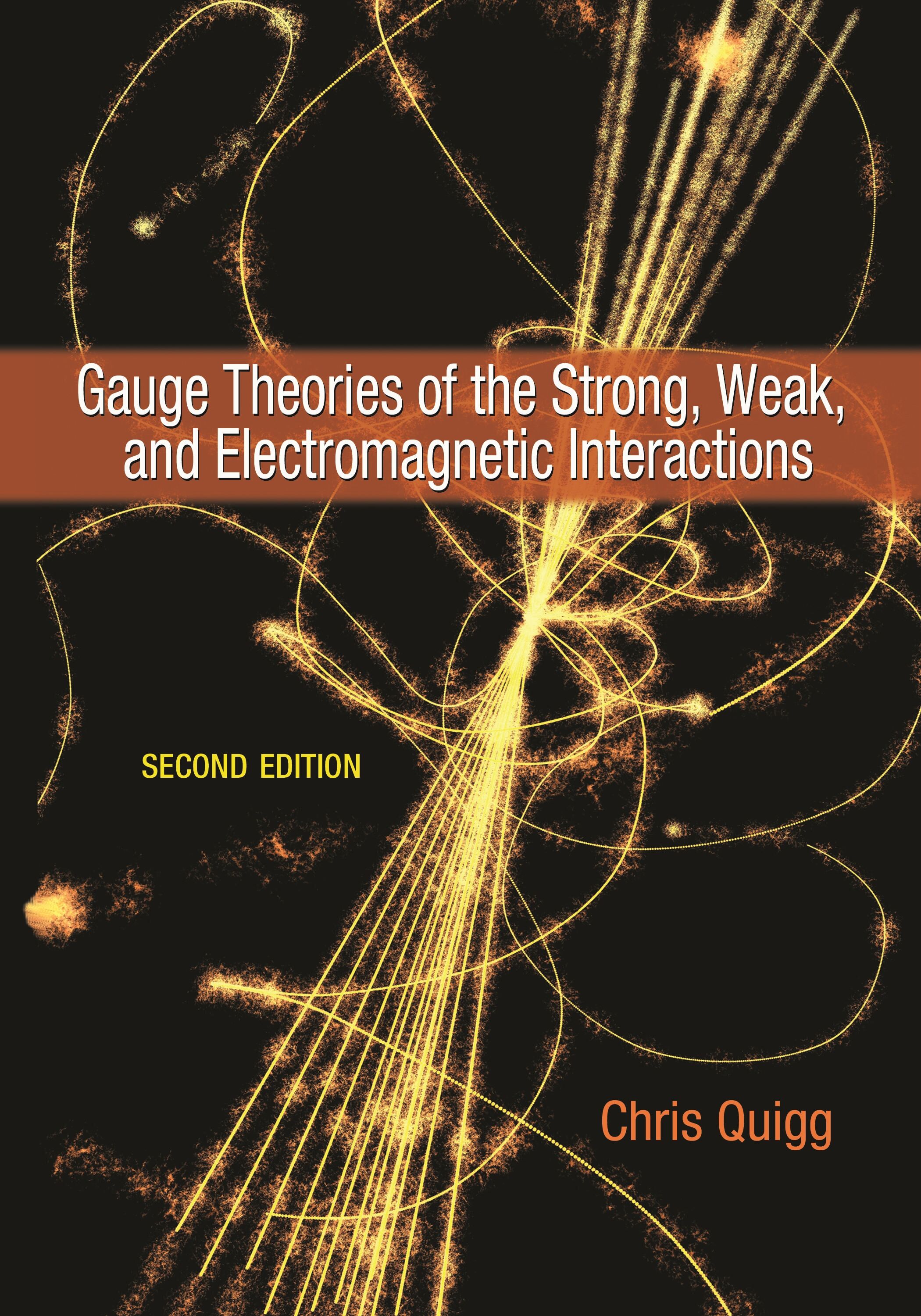
Gauge Theories of the Strong, Weak, and Electromagnetic Interactions
A thoroughly revised edition of a landmark textbook on gauge theories and their applications to particle physicsThis completely revised and updated graduate-level textbook is an ideal introduction to gauge theories and their applications to high-energy particle physics, and takes an in-depth look at two new laws of nature—quantum chromodynamics and the electroweak theory. From quantum electrodynamics through unified theories of the interactions among leptons and quarks, Chris Quigg examines the logic and structure behind gauge theories and the experimental underpinnings of today's theories. Quigg emphasizes how we know what we know, and in the era of the Large Hadron Collider, his insightful survey of the standard model and the next great questions for particle physics makes for compelling reading.The brand-new edition shows how the electroweak theory developed in conversation with experiment. Featuring a wide-ranging treatment of electroweak symmetry breaking, the physics of the Higgs boson, and the importance of the 1-TeV scale, the book moves beyond established knowledge and investigates the path toward unified theories of strong, weak, and electromagnetic interactions. Explicit calculations and diverse exercises allow readers to derive the consequences of these theories. Extensive annotated bibliographies accompany each chapter, amplify points of conceptual or technical interest, introduce further applications, and lead readers to the research literature. Students and seasoned practitioners will profit from the text's current insights, and specialists wishing to understand gauge theories will find the book an ideal reference for self-study.Brand-new edition of a landmark text introducing gauge theoriesConsistent attention to how we know what we knowExplicit calculations develop concepts and engage with experimentInteresting and diverse problems sharpen skills and ideasExtensive annotated bibliographies
eBook

Quanta and fields : the biggest ideas in the universe
\"In the second book of this already internationally acclaimed series, Sean Carroll, the most trusted explainer of the most mind-boggling concepts, digs deep into matter itself. What is the universe made of? In his quest to redefine the \"popular\" treatment of the biggest ideas in the universe, Sean Carroll is creating a profoundly new approach to physics and math as reviewer after reviewer has attested. Adventuring in the math of fields, he now intrepidly guides readers into the fantastic depths of The Standard Model of particle physics illuminating the mysteries of quantum reality. The universe is made of atoms and Sean Carroll explains exactly what that means and how we know it\"-- Provided by publisher.
Book
The nature of space and time
Who doesn’t love a good argument? When physics heavyweights Stephen W. Hawking and Roger Penrose delivered three sets of back-and-forth lectures capped by a final debate at Cambridge’s Isaac Newton Institute, the course of modern cosmological thinking was at stake. As it happens, The Nature of Space and Time, which collects these remarks, suggests that little has changed from the days when Einstein challenged Bohr by refusing to believe that God plays dice. The math is more abstruse, the arguments more refined, but the argument still hinges on whether our physical theories should be expected to model reality or merely predict measurements.
eBook

Quantum physics, mini black holes, and the multiverse : debunking common misconceptions in theoretical physics
\"This book explores, explains and debunks some common misconceptions about quantum physics, particle physics, space-time, and Multiverse cosmology. It seeks to separate science from pseudoscience. The material is presented in layperson-friendly language, followed by additional technical sections which explain basic equations and principles.\"--Back cover.
Book

The Everett Interpretation of Quantum Mechanics
Hugh Everett III was an American physicist best known for his many-worlds interpretation of quantum mechanics, which formed the basis of his PhD thesis at Princeton University in 1957. Although counterintuitive, Everett's revolutionary formulation of quantum mechanics offers the most direct solution to the infamous quantum measurement problem--that is, how and why the singular world of our experience emerges from the multiplicities of alternatives available in the quantum world. The many-worlds interpretation postulates the existence of multiple universes. Whenever a measurement-like interaction occurs, the universe branches into relative states, one for each possible outcome of the measurement, and the world in which we find ourselves is but one of these many, but equally real, possibilities. Everett's challenge to the orthodox interpretation of quantum mechanics was met with scorn from Niels Bohr and other leading physicists, and Everett subsequently abandoned academia to conduct military operations research. Today, however, Everett's formulation of quantum mechanics is widely recognized as one of the most controversial but promising physical theories of the last century.
In this book, Jeffrey Barrett and Peter Byrne present the long and short versions of Everett's thesis along with a collection of his explanatory writings and correspondence. These primary source documents, many of them newly discovered and most unpublished until now, reveal how Everett's thinking evolved from his days as a graduate student to his untimely death in 1982. This definitive volume also features Barrett and Byrne's introductory essays, notes, and commentary that put Everett's extraordinary theory into historical and scientific perspective and discuss the puzzles that still remain.
eBook