
Catalogue Search | MBRL


Are you sure you want to remove the book from the shelf?

{{itemTitle}}
7,806
result(s) for
"SEA POWER"
Sort by:

Europe, small navies and maritime security : balancing traditional roles and emergent threats in the 21st century
This book seeks to identify and address gaps in our understanding of maritime security and the role of small navies in Europe. The majority of Europe's navies are small, yet they are often called upon to address a complex array of traditional and non-traditional threats. This volume examines the role of small navies within the European security architecture, by discussing areas of commonality and difference between navies, and arguing that it is not possible to fully understand either maritime strategy or European security without taking into account the actions of small navies. It contains a number of case studies that provide an opportunity to explore how different European states view the current security environment and how naval policy has undergone significant changes within the lifetime of the existing naval assets. In addition, the book examines how maritime security and naval development in Europe might evolve, given that economic forecasts will likely limit the potential procurement of larger' naval assets in the future, which means that European states will increasingly have to do more with less in the maritime domain. This book will be of much interest to students of maritime strategy, naval power, strategic studies, European politics andinternational relationsin general.
Book

Militarism in a global age : naval ambitions in Germany and the United States before World War I
At the turn of the twentieth century, the United States and Germany emerged as the two most rapidly developing industrial nation-states of the Atlantic world. The elites and intelligentsias of both countries staked out claims to dominance in the twentieth century. In Militarism in a Global Age, Dirk Bönker explores the far-reaching ambitions of naval officers before World War I as they advanced navalism, a particular brand of modern militarism that stressed the paramount importance of sea power as a historical determinant. Aspiring to make their own countries into self-reliant world powers in an age of global empire and commerce, officers viewed the causes of the industrial nation, global influence, elite rule, and naval power as inseparable. Characterized by both transnational exchanges and national competition, the new maritime militarism was technocratic in its impulses; its makers cast themselves as members of a professional elite that served the nation with its expert knowledge of maritime and global affairs.
American and German navalist projects differed less in their principal features than in their eventual trajectories. Over time, the pursuits of these projects channeled the two naval elites in different directions as they developed contrasting outlooks on their bids for world power and maritime force. Combining comparative history with transnational and global history, Militarism in a Global Age challenges traditional, exceptionalist assumptions about militarism and national identity in Germany and the United States in its exploration of empire and geopolitics, warfare and military-operational imaginations, state formation and national governance, and expertise and professionalism.
eBook


Maritime Strategy and National Security in Japan and Britain
This thought-provoking volume explores how, across more than a century, sea power empowered both the UK and Japan with a defensive shield, an instrument of deterrence, and an enabling tool in expeditionary missions to implement courses of actions to preserve national economic and security interests worldwide.
eBook

The Ptolemies, the Sea and the Nile
With its emphasis on the dynasty's concern for control of the sea – both the Mediterranean and the Red Sea – and the Nile, this book offers a new and original perspective on Ptolemaic power in a key period of Hellenistic history. Within the developing Aegean empire of the Ptolemies, the role of the navy is examined together with that of its admirals. Egypt's close relationship to Rhodes is subjected to scrutiny, as is the constant threat of piracy to the transport of goods on the Nile and by sea. Along with the trade in grain came the exchange of other products. Ptolemaic kings used their wealth for luxury ships and the dissemination of royal portraiture was accompanied by royal cult. Alexandria, the new capital of Egypt, attracted poets, scholars and even philosophers; geographical exploration by sea was a feature of the period and observations of the time enjoyed a long afterlife.
eBook
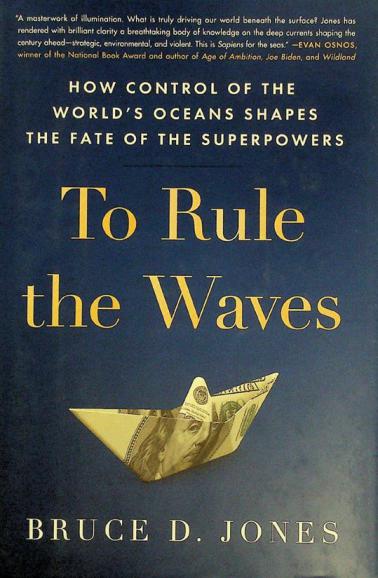
To rule the waves : how control of the world's oceans shapes the fate of the superpowers
\"For centuries, oceans were the chessboard on which empires battled for dominance. But in the nuclear age, air power and missile systems dominated our worries about security, and for the United States, the economy was largely driven by domestic production, with trucking and railways that crisscrossed the continent the primary modes of commercial transit. All that has changed, as nine-tenths of global commerce and the bulk of energy trade is today linked to sea-based flows. A brightly-painted 40-foot steel shipping container loaded in Asia with twenty tons of goods may arrive literally anywhere else in the world; how that really happens and who actually profits by it show that the struggle for power on the seas is a critical issue today. Now, in bright, closely observed prose, To Rule the Waves author Bruce Jones conducts us on a fascinating voyage through the great modern ports and naval bases of this era-from the vast container ports of Shanghai and Hong Kong to the vital naval base of the American 7th fleet in Hawaii to the sophisticated security arrangements in the port of New York. Along the way, the book illustrates how global commerce works, that we are amidst a global naval arms race, and why the oceans are so crucial to America's standing going forward. As Jones reveals, the three great geopolitical struggles of our time-for military power, for economic dominance, and over our changing climate-are playing out atop, within, and below the world's oceans. The essential question, he shows, is this: who will rule the waves and set the terms of the world to come?\"-- Provided by publisher.
Book

With Sails Whitening Every Sea
Many Americans in the Early Republic era saw the seas as another
field for national aggrandizement. With a merchant marine that
competed against Britain for commercial supremacy and a whaling
fleet that circled the globe, the United States sought a maritime
empire to complement its territorial ambitions in North America. In
With Sails Whitening Every Sea , Brian Rouleau argues that
because of their ubiquity in foreign ports, American sailors were
the principal agents of overseas foreign relations in the early
republic. Their everyday encounters and more problematic
interactions-barroom brawling, sexual escapades in port-city
bordellos, and the performance of blackface minstrel shows-shaped
how the United States was perceived overseas.
Rouleau details both the mariners' \"working-class diplomacy\" and
the anxieties such interactions inspired among federal authorities
and missionary communities, who saw the behavior of American
sailors as mere debauchery. Indiscriminate violence and licentious
conduct, they feared, threatened both mercantile profit margins and
the nation's reputation overseas. As Rouleau chronicles, the
world's oceans and seaport spaces soon became a battleground over
the terms by which American citizens would introduce themselves to
the world. But by the end of the Civil War, seamen were no longer
the nation's principal ambassadors. Hordes of wealthy tourists had
replaced seafarers, and those privileged travelers moved through a
world characterized by consolidated state and corporate authority.
Expanding nineteenth-century America's master narrative beyond the
water's edge, With Sails Whitening Every Sea reveals the
maritime networks that bound the Early Republic to the wider
world.
Many Americans in the Early Republic era saw the seas as another
field for national aggrandizement. With a merchant marine that
competed against Britain for commercial supremacy and a whaling
fleet that circled the globe, the United States sought a maritime
empire to complement its territorial ambitions in North America. In
With Sails Whitening Every Sea , Brian Rouleau argues that
because of their ubiquity in foreign ports, American sailors were
the principal agents of overseas foreign relations in the early
republic. Their everyday encounters and more problematic
interactions-barroom brawling, sexual escapades in port-city
bordellos, and the performance of blackface minstrel shows-shaped
how the United States was perceived overseas.Rouleau details both
the mariners' \"working-class diplomacy\" and the anxieties such
interactions inspired among federal authorities and missionary
communities, who saw the behavior of American sailors as mere
debauchery. Indiscriminate violence and licentious conduct, they
feared, threatened both mercantile profit margins and the nation's
reputation overseas. As Rouleau chronicles, the world's oceans and
seaport spaces soon became a battleground over the terms by which
American citizens would introduce themselves to the world. But by
the end of the Civil War, seamen were no longer the nation's
principal ambassadors. Hordes of wealthy tourists had replaced
seafarers, and those privileged travelers moved through a world
characterized by consolidated state and corporate authority.
Expanding nineteenth-century America's master narrative beyond the
water's edge, With Sails Whitening Every Sea reveals the
maritime networks that bound the Early Republic to the wider
world.
eBook


A Service Ready for Total War? The State of the Royal Navy in July 1914
In early 1914 Britain’s naval leadership decided to call a conference of flag officers at which the most pressing issues then facing the Royal Navy could be aired and discussed. The conference was scheduled for the end of July 1914. Owing to the European crisis that erupted at just the very moment when it was supposed to take place, the conference was never held. However, the bulk of the paperwork still exists. This documentation provides a unique snapshot of the thinking of Britain’s key naval commanders on strategic, tactical and materiel considerations at the very moment when they were about to embark upon the most serious of examinations, the test of a major war. This article uses these files to evaluate the extent to which the Royal Navy was aware of the challenges that were about to confront it and the strengths and weaknesses that would aid or hinder them in this task. It thereby assesses the service’s readiness for total war, concluding that it was far from the conservative body of popular caricature.
Journal Article